Mental Health and Economic Mobility: The Missing Link In Global Development
A staggering 1 billion people globally live with a mental health condition, making it one of the most widespread and most ignored drivers of economic stagnation. Depression and anxiety alone cost the global economy US$1 trillion every year in lost productivity, with an estimated 12 billion working days lost annually. This article examines how mental health shapes a person’s ability to rise out of poverty, access opportunity, and participate fully in the economy. It argues that mental health is not a side issue but a core driver of economic mobility, a missing link in global development strategies that can no longer be ignored.
INSIGHTS
enoma ojo (2026)
2/14/202610 min read


More than 1 billion people globally live with a mental health condition, making it one of the most widespread and most ignored drivers of economic stagnation. Depression and anxiety alone cost the global economy US$1 trillion every year in lost productivity, with an estimated 12 billion working days lost annually. By 2030, the cumulative economic cost of mental illness is projected to reach US$16 trillion, a figure that rivals the GDP of the world’s largest economies. Yet governments allocate a median of just 2% of health budgets to mental health, leaving entire nations structurally underprepared for the human-capital crisis unfolding within their borders.
These numbers reveal a truth the development community has long overlooked: mental health is not a social side issue; it is an economic engine. A workforce burdened by untreated psychological distress cannot innovate, cannot adapt, and cannot sustain long-term growth. Conversely, every US$1 invested in mental health interventions yields a return of US$5–6, making it one of the highest-impact investments available to policymakers today. This is the missing link in global development. Economic mobility, productivity, and national competitiveness all begin in the mind. Until nations treat mental well-being as core economic infrastructure, development strategies will continue to rise on paper and collapse in practice. The world can no longer afford to build economies on unstable psychological foundations.
Mental health has long been treated as a private struggle or a narrow medical issue, but the world can no longer afford to see it that way. Emerging global evidence reveals a far more consequential truth: the psychological well-being of a population is one of the strongest forces shaping a nation’s development trajectory. It influences how children learn, how adults work, how communities function, and how societies grow. When mental health deteriorates at scale, the consequences do not remain confined to clinics or households; they spill into classrooms, workplaces, institutions, and economies.
Across continents, countries are discovering that chronic stress, trauma, and untreated mental illness quietly erode the foundations of progress. They weaken cognitive capacity, reduce productivity, undermine trust, and limit the very behaviors that drive mobility upward. A society burdened by psychological distress cannot fully harness its human capital, no matter how ambitious its policies or how abundant its resources. The mind becomes the bottleneck through which all development efforts must pass.
This is why mental health must be understood not as a peripheral concern, but as a central pillar of global development. It is the hidden variable that explains why some nations stagnate despite economic reforms, why some communities remain trapped in cycles of poverty, and why individuals with talent and opportunity still struggle to rise. The evidence is unmistakable: when mental well-being collapses, development slows; when it strengthens, societies unlock new levels of resilience, creativity, and economic mobility.
Mental development is the foundation of sustainable economic development. The United Nations (2024) reports that over 1 billion people worldwide live with a mental health condition. Mental health disorders are the second leading cause of long-term disability globally. McKinsey & Company (2025) reports that mental health conditions is attributed to 290 million disability-adjusted life years, in relation to the global disease burden. WHO (2024) in its report, reports that depression and anxiety cost the global economy over US$1 trillion every year in lost productivity. Untreated mental illness also costs the global economy US$1 trillion annually, according to OECD‑referenced data. Mental illness will cost the world US$16 trillion by 2030, driven largely by lost productivity and early onset of illness, and an estimated 12 billion working days are lost each year due to mental illness. In a world racing to build infrastructure, expand education, and stimulate growth, we have overlooked the most essential infrastructure of all, the psychological stability of the people expected to carry these ambitions forward. Development begins in the mind. And until mental health is treated as a development priority, the global promise of mobility and progress will remain out of reach for millions.
Mental health has long been treated as a private struggle or a narrow medical issue, but the world can no longer afford to see it that way. Today, more than one billion people are living with a mental health condition, according to the World Health Organization. This makes mental disorders one of the largest and fastest‑growing global health burdens, cutting across every age group, region, and socioeconomic class. Yet despite the scale of the crisis, most countries still fail to provide adequate support, leaving millions untreated and economies weakened. The consequences extend far beyond hospitals and clinics. Mental health conditions are now the second leading cause of long‑term disability worldwide. Their economic impact is staggering: anxiety, depression, and related disorders cost the global economy an estimated $1 trillion every year in lost productivity. Additional analyses show that untreated mental illness, including depression, anxiety, and schizophrenia, contributes another $1 trillion in annual losses, driven by absenteeism, presenteeism, and reduced workforce participation.
These numbers reveal a deeper truth: when populations struggle with chronic stress, trauma, or untreated mental illness, the effects ripple across every dimension of development. Education systems suffer as students with untreated mental health challenges fall behind. Workplaces lose billions as employees miss work or show up unable to perform at full capacity, with data showing that 60% of employees with mental health issues miss 10 or more workdays annually, and depression alone reduces productivity by 35%. Governance and social cohesion weaken as communities under psychological strain become more vulnerable to instability, mistrust, and disengagement. In the workplace, workforce productivity losses are the hidden drains to national economies. Mental health issues drive massive absenteeism and presenteeism. Patel (2026) reports that global presenteeism from mental health issues accounts for 70% of total productivity loss. Worldmetrix (2026) in its study observed that workers with untreated mental illness have three times more absences than those receiving treatment, and for country-specific losses, the U.S. loses over $47.8 billion in absenteeism costs annually. The EU, with over €240 billion lost annually to depression‑related absenteeism, and Canada has over CAD $50 billion annual economic burden. India has a US$60 billion annual cost, and this represents about 0.7% of its annual GDP.
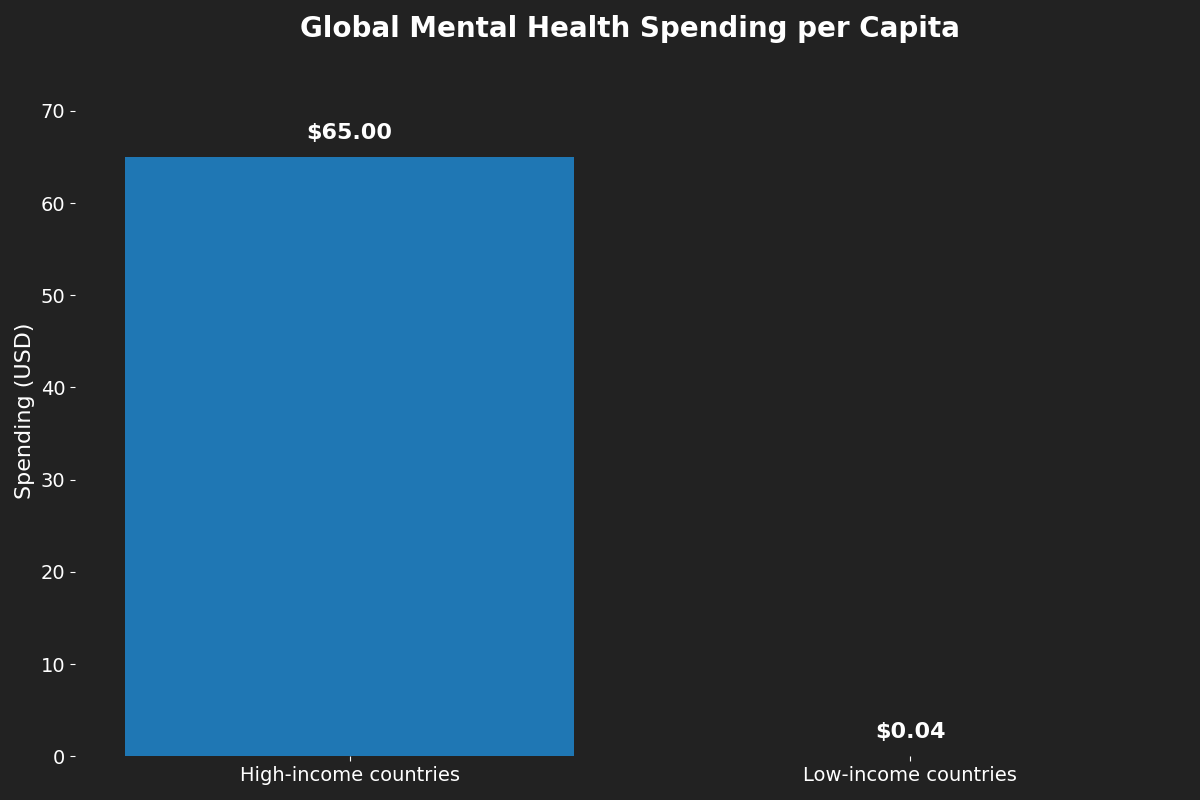
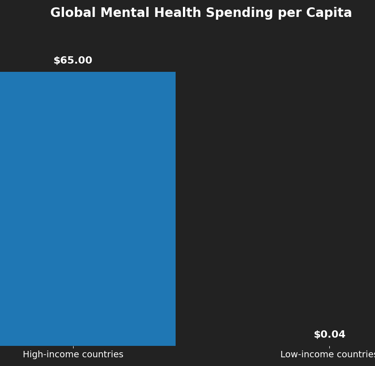
The chart below shows that high‑income countries invest over 1,600 times more per person than low‑income countries. Despite the scale of the crisis, global mental‑health spending has not improved since 2017. Low‑income countries remain trapped in a cycle of underfunding, which results in untreated conditions, reduced productivity, and deeper poverty. Global mental‑health spending is marked by an extreme and persistent imbalance. High‑income countries invest about $65 per person, while low‑income countries spend only $0.04 per person—a gap of more than 1,600‑to‑1. This disparity reflects deeper structural inequalities in health budgets, workforce capacity, and national development priorities. Despite rising awareness of mental‑health needs, global spending has remained largely stagnant, leaving low‑income countries without the resources to provide even basic care. The result is a cycle where untreated mental‑health conditions limit productivity, weaken human capital, and restrict economic mobility, especially in the world’s poorest regions.
Mental health is not a peripheral concern. It is a central determinant of national progress, shaping human capital, economic mobility, and long‑term development outcomes. The evidence is clear: no country can achieve sustainable growth while ignoring its people's psychological well-being. At the individual level, mental well-being shapes the cognitive abilities that drive mobility upward. Skills such as planning, emotional regulation, problem‑solving, and resilience are not merely personality traits; they are psychological capacities that depend heavily on mental health. When these capacities weaken, economic mobility becomes harder to achieve. Poverty and poor mental health reinforce each other in a self‑perpetuating cycle. Living in scarcity creates chronic stress, which reduces cognitive bandwidth and narrows attention to short‑term survival. This makes it harder to pursue education, manage finances, or take the risks required for upward mobility. Research shows that chronic stress impairs executive function, the mental processes responsible for focus, memory, and decision‑making. These are the exact abilities needed to climb the economic ladder. When stress becomes a daily reality, mobility becomes a distant possibility. Mental health challenges also influence behavior in ways that directly affect economic outcomes. Anxiety increases risk aversion, depression reduces motivation, and trauma disrupts trust and social engagement. These behavioral shifts limit a person’s ability to seize opportunities or adapt to changing economic conditions.
The intergenerational impact is equally profound. Children raised in environments marked by instability, violence, or parental mental illness often show reduced cognitive development, lower academic performance, and diminished future earnings. Mental health becomes an inherited economic disadvantage. At the community level, widespread mental distress weakens social cohesion. Trust declines, conflict increases, and collective action becomes harder. These social dynamics undermine the very institutions that support mobility, schools, workplaces, and local governance structures. Nationally, untreated mental health conditions reduce productivity and economic output. Depression and anxiety alone account for billions in lost productivity each year. Countries with weak mental health systems face slower growth, lower labor force participation, and higher healthcare costs.
The global treatment gap remains staggering. In many developing and low‑income countries, mental health receives less than 2% of health budgets, and there may be only one psychiatrist for hundreds of thousands of people. This gap is not just a health failure; it is a development failure. Mental health also shapes entrepreneurship, a key driver of economic mobility. Starting a business requires risk‑taking, creativity, and resilience. Chronic stress and anxiety suppress these qualities, reducing the likelihood that individuals will pursue entrepreneurial paths. Migration, another major mobility pathway, is similarly affected. The emotional strain of instability can make people less willing to relocate for opportunity, even when such moves could dramatically improve their economic prospects.
Education systems are deeply affected by mental health conditions. Students dealing with stress, trauma, or emotional instability struggle to learn, concentrate, and perform academically. This weakens the pipeline of skilled workers and reduces national competitiveness. Teachers and school environments are also impacted. Burnout among educators reduces instructional quality, while schools in high‑stress communities face higher rates of absenteeism and behavioral challenges. Mental health becomes a structural barrier to educational mobility. In the workplace, mental health determines productivity, collaboration, and innovation. Burnout and stress reduce output, increase turnover, and weaken organizational performance. Companies lose billions annually to mental‑health‑related absenteeism, and nations lose GDP.
The link between mental health and governance is often overlooked. Populations experiencing widespread stress or trauma are more susceptible to misinformation, less trusting of institutions, and more likely to disengage from civic life. This weakens democratic processes and long‑term development planning. Countries with strong mental health systems tend to have higher social mobility. They invest in early childhood development, provide stable environments, and ensure access to mental health services. These investments create populations that are more resilient, innovative, and economically dynamic. Conversely, nations with high levels of violence, instability, or untreated trauma often experience stagnation. Their populations struggle to accumulate human capital, and their institutions remain fragile. Mental health becomes a hidden barrier to national progress. The economic returns on mental health investment are remarkably high. Studies show that every dollar spent on mental health treatment yields four to five dollars in improved productivity and health outcomes. This makes mental health one of the most cost‑effective development interventions available.
Recognizing mental health as a development issue reframes global priorities. It shifts the conversation from treating illness to building psychological infrastructure, resilience, stability, and cognitive capacity. These are the foundations upon which economic mobility is built. Mental well-being is not a luxury; it is the psychological infrastructure upon which every other form of progress depends. Nations often invest heavily in roads, schools, and technology, yet overlook the most fundamental infrastructure of all, the human mind. Without mental stability, even the best-designed development programs struggle to take root. People cannot plan for the future when their present is consumed by stress. They cannot innovate when their cognitive bandwidth is depleted. They cannot climb the economic ladder when trauma keeps them anchored to survival mode. A society cannot expect its people to rise when their emotional foundations are crumbling. Stress, trauma, and hopelessness are not invisible inconveniences; they are structural barriers that shape behavior, decision‑making, and opportunity. They influence whether a child can learn, whether a worker can perform, whether a parent can nurture, and whether a community can trust. When mental health collapses, the entire architecture of mobility collapses with it.
This is why mental health must be recognized as a core pillar of global development. It is not an add‑on, not a secondary concern, not a soft issue to be addressed after “real” development work is done. It is the missing pillar, the one that explains why some nations stagnate despite economic reforms, why some communities remain trapped in cycles of poverty, and why individuals with potential struggle to convert opportunity into progress. Economic mobility is not only about access to resources; it is about the capacity to use them. That capacity is psychological. It depends on clarity of thought, emotional resilience, and the ability to imagine a future worth striving for. When mental well-being is strong, people can plan, adapt, take risks, and persist. When it is weak, even the simplest upward steps feel insurmountable.
Studies have shown that development is about expanding human freedom; if it is, then mental health is the foundation of that freedom. It frees the mind from the tyranny of stress. It frees individuals from the weight of trauma. It frees communities from cycles of fear and instability. And it frees nations to harness the full potential of their people. The path to true economic mobility, for individuals, communities, and countries, begins with acknowledging that the mind is a developmental asset. Investing in mental health is not charity; it is a strategy. It is one of the highest‑return investments a society can make, unlocking productivity, strengthening institutions, and enabling generations to rise beyond the limits of their circumstances.
In the end, the world must confront a simple truth: there is no sustainable development without mental development. A society that nurtures the mental well-being of its people is a society that equips them to climb, to build, to innovate, and to lead. Mental health is the quiet force behind every great transformation, and the key to unlocking genuine, lasting economic mobility. A society cannot rise higher than the psychological foundation of its people. If nations truly want prosperity that endures, they must treat mental health not as a social accessory but as economic infrastructure. Because when minds are stable, possibilities expand; when minds are supported, innovation accelerates; and when minds are free, development finally becomes sustainable. Mental health is not the soft side of development; it is the source code of progress. No nation can rise beyond the strength of its mind, and mental health remains the missing engine of every development agenda that hopes to last.
Let's continue this conversation on Sustack: https://enomaojo.substack.com
References:
World Health Organization. (2022) World Mental Health Report: Transforming Mental Health For All
World Bank (2021) Mental Health and Economic Development: Global Insights
McKinsey & Company (2025). Investing in The Future: How Better Mental Health Benefits Everyone
Worldmetrix,org Report (2026). Untreated Mental Illness Statistics
Psychaitric Times (2018). Mental Illness Will Cost the World $16 USD Trillion by 2030
Rajesh Patel (2026). Mental Health in The Workplace Statistics. Gitnux Report
© 2026 Enoma Ojo. All rights reserved. No part of this publication may be reproduced without permission.