Why Some Nations Wake Up, and Others Stay Asleep: The Psychology of National Transformation
This article identified national identity as the main driver of national cohesion and momentum for socio-political and economic transformation. The psychology of identity is the most overlooked force in national development, yet it is the one factor that determines whether a country can generate sustained momentum for change. Nations do not rise because of resources, geography, or population size; they rise because their people share a common story about who they are and where they are going. Without this shared identity, every reform becomes contested, every institution becomes fragile, and every crisis becomes a national fracture instead of a national rallying point. Identity is the emotional infrastructure that makes progress possible. Ultimately, the psychology of identity is the difference between nations that rise and those that remain stuck. Identity creates trust, trust strengthens institutions, and strong institutions create momentum. This is why Rwanda and Vietnam moved upward while Nigeria, Chad, Haiti, and Burundi remain trapped in cycles of stagnation. When a nation knows who it is, it can decide where it is going. When it does not, it drifts. This article reveals this hidden truth: national identity is not symbolic; it is the engine of national transformation.
ARTICLES & ESSAYS
enoma ojo (2025)
3/8/202636 min read
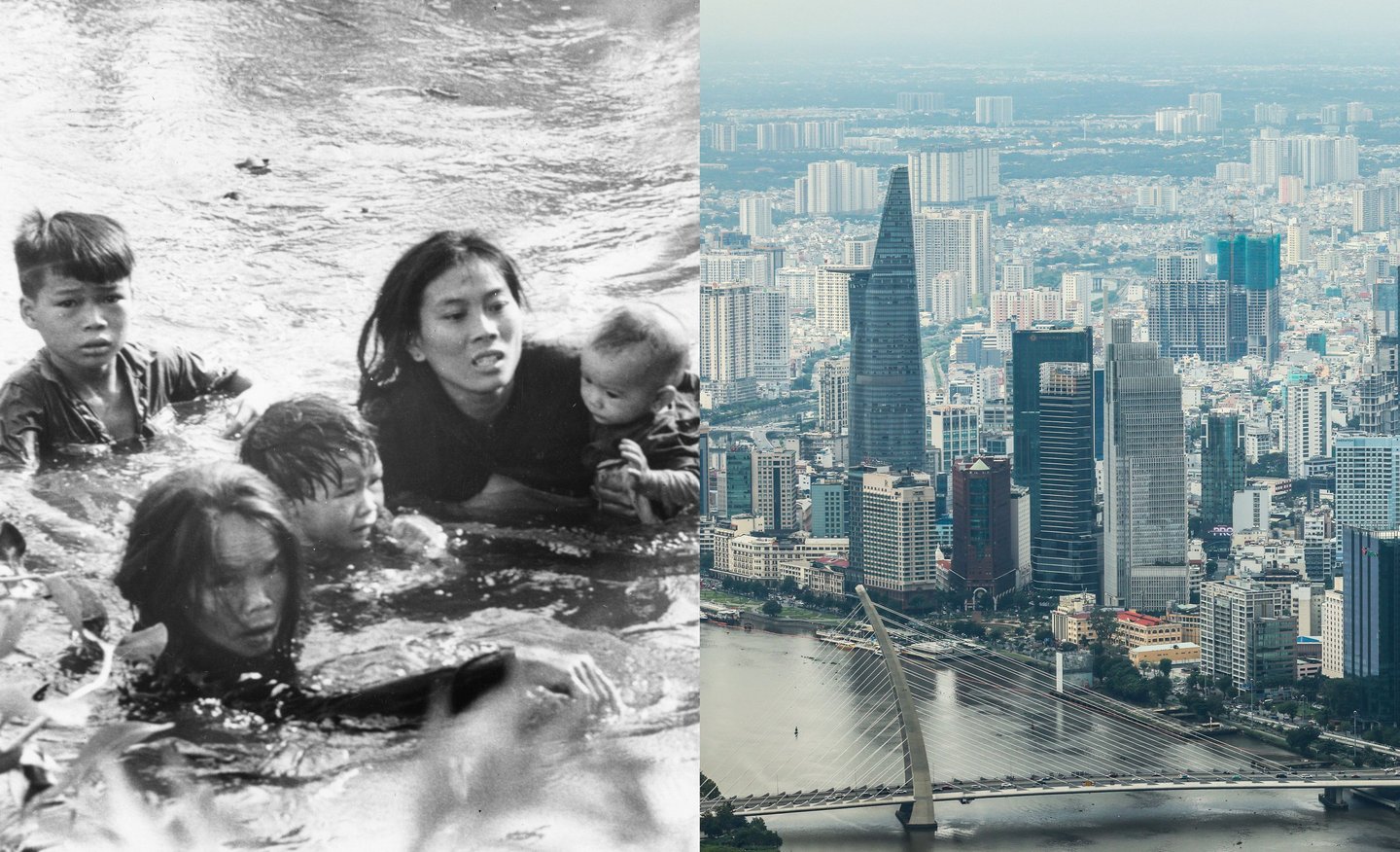

Nations rise or decline not because of fate or geography, but because of the psychology of their people. A nation “wakes up” when its citizens collectively shift from resignation to agency. A nation “stays asleep” when its institutions and people remain trapped in patterns of fear, scarcity, and helplessness. National sleep is not literal inactivity; it is a psychological paralysis where societies adapt to dysfunction rather than confront it. People learn to survive decline instead of imagining alternatives, and this adaptation becomes a cultural habit passed from one generation to the next.
At the heart of national stagnation is a scarcity mindset, the belief that resources are limited, opportunities are rare, and risk is dangerous. This mindset shrinks ambition, discourages innovation, and normalizes mediocrity across institutions. When a nation is asleep, its institutions become reactive rather than visionary. They manage crises instead of preventing them, reward obedience instead of initiative, and operate as custodians of the past rather than architects of the future. A sleeping nation also suffers from collective learned helplessness, a psychological condition where people stop believing their actions matter. Civic participation declines, corruption becomes expected, and public trust erodes until apathy becomes the national mood.
In contrast, a nation “wakes up” when its people begin to reclaim their sense of possibility. This awakening is subtle at first, small acts of courage, new ideas, and early wins that challenge the belief that nothing can change. The first sign of awakening is a new national story. Nations that transform rewrite their identity: from victims to agents, from survivors to builders, from wounded societies to resilient ones. Narrative becomes the foundation for renewal. Incentives play a decisive role in national consciousness. When effort is rewarded, corruption punished, and innovation encouraged, people begin to believe that progress is possible. When incentives are misaligned, even the most talented citizens disengage.
Leadership acts as a psychological thermostat for the nation. Leaders who govern from fear create fearful societies; leaders who govern from clarity and courage create momentum. Emotional stability at the top becomes emotional stability in the culture. Nations that break through do so when three forces converge: a crisis that exposes the cost of stagnation, a generation willing to challenge inherited limitations, and a strategic minority capable of building early momentum. Crisis alone does not awaken a nation; it merely creates the conditions for awakening. What matters is whether the society interprets the crisis as a signal to change or a reason to retreat further into fear. Young people often become the catalysts of national awakening because they are less attached to old narratives. They question assumptions, reject fatalism, and demand a future that reflects their aspirations rather than their parents’ traumas.
Transformation rarely begins with the entire population. It begins with a critical mass of entrepreneurs, educators, reformers, technocrats, and artists, who create visible wins that shift the national mood from despair to possibility. The deepest truth is that nations do not transform; people do. A nation is simply the sum of millions of individual psychologies shaped by trauma, hope, memory, incentives, and imagination. When enough minds shift, the nation shifts. Ultimately, a nation wakes up when its people stop negotiating with their limitations and start negotiating with their possibilities. National awakening is not an event but a psychological revolution, one that belongs to societies willing to choose consciousness over comfort, courage over nostalgia, and agency over fear.
Every nation operates on a hidden psychological engine that determines whether it moves forward or remains stuck. This engine is not built from policies or resources alone, but from the collective beliefs, emotions, and mental models that shape how people interpret their reality. National momentum is ultimately a psychological phenomenon before it becomes an economic or political one. At the center of this engine is identity, the story a people tell about who they are. Nations that see themselves as victims of history tend to reproduce cycles of stagnation, while nations that see themselves as authors of their future generate the confidence needed for transformation. Identity becomes the lens through which possibility or limitation is interpreted.
Collective self‑esteem plays a decisive role in national behavior. When citizens feel pride in their national identity, they are more willing to invest, sacrifice, and collaborate. When they carry shame, cynicism, or a sense of inferiority, they disengage from public life and assume the worst about their institutions. A nation’s emotional posture becomes its developmental ceiling. Many societies remain stuck because of learned helplessness, a psychological condition where people internalize the belief that nothing will ever change. After years of corruption, instability, or failed reforms, citizens begin to see effort as pointless. This mindset quietly erodes initiative, creativity, and civic participation, turning stagnation into a self‑fulfilling prophecy.
Social trust is another foundational force. Nations with high trust can coordinate, cooperate, and build long-term institutions because people believe others will act in good faith. Nations with low trust assume everyone is out to cheat the system, which leads to defensive behavior, short-term thinking, and widespread rule‑breaking. Trust determines whether a society can act collectively or remains fragmented. The psychology of leadership acts as a national amplifier. Leaders who operate from fear, insecurity, or ego transmit those emotions into the culture, creating anxious or polarized societies. Leaders who operate from clarity, stability, and courage elevate the emotional climate of the nation. Leadership is not just administrative; it is a psychological contagion.
These forces interact continuously, shaping whether a nation builds momentum or remains trapped. High identity, high trust, and high collective self-esteem create upward spirals of progress. Low trust, low self-esteem, and learned helplessness create downward spirals of stagnation. Momentum emerges when enough psychological variables align in the direction of possibility. Ultimately, national transformation is not triggered by a single policy or leader but by a shift in the collective mind. When people begin to believe in themselves, trust one another, reject helplessness, and follow leaders who embody emotional stability, a nation awakens. When these forces remain weak or distorted, the nation stays asleep, regardless of its resources or potential.
Nations rise or stagnate not because of luck or geography, but because of the psychological forces that shape how their people interpret their past, their challenges, and their possibilities. The biggest difference between breakthrough nations and stagnant ones is not material; it is mental.
Countries that break through almost always possess a shared national mission, a unifying psychological anchor that aligns citizens, institutions, and leaders toward a common future. This mission becomes the emotional engine that drives sacrifice, discipline, and long-term thinking. A national mission can take many forms, industrialization, modernization, rebuilding after war, or reclaiming dignity after humiliation—but the content matters less than the clarity. What matters is that the mission is widely believed, emotionally resonant, and tied to a collective sense of destiny.
Stagnant nations often lack this shared mission. Their people do not agree on where the country is going, what it stands for, or what future they are building. Without a unifying purpose, national energy becomes fragmented, reactive, and easily hijacked by short-term political battles. Breakthrough nations also undergo a psychological shift in which they reject excuses. They stop blaming colonialism, geography, history, external enemies, or internal divisions for their failures. These factors may be real, but they no longer serve as shields against responsibility. This rejection of excuses marks a profound transition from explanation to execution. Nations that rise stop asking, “Who is at fault?” and start asking, “What must we do?” This shift in mindset transforms national psychology from victimhood to agency. The hardest and rarest transformation is the emergence of a high-performance culture. This is the stage where excellence becomes normal, competence becomes expected, and mediocrity becomes socially unacceptable. It is the psychological equivalent of raising the national thermostat. Most nations never reach this stage because mediocrity is comfortable. It demands nothing, threatens no one, and allows societies to avoid the discomfort of accountability. High-performance cultures require discipline, honesty, and the willingness to confront painful truths about institutional weakness.
When a nation does build a high-performance culture, it becomes self-reinforcing. Schools, businesses, government agencies, and civic institutions begin to reward excellence and punish incompetence. Over time, this creates a national environment where progress compounds and momentum accelerates. Ultimately, nations break through when they combine a unifying mission, a rejection of excuses, and a culture that normalizes excellence. Nations stay asleep when they cling to grievance, avoid responsibility, and tolerate mediocrity. The difference between the two is psychological long before it becomes economic or political.
Case Studies: Vietnam, South Korea, Ethiopia, Nigeria, Japan, Chad, DRC, Burundi, Haiti, and Rwanda
Nations do not transform through economics alone; they transform through psychology. The stories they tell themselves, the discipline they cultivate, and the emotional energy they mobilize determine whether they rise or remain stagnant. The Ten case studies, Vietnam, South Korea, Ethiopia, Chad, Burundi, Haiti, DRC, Rwanda, Japan, and Nigeria- illustrate how national psychology shapes national destiny. Vietnam’s transformation is often described as an economic miracle, but its foundation is psychological. After decades of war and scarcity, the country made a collective decision that poverty would no longer define its identity. This shift in mindset created the conditions for discipline, unity, and long-term national focus.
Vietnam’s rise was powered by a quiet but powerful cultural ethic: work hard, sacrifice now, and build a future worthy of national pride. This internal discipline became a national operating system, enabling the country to attract investment, expand manufacturing, and lift millions out of poverty. South Korea’s transformation emerged from a different psychological source: trauma. The devastation of the Korean War produced a national vow, “Never again”, that became the emotional fuel for decades of intense industrialization, education reform, and technological ambition. Pain became purpose. South Korea’s national psychology fused humiliation with determination. The country refused to accept weakness as its destiny, and this refusal created a culture of excellence, sacrifice, and relentless forward motion. The result was one of the fastest and most dramatic national transformations in modern history.
Ethiopia’s early 2010s surge was rooted in a new national identity: the belief that it could become a modern African state. This psychological shift, after decades of famine narratives and global pity, unlocked a period of rapid growth, infrastructure expansion, and rising national confidence. Even though Ethiopia later faced political turbulence, the psychological awakening was real. For the first time in generations, millions of Ethiopians believed their country could compete, modernize, and redefine its place on the continent. Identity, not policy, was the spark.
Japan and South Korea
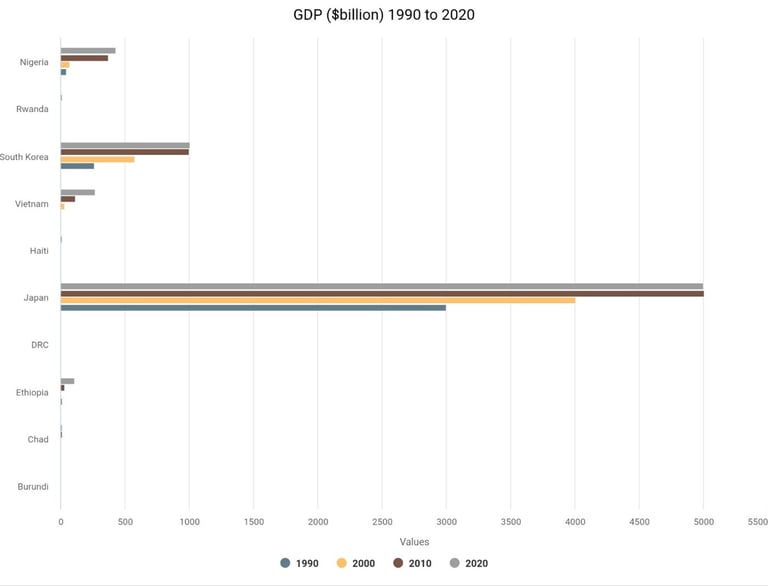
Japan and South Korea represent two of the most dramatic economic transformations of the last sixty years, rising from post‑war hardship and poverty to become global industrial and technological powerhouses. Their trajectories, visible in the chart’s steep GDP expansions, illustrate how disciplined national strategy, export‑driven growth, and human‑capital investment can reshape a nation’s destiny within a single lifetime. Japan’s rise began in the 1960s, when it shifted from basic manufacturing to high‑precision industrial production. Supported by strong state coordination, a culture of quality, and rapid technology adoption, Japan’s GDP surged from under $100 billion in 1960 to trillions by 1990. Johnson (1982) highlighted the important role played by the Ministry of International Trade and Industry (MITI), as the leading state actor in the economy. However, this period cemented Japan as the world’s second‑largest economy and a global leader in automobiles, electronics, and advanced machinery. OECD (2021) reports on Japan’s long-term industrial strength, technological innovation, and manufacturing excellence.
Through the 1990s and 2000s, Japan transitioned from heavy industry to high‑tech innovation, maintaining global influence despite economic stagnation. Robotics, semiconductors, and advanced materials became national strengths, while world‑class infrastructure, universal healthcare, and high educational standards preserved Japan’s status as a stable, high‑income society. By 2020, its GDP had approached $5 trillion, reflecting enduring industrial depth. From 2010 to 2025, Japan focused on technological refinement, automation, and global supply‑chain leadership. Even with demographic challenges, the country sustained high productivity and remained a benchmark for industrial discipline, manufacturing excellence, and technological sophistication. Its long‑term success demonstrates the power of early industrialization and continuous innovation. Amsden (1989) examines South Korean growth as an example of "late industrialization.
South Korea’s transformation is even more dramatic, beginning in the 1960s when its GDP was comparable to that of some of the poorest countries in the world. Through aggressive state‑led industrialization, Korea built foundational industries—steel, shipbuilding, chemicals—that laid the groundwork for rapid economic expansion. By the 1980s and 1990s, the country had become a major global exporter. The rise of the chaebols, Samsung, Hyundai, LG, accelerated Korea’s ascent, enabling large‑scale investment in manufacturing, technology, and global market penetration. By 2000, Korea had firmly entered the ranks of advanced industrial economies, with a GDP that continued to climb steadily through 2020, reaching well over a trillion dollars in the chart. Between 2000 and 2025, South Korea evolved from a manufacturing hub into a global technology leader. It became dominant in semiconductors, smartphones, consumer electronics, and electric‑battery innovation. This shift up the value chain, mirroring Japan’s earlier path, solidified Korea’s position as one of the world’s most dynamic, innovation‑driven economies.
Together, Japan and South Korea demonstrate a shared pattern of success: early industrialization, export‑oriented growth, disciplined human‑capital development, and relentless movement toward higher‑value industries. Their GDP trajectories from 1960 to 2025 show what is possible when national strategy, cultural cohesion, and technological ambition align. They remain two of the clearest examples of sustained industrial transformation in modern history.
Vietnam
Vietnam began the 1960s as a war‑torn, divided, low‑income country with almost no industrial base. Its GDP in 1960 was extremely small, reflecting an economy dominated by subsistence agriculture, conflict, and political fragmentation. Unlike Japan or Korea, Vietnam’s starting point was defined by destruction, not reconstruction. The post‑war period (1975–1985) was marked by scarcity, rationing, and economic stagnation. The chart shows almost no meaningful GDP expansion during these decades. Vietnam was trapped in a centrally planned system that limited productivity, innovation, and private enterprise. Poverty was widespread, and the country remained isolated from global markets. Everything changed in 1986 with the launch of Đổi Mới, Vietnam’s sweeping economic reform program. This was the psychological turning point: the moment Vietnam chose reinvention over ideology. The reforms opened the economy, legalized private enterprise, encouraged foreign investment, and shifted the country toward a market‑oriented model. From this point forward, the GDP curve begins its steady upward climb. McCaig and Pavcnik (2018) highlighted Vietnam’s shift from low-value to mid-value manufacturing, the rise of electronic assembly, export expansion, and labor discipline and competitiveness.
Between 1990 and 2010, Vietnam experienced one of the fastest sustained growth periods in the developing world. The chart shows a clear acceleration during these decades. Vietnam became a major exporter of textiles, agriculture, and low‑cost manufacturing. Millions were lifted out of poverty, and the country began integrating into global supply chains.
By 2010, Vietnam had transformed into a competitive manufacturing hub. Electronics assembly, furniture production, and industrial exports surged. Global companies, such as Samsung, Intel, and LG, began building large operations in Vietnam, attracted by political stability, disciplined labor, and a government committed to economic openness. This period marks Vietnam’s shift from low‑value to mid‑value production. From 2010 to 2020, Vietnam’s GDP growth remained remarkably stable, even during global shocks. IMF (2023), in its article, reports on the stable GDP growth from 2010 to 2020, FDI inflows from Samsung, Intel, and LG, and Vietnam’s rise as a competitive manufacturing hub.
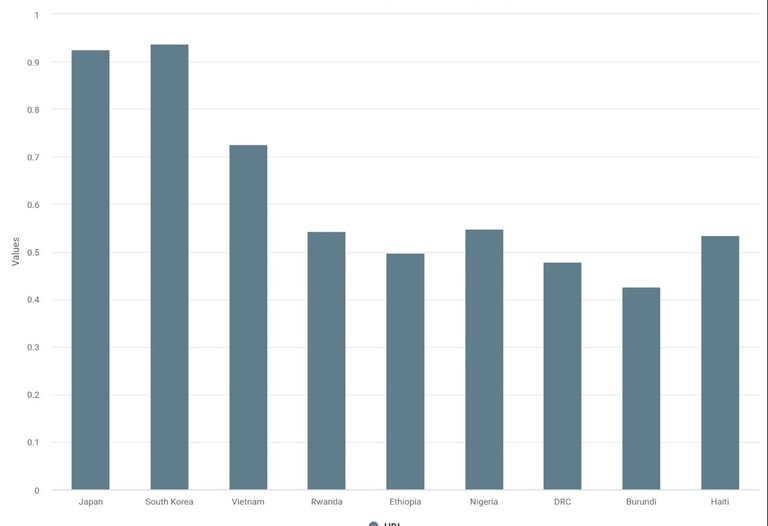
The chart shows a strong upward trajectory, reflecting Vietnam’s resilience. The country expanded into higher‑value manufacturing, including smartphones, electronics, and technology components. It also became one of the most attractive destinations for companies diversifying away from China. Vietnam’s HDI reached 0.766 in 2023, reflecting decades of consistent progress (UNDP, 2023).
By 2020, Vietnam’s GDP had grown many times over its 1960 level, demonstrating the power of consistent, incremental progress. Unlike Japan and Korea’s explosive jumps, Vietnam’s rise is defined by steady compounding, a nation that built momentum year after year, decade after decade. This is development through discipline, not drama. By 2025, Vietnam will stand as one of the most successful development stories in Asia: politically stable, economically open, globally integrated, and psychologically transformed. Its success is rooted in humility, pragmatism, and a national willingness to adapt. Vietnam shows the world that you don’t need to start strong to finish strong, you just need to move forward with consistency, clarity, and collective will.
Ethiopia
Ethiopia entered the 1960s as one of the poorest countries in the world, with a tiny GDP and an economy dominated by subsistence agriculture. The chart shows Ethiopia at the bottom of the group, reflecting a nation with minimal industrial capacity, limited infrastructure, and a largely rural population. Its economic base was fragile, narrow, and vulnerable to droughts and political instability. The 1970s and 1980s were marked by political upheaval, famine, and conflict, which kept GDP growth extremely low. The Derg regime, civil war, and repeated humanitarian crises prevented any meaningful industrial or economic expansion. The chart shows almost no upward movement during these decades, a visual representation of stagnation and national trauma.
Ethiopia’s turning point began in the early 1990s after the fall of the Derg, when a new government prioritized stability, rural development, and basic infrastructure. GDP began to rise slowly but steadily. Roads, schools, and health systems expanded. The country remained poor, but the foundations for long‑term growth were laid. The real acceleration came between 2000 and 2015, when Ethiopia became one of the fastest‑growing economies in the world. The chart shows a clear upward shift during this period. Massive public investment in infrastructure, roads, dams, railways, and industrial parks fueled growth. Poverty rates fell sharply, and Ethiopia began transitioning from a purely agricultural economy to one with emerging manufacturing capacity.
Industrial parks and export‑oriented manufacturing became central to Ethiopia’s strategy. The government attracted foreign investors in textiles, leather, and light manufacturing. Companies from China, Turkey, and Europe began setting up factories. Ethiopia positioned itself as a low‑cost alternative to Asia, aiming to replicate the early stages of Vietnam’s model. By 2020, Ethiopia’s GDP had grown many times over its 1960 level, reflecting decades of consistent investment and structural reform. The chart shows Ethiopia still far below Japan, Korea, or even Vietnam, but the growth trajectory is unmistakable. Ethiopia became a symbol of African development potential: disciplined, state‑led, and focused on long‑term transformation. UNDP data shows that Ethiopia’s HDI remains below the regional average (UNDP, 2022).
However, political instability after 2018, including conflict, inflation, and currency pressures, slowed the momentum. While the chart ends at 2020, the years that follow show a country wrestling with internal tensions that threaten its economic gains. Ethiopia’s challenge is not capacity, it is stability. The economic engine is real, but fragile. By 2025, Ethiopia stands as a nation with extraordinary potential and unresolved contradictions: rapid growth built on a narrow base, industrial ambition constrained by political volatility, and a population ready for transformation but held back by instability. Its story is one of resilience, ambition, and unfinished progress, a reminder that economic miracles require not only strategy and investment, but also unity, peace, and long‑term political coherence.
Nigeria
Nigeria entered 1960 with extraordinary advantages: a large population, fertile land, strong agricultural exports, and vast natural resources. Unlike Ethiopia or Vietnam, Nigeria did not begin its journey from scarcity or destruction. It began with abundance. Yet the chart shows that from 1960 onward, Nigeria’s GDP trajectory remains flat and inconsistent, revealing a country that never converted its early strengths into sustained development. The first two decades after independence were marked by political instability, coups, and civil war, which prevented the formation of a coherent national development strategy. While countries like Japan and South Korea were building industrial foundations, Nigeria was struggling to establish political unity. This early fragmentation created a long‑term pattern: economic decisions driven by short‑term politics rather than long‑term national vision.
The discovery and expansion of oil exports in the 1970s fundamentally reshaped Nigeria’s economy, but in the wrong direction. Oil revenue replaced real economic planning, creating a dangerous dependence on a single commodity. Agriculture declined, manufacturing stagnated, and the state became the primary source of wealth. The chart reflects this: Nigeria’s GDP rises slightly during oil booms but never transitions into a true industrial curve. By the 1980s and 1990s, Nigeria’s economy had become narrow, volatile, and vulnerable to global oil price swings. Instead of building factories, Nigeria built import dependence. Instead of strengthening institutions, it strengthened patronage networks. The result was a cycle of inflation, debt, and structural adjustment programs that weakened the country’s productive capacity. The GDP line remains shallow because the economic base remains shallow.
Chronic governance failures further undermined Nigeria’s ability to grow. Corruption, policy inconsistency, weak institutions, and poor regulatory enforcement eroded investor confidence and stifled innovation. While Vietnam and Ethiopia used strong state coordination to drive development, Nigeria’s state became fragmented, reactive, and often predatory. This institutional weakness is one of the clearest explanations for Nigeria’s stagnant trajectory. Manufacturing, once promising in the 1970s and early 1980s, collapsed instead of expanding. Power shortages, infrastructure decay, and cheap imports destroyed local industries. Nigeria never moved up the value chain; it moved out of it. The chart shows no structural break, no industrial leap, no moment where Nigeria shifts from consumption to production. This is the core difference between Nigeria and every successful Asian economy. A World Bank (2023) report on Nigeria development update, observed governance failures, policy inconsistencies, weak institutions, investor uncertainty, infrastructural decay, and power shortages, coupled with regulatory failures as the major challenges to growth and development.
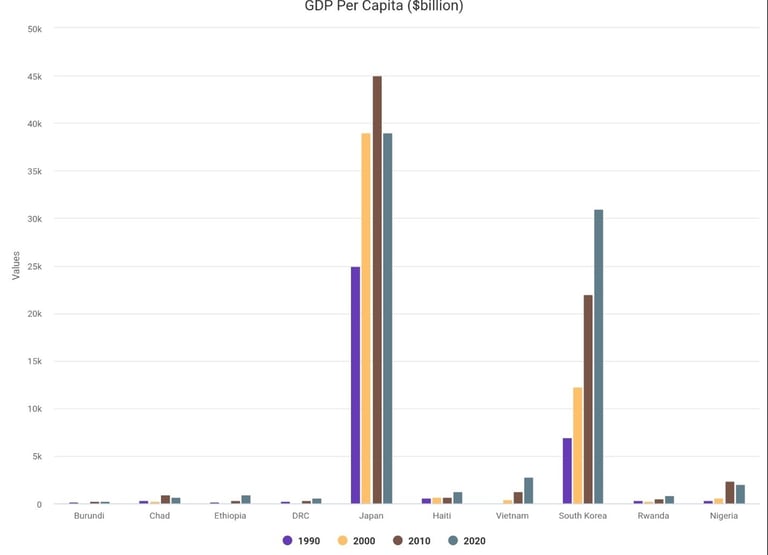
Rapid population growth outpaced economic growth, creating a widening gap between national potential and lived reality. Nigeria’s population quadrupled, but its economy did not. GDP per capita stagnated, poverty deepened, and public services became overwhelmed. A country cannot prosper when its demographic expansion is not matched by economic transformation. The chart’s flatness is not just economic; it is demographic pressure without productivity. By 2025, Nigeria stands as a nation defined by unrealized potential: rich in resources, talent, and opportunity, yet unable to convert these into sustained development. The chart makes the contrast unmistakable: Japan rises sharply, Korea accelerates dramatically, Vietnam climbs steadily, Ethiopia begins a late surge, but Nigeria remains structurally unchanged. Its challenge is not capacity but coherence. Until Nigeria builds institutions, trust, and a unified development vision, its growth will remain shallow, fragile, and far below what its people deserve.
Rwanda
Rwanda entered the 1960s as a small, landlocked, low‑income country with limited natural resources and a largely agrarian economy. Its GDP was among the lowest in the world, and unlike Nigeria or Ethiopia, Rwanda had neither scale nor strategic geographic advantages. The chart reflects this: Rwanda begins at the very bottom, with almost no measurable industrial or economic base. The decades between 1960 and 1990 were marked by political tension, ethnic division, and periodic violence that prevented sustained economic development. Rwanda’s GDP remained extremely low, showing only marginal increases. The country lacked infrastructure, industrial capacity, and the institutional stability needed to support long‑term growth. These early decades set the stage for the catastrophic collapse that would follow.
The 1994 genocide against the Tutsi was the defining rupture in Rwanda’s modern history, destroying institutions, infrastructure, and the social fabric. GDP contracted sharply, and the country faced near‑total collapse. Yet this moment also became the foundation for Rwanda’s future transformation, a national rebirth built on unity, discipline, and a collective refusal to repeat the past. From the late 1990s onward, Rwanda embarked on one of the most ambitious reconstruction and governance reforms in Africa. The government prioritized security, national cohesion, anti‑corruption measures, and institutional rebuilding. The chart shows Rwanda’s GDP beginning a slow but steady upward climb, the early signs of a country rebuilding itself from the ground up. Between 2000 and 2015, Rwanda became one of the fastest‑growing economies in Africa, driven by strong governance, strategic planning, and disciplined execution. Investments in health, education, infrastructure, and technology created a foundation for long‑term growth. Rwanda’s Vision 2020 plan guided national priorities, and the country became known for its efficiency, order, and low levels of corruption, rare strengths in the region.
Rwanda’s economic model focused on services, tourism, agriculture modernization, and emerging technology sectors. The country positioned itself as a conference hub, a regional logistics center, and a leader in digital governance. While its GDP remained modest compared to larger nations, the growth trajectory was consistent and intentional. The chart reflects this: Rwanda’s GDP rises steadily, showing structural improvement rather than volatility. By 2020, Rwanda had achieved dramatic improvements in health outcomes, education access, infrastructure quality, and ease of doing business. Poverty rates fell, life expectancy increased, and the country became a symbol of what disciplined governance can achieve even with limited resources. Rwanda’s growth is not explosive like South Korea’s or Vietnam’s, it is methodical, stable, and rooted in institutional strength. According to the UNDP Human Development Report (2023), Rwanda’s HDI has risen steadily over the past decade.
By 2025, Rwanda stands as one of Africa’s most admired development stories: a nation that transformed tragedy into discipline, scarcity into strategy, and vulnerability into resilience. Its GDP remains small in absolute terms, as shown in the chart, but its trajectory is unmistakably upward. Rwanda’s success is not defined by size, but by direction, a country proving that with unity, governance, and long‑term planning, even the smallest nations can build a path toward prosperity.
Chad
Chad entered the 1960s as one of the most geographically disadvantaged countries in Africa, landlocked, arid, and deeply rural. Its economy depended almost entirely on subsistence agriculture and livestock, with minimal infrastructure and almost no industrial base. Like Rwanda, Chad began at the bottom of the global GDP scale, but unlike Rwanda, its challenges were rooted not only in governance but in harsh environmental constraints. The decades between 1960 and 1990 were marked by chronic political instability, civil conflict, and regional fragmentation. Northern and southern regions operated with different economic realities, and repeated rebellions prevented the emergence of a unified national development strategy. GDP growth remained stagnant, reflecting a country unable to convert its limited resources into sustained progress.
The discovery of oil in the late 1990s created hope for transformation, but also intensified internal tensions.
Oil revenues began flowing in the early 2000s, and the chart shows a noticeable rise in GDP. Yet this growth was uneven, heavily centralized, and vulnerable to global price shocks. Infrastructure improved, but governance challenges limited the long‑term impact. Between 2000 and 2015, Chad experienced periods of rapid GDP expansion driven by oil exports.
However, this growth was volatile rather than structural. Agriculture remained underdeveloped, human capital investments lagged, and the country struggled to diversify. The chart reflects sharp rises and falls, a classic resource‑dependent pattern.
Security pressures, including regional insurgencies and cross‑border instability, further constrained development. Chad became a key military actor in the Sahel, diverting resources toward security rather than economic transformation. Social indicators improved slowly but remained among the lowest globally. By 2020, Chad faced the dual challenge of declining oil revenues and climate stress. Desertification, drought cycles, and population pressures strained rural livelihoods. The GDP curve flattened, showing a country struggling to transition beyond extractive dependence. Yet Chad’s resilience is undeniable. Despite limited resources, the country has maintained relative political continuity in recent years and begun exploring diversification in agriculture, solar energy, and regional trade.
Burundi
Burundi entered the 1960s with many of the same structural disadvantages as Rwanda: small, landlocked, agrarian, and resource‑poor. Its GDP was extremely low, and the economy relied almost entirely on subsistence farming and coffee exports. The decades after independence were marked by recurring ethnic conflict and political instability. Like Rwanda, Burundi experienced cycles of violence between Hutu and Tutsi groups, but unlike Rwanda, these conflicts stretched across decades, preventing sustained development. The GDP curve remained flat, reflecting stagnation. The civil war of the 1990s and early 2000s devastated the economy. Infrastructure collapsed, agricultural output fell, and poverty deepened. The chart shows a sharp decline, mirroring the country’s institutional breakdown.
The 2005 peace agreement created space for recovery. GDP began to rise slowly, driven by agricultural rehabilitation and modest improvements in governance. However, growth remained fragile and heavily dependent on donor support. Between 2005 and 2015, Burundi made progress in health, education, and rural development. But political tensions resurfaced in 2015, triggering sanctions, capital flight, and economic contraction. The chart reflects this downturn clearly. By 2020, Burundi remained one of the poorest countries in the world. Limited industrialization, low productivity, and political isolation constrained growth. Yet the country maintained relative stability and continued investing in agriculture and basic services.
Recent years have seen cautious diplomatic re‑engagement and slow economic recovery. GDP growth is modest but positive, reflecting gradual stabilization. By 2025, Burundi’s trajectory remains fragile but hopeful, a nation rebuilding slowly, constrained by history but not defined by it.
Its future depends on political reconciliation, agricultural modernization, and regional integration.
Haiti
Haiti entered the 1960s with deep structural challenges rooted in colonial extraction, political instability, and environmental degradation.
Its GDP was low, and the economy depended on agriculture, remittances, and small‑scale trade. The Duvalier dictatorship (1957–1986) created decades of repression and economic stagnation. GDP growth was minimal, and institutions weakened. The chart shows a flat trajectory, reflecting a country unable to build momentum. The transition to democracy in the late 1980s brought hope but also instability. Coups, embargoes, and governance crises prevented sustained development. GDP fluctuated but remained low. The 2010 earthquake was a catastrophic rupture. Over 200,000 lives were lost, infrastructure collapsed, and GDP contracted sharply. The chart shows a dramatic drop, one of the steepest in modern development history.
Billions in aid flowed in, but reconstruction was uneven and often mismanaged. GDP recovered slightly but never returned to pre‑earthquake potential. Political instability persisted. Between 2015 and 2020, Haiti faced worsening governance, rising insecurity, and economic contraction. Inflation surged, institutions weakened, and the GDP curve flattened again. A World Bank (2023) report states that low GDP growth rate, economic stagnation, political instability, impacts of coups, and the 2010 earthquake, which devastated the country, remain the obstacles to meaningful growth and development. By 2025, Haiti will remain trapped in a cycle of crisis and partial recovery. Yet its people continue to demonstrate extraordinary resilience, creativity, and community solidarity. Haiti’s future depends on rebuilding institutions, stabilizing governance, and investing in human capital, the foundations of any long‑term recovery. Its story is one of struggle, but also of enduring hope.
DRC
The DRC entered the 1960s with immense natural wealth, minerals, forests, water, but almost no institutional capacity to manage it. Its GDP was modest, but its potential was enormous. The chart begins with volatility rather than stability. The post‑independence period was marked by coups, secessionist movements, and governance collapse. Mobutu’s long rule brought relative stability but entrenched corruption and economic decline. GDP stagnated through the 1970s and 1980s. The First and Second Congo Wars (1996–2003) were among the deadliest conflicts since World War II. Millions died, infrastructure collapsed, and GDP plummeted. The chart shows a dramatic downward trajectory. World Bank (2023) overview of the DRC showed the enormous natural resource wealth, weak institutions and governance collapse, chronic volatility in GDP growth rate, and corruption and state fragility under Mobutu.
The 2003 peace agreement created space for reconstruction. GDP began to rise, driven by mining exports and foreign investment. Yet growth was uneven and heavily concentrated in extractive sectors. Between 2005 and 2015, the DRC experienced strong GDP growth on paper, but limited structural transformation. Mining boomed, but agriculture, manufacturing, and services lagged. Poverty remained widespread. Governance challenges, insecurity in the east, and weak institutions limited the impact of growth.
The GDP chart reflects volatility, sharp rises tied to commodity prices, followed by declines. By 2020, the DRC remained a paradox: rich in resources, poor in outcomes. Yet investments in infrastructure, energy, and regional integration began to show promise. By 2025, the DRC stands as Africa’s greatest unrealized opportunity, a nation whose future depends on governance reform, peacebuilding, and the ability to convert mineral wealth into broad‑based development.
Its trajectory is upward but fragile, shaped by both extraordinary potential and persistent instability.
The Hidden Role of Collective Identity
Collective identity functions as a nation’s operating system, the invisible software that determines how people think, behave, and respond to challenges. When this identity is coherent, nations move with purpose. When it is fragmented, nations drift without direction. Rising nations almost always possess a strong, unified identity that shapes their national psychology. This identity becomes a source of discipline, resilience, and shared expectation. It tells citizens who they are and what kind of society they are building. Anderson (1983), on the origin and spread of nationalism, observed that nations are built through shared identity and collective imagination.
Japan’s identity is anchored in discipline, precision, and collective responsibility. These traits are not merely cultural; they are psychological commitments that shape national behavior, from education to industry to governance. South Korea’s identity is built on resilience forged through trauma. The memory of war and humiliation created a national determination to rebuild, compete, and excel. This resilience became the emotional fuel for one of the fastest transformations in modern history. Vietnam’s identity centers on industriousness and quiet determination. After decades of conflict and scarcity, the nation embraced a work ethic rooted in humility, sacrifice, and long-term focus. This identity shift became the foundation of its economic rise.
Rwanda’s identity is grounded in order, discipline, and national unity. After the genocide, the country rebuilt itself around a collective commitment to stability and accountability. This identity created a culture where rules matter, and progress is intentional. Singapore’s identity is defined by pragmatism, an unromantic, results-driven mindset that prioritizes competence over ideology. This pragmatic identity allowed the country to leap from poverty to global relevance in a single generation. Fukuyama (1995), on the creation of prosperity, showed how social trust and a common and shared identity drive economic growth and institutional strength.
In contrast, stagnant nations suffer from identity confusion. They cannot answer the most basic psychological questions: Who are we? What do we stand for? What do we tolerate? What do we reject? Without these answers, national behavior becomes inconsistent and reactive. Identity confusion leads to directionless governance, inconsistent policies, and a population that cannot align around shared expectations. When a nation does not know itself, it cannot discipline itself. And without discipline, transformation is impossible. Ultimately, identity is destiny. Nations rise when their identity provides clarity, coherence, and collective purpose. Nations stagnate when their identity is fragmented, contradictory, or undefined. Without identity, there is no direction, and without direction, there can be no national transformation.
Collective identity is the psychological foundation of national progress, and its absence is one of the most important, yet least discussed, reasons why countries like Nigeria, Chad, Haiti, and Burundi struggle to build momentum. World Bank (2011) observed that weak identity and low cohesion fuel conflict and stunts economic growth and development. A nation cannot rise when its people do not share a common story, a common purpose, or a common understanding of who they are. Without this shared identity, every national challenge becomes fragmented, politicized, and personalized. Instead of moving as one body, the nation pulls itself apart.
In Nigeria, the absence of a unified national identity is visible in deep ethnic, regional, and religious divisions that shape politics, trust, and public expectations. These divisions weaken institutions because citizens often see the state not as a shared project but as a prize to be captured by one group at the expense of others. This fragmentation fuels corruption, undermines national planning, and prevents the kind of long‑term discipline that lifted countries like Rwanda and Vietnam. Nigeria’s potential remains trapped behind identity fractures that block collective action.
Chad faces a similar challenge, where identity fragmentation is compounded by geography, chronic instability, and weak state capacity. Without a strong sense of shared belonging, governance becomes fragile and inconsistent. Citizens do not trust institutions, institutions do not trust citizens, and the result is a cycle of survival politics rather than nation‑building. In such an environment, even well‑designed reforms fail because the psychological foundation needed to sustain them is missing.
Haiti’s struggles are rooted in a different but equally damaging identity crisis, one shaped by historical trauma, repeated political collapse, and a long legacy of external interference. These forces have eroded national cohesion and created a society where trust in institutions is extremely low. Without a shared national identity, Haiti cannot convert its resilience and cultural strength into coordinated national progress. Every crisis resets the country because there is no unifying narrative strong enough to hold the nation together through adversity.
Burundi’s history of ethnic conflict has left deep scars on its national identity, making unity fragile and progress uneven. When identity is contested, institutions become battlegrounds rather than instruments of development. This prevents the emergence of a stable social contract, the agreement that citizens and the state are working toward the same future. Without this contract, long‑term development becomes nearly impossible. Burundi’s experience shows how unresolved identity fractures can trap a nation in cycles of tension and stagnation.
The Cost of Staying Asleep
When a nation refuses to wake up, the consequences unfold slowly but relentlessly. Decline does not announce itself with a single catastrophic event; it creeps in through the daily normalization of dysfunction. A sleeping nation convinces itself that decay is stability simply because the collapse is quiet. One of the first signs of national sleep is brain drain. The most talented citizens, those with ambition, creativity, and global competitiveness, begin to leave. They are not fleeing poverty alone; they are fleeing a psychological environment that suffocates possibility. Their departure drains the nation of the very people capable of driving renewal.
As talent exits, institutions begin to collapse. Schools, hospitals, courts, and public agencies lose competence and credibility. Systems that once held society together become hollow shells, performing rituals of governance without delivering results. Institutional decay becomes a daily inconvenience that citizens learn to endure. In this vacuum, corruption becomes culture. It stops being an exception and becomes the operating logic of survival. People no longer expect fairness or transparency; they expect shortcuts, bribes, and manipulation. Corruption becomes the language through which society negotiates its own dysfunction.
The erosion of institutions and the rise of corruption inevitably produce insecurity. When the state cannot enforce rules or protect citizens, fear becomes a permanent feature of daily life. People retreat into self-protection, and communities fracture under the weight of distrust. Economic stagnation follows as a natural consequence. Investors avoid environments where rules are unpredictable, talent is fleeing, and institutions are unreliable. Local businesses struggle to grow, innovation dies, and the economy becomes dependent on consumption rather than production. Stagnation becomes the national baseline. Over time, the psychological toll becomes generational. Young people inherit a society where effort does not translate into opportunity, and hope feels naïve. Generational despair sets in as the future becomes a place to escape rather than a place to build. This despair is the deepest cost of national sleep.
As despair spreads, citizens begin to adapt to dysfunction. They lower their expectations, adjust their ambitions, and normalize what should be unacceptable. Power outages, insecurity, corruption, and inefficiency become “just the way things are.” Adaptation becomes a coping mechanism that reinforces stagnation. A sleeping nation is not peaceful; it is decaying. The absence of visible conflict is not the presence of stability. Beneath the surface, trust erodes, institutions weaken, and the social fabric frays. The nation continues to function, but only in the way a body functions after the spirit has left it. The true danger of national sleep is that it feels comfortable. It allows societies to avoid hard questions, painful reforms, and the discomfort of accountability. But comfort is the enemy of transformation. Until a nation confronts the psychological cost of its sleep, it cannot begin the work of awakening.
Rwanda and Vietnam are two of the most compelling examples of nations that transformed adversity into disciplined national momentum. Despite beginning from extremely low economic baselines, Rwanda, after the 1994 genocide, and Vietnam, after decades of war and isolation, both countries built a culture of collective discipline, national cohesion, and long‑term planning. Their governments established clear development visions, reduced corruption, invested heavily in human capital, and created a psychological environment where citizens believed progress was possible. This belief, the sense that “we can rise”, became a self‑reinforcing engine of growth.
Vietnam’s momentum came from a unified national identity, strong state capacity, and a social contract built on shared sacrifice and collective advancement. Rwanda’s came from rebuilding trust, enforcing order, and creating institutions that signaled stability and predictability. In both countries, governance, social trust, and national purpose aligned, allowing economic reforms to take root and compounding progress year after year.
In contrast, Nigeria, Chad, Haiti, and the DRC have struggled not because they lack resources, but because they lack the psychological and institutional foundations that sustain momentum. These nations face chronic instability, weak institutions, fragmented national identity, and cycles of corruption that erode public trust. When citizens do not believe that progress is real or that institutions will protect them, long‑term investment, both economic and psychological, collapses. The result is stagnation: economies that rise and fall with commodities, governments that struggle to plan beyond short political cycles, and societies where survival replaces strategy.
Nigeria’s volatility reflects governance inconsistency and a fragmented national identity. Chad’s stagnation is tied to geography, fragility, and decades of political instability. Haiti’s crises, political, environmental, and institutional, repeatedly reset any progress made. The DRC, despite immense natural wealth, remains trapped in a cycle where conflict, corruption, and weak state capacity prevent the conversion of resources into development. The difference is not simply economic; it is psychological. Rwanda and Vietnam built belief, discipline, and direction.
Nigeria, Chad, Haiti, and the DRC remain trapped in distrust, fragmentation, and survival mode. National momentum is ultimately a psychological phenomenon. A country rises when its people believe the future is worth building, and stagnates when they no longer do.
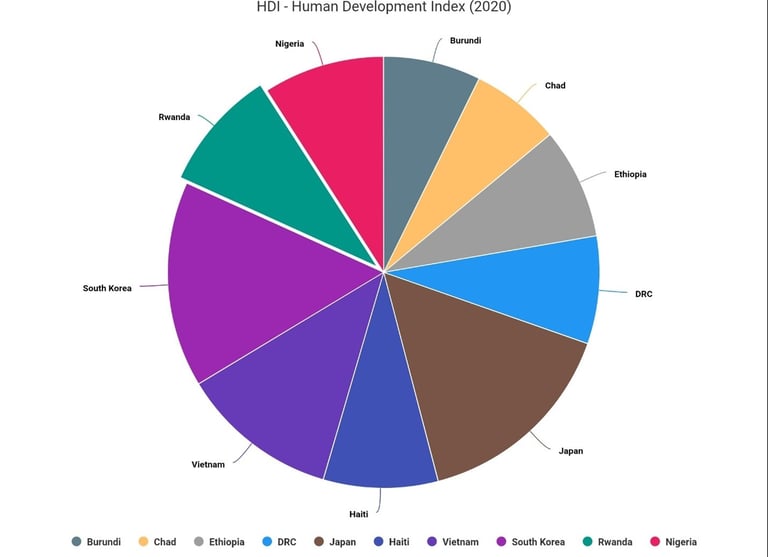
Rwanda and Vietnam stand out as two nations that have built steady, intentional national momentum over the past several decades. Despite beginning from extremely low economic baselines, both countries aligned governance, social trust, and long‑term planning in ways that allowed progress to compound. Their HDI levels, GDP trajectories, and governance indicators all reflect a pattern of disciplined, upward movement rooted in national cohesion and a shared sense of purpose.
Vietnam’s rise is driven by strong state capacity, a unified national identity, and consistent economic reforms that began in the late 1980s. Its growth has been stable, broad‑based, and anchored in manufacturing, education, and export‑driven development. Rwanda’s momentum, though emerging from a different historical rupture, follows a similar psychological pattern: strong institutions, low corruption, and a national narrative centered on unity and reconstruction. Both countries demonstrate how belief, discipline, and direction can transform low‑income nations into rising development models.
In contrast, Nigeria, Chad, Haiti, and the DRC exhibit patterns of stagnation or volatility that stem not from a lack of resources but from weak institutions, fragmented national identity, and chronic instability. Their HDI scores remain low, and their GDP trajectories show either flat lines or sharp fluctuations tied to conflict, commodity dependence, or political crises. These nations struggle to convert potential into progress because the psychological foundations of momentum, trust, stability, and long‑term vision- remain fragile. Nigeria’s development is constrained by governance inconsistency and deep regional fragmentation, producing growth that rises and falls with oil cycles rather than structural transformation.
Chad’s trajectory is shaped by harsh geography, political fragility, and dependence on volatile oil revenues. Haiti’s repeated political, environmental, and institutional crises have erased gains and prevented sustained progress. The DRC, despite immense mineral wealth, remains trapped in a cycle of conflict and corruption that undermines every attempt at reform. The contrast between these two groups of nations reveals a deeper truth: national momentum is not merely economic, it is psychological. Countries rise when governance, identity, and public belief align around a shared future, and they stagnate when distrust, instability, and short‑term survival dominate public life. Rwanda and Vietnam show what disciplined national psychology can achieve. Nigeria, Chad, Haiti, and the DRC show what happens when that psychological foundation is missing.
What It Takes to Trigger a National Awakening
National awakening is not an accident or a miracle; it is the result of psychological forces converging at the right moment. Nations do not rise simply because conditions improve; they rise because the collective mind of the society shifts from denial to awareness, from resignation to agency. The first catalyst of awakening is a crisis that exposes the truth. Every rising nation has a moment when the old illusions collapse, and the cost of stagnation becomes undeniable. This crisis acts as a mirror, forcing the society to confront realities it has avoided for years or even generations. Crises that trigger awakening are not always economic or political; they can be moral, cultural, or existential. What matters is that the crisis breaks the national habit of denial. It creates a psychological rupture that makes “business as usual” impossible.
In this moment of rupture, a second force becomes essential: a leader or movement capable of articulating a new story. Nations do not awaken through data or policy alone; they awaken through narrative. A compelling story gives people language for their pain and a vision for their future. This new story must be powerful enough to replace the old one. It must reinterpret the crisis not as a sign of doom but as a turning point. It must transform despair into direction. Without a narrative shift, the crisis becomes trauma rather than transformation. The third force is the emergence of a critical mass of citizens who decide “enough.” National awakening does not require the entire population to change at once. It requires just enough people, teachers, entrepreneurs, reformers, artists, and technocrats to shift the psychological center of gravity. Acemoglu and Robinson (2012), on why nations fail, opined that nations are awakened when institutions shift processes from extractive to inclusive, which is the core idea in national awakening.
This critical mass becomes the emotional engine of the awakening. Their belief, their courage, and their refusal to accept decline begin to influence others. Momentum spreads not through force but through example. Awakening becomes contagious. When these three forces, crisis, narrative, and critical mass, collide, a nation crosses an invisible threshold. The society begins to reinterpret its challenges as opportunities. The people begin to see themselves not as victims of history but as authors of a new chapter. Awakening is ultimately a psychological decision. It is the moment a nation stops negotiating with its limitations and starts negotiating with its possibilities. It is the moment when fear loses its authority, and hope becomes a strategy rather than a fantasy. The nations that rise are those that choose to wake up. The nations that stagnate are those that cling to denial, excuses, and nostalgia. Awakening is not destiny, it is a choice made by societies that decide they are tired of sleeping through their own potential. Fukuyama (2018) observed that identity crisis can either fracture a nation or trigger a collective awakening.
This article’s comparison between Japan and South Korea on one side, and countries like Nigeria, Chad, Burundi, the DRC, and Ethiopia on the other, reveals a fundamental truth about national development: economic transformation is not driven by resources, population size, or geography; it is driven by national psychology and institutional discipline. Japan and South Korea began their development journeys under severe constraints: war devastation, limited natural resources, and geopolitical vulnerability. Yet they built strong institutions, cultivated a unified national identity, and embraced long‑term planning. Their success came from collective discipline, social trust, and a national belief in progress. These psychological foundations allowed them to industrialize rapidly, invest in human capital, and maintain policy continuity across decades.
In contrast, Nigeria, Chad, Burundi, the DRC, and Ethiopia illustrate how weak institutions, fragmented identity, and chronic instability undermine development even when natural resources are abundant. These nations struggle not because they lack potential, but because the psychological and institutional environment does not support long‑term momentum. Volatility, corruption, and distrust create a cycle where progress is repeatedly interrupted, preventing the compounding effect that lifted Japan and South Korea.
The lesson is clear: National momentum is a psychological phenomenon before it becomes an economic one. Countries rise when they build trust, unity, and institutional discipline, and they stagnate when these foundations are missing. Japan and South Korea show what is possible when a nation aligns around a shared future. Nigeria, Chad, Burundi, the DRC, and Ethiopia show what happens when fragmentation and instability prevent that alignment. Ultimately, the comparison teaches that development is not a story of resources, it is a story of mindset, governance, and national cohesion. Nations that master these internal forces move upward. Those who do not remain trapped in cycles of stagnation.
A Call to the Future
The world is entering a new era where the traditional markers of national power, land, resources, population, and geography, no longer guarantee success. The decisive variable of the 21st century is psychological: how a nation thinks, how it interprets challenges, and how it organizes its collective mind. In this new era, nations rise not because they are the richest or the strongest, but because they possess the mental agility to adapt, the emotional resilience to endure, and the cultural discipline to execute. Psychology has become the new currency of global competitiveness. The societies that will thrive are those that understand the power of mindset. They cultivate national confidence, social trust, and a shared sense of purpose. They invest in the psychological infrastructure that allows citizens to imagine, innovate, and collaborate.
Conversely, nations that ignore the psychological dimension of development will fall behind. They may have resources, talent, and opportunity, but without a coherent national psychology, these assets remain dormant. Potential without a mindset becomes a wasted possibility. The central question every society must now confront is deceptively simple: Are we awake, or are we asleep? This question is not poetic; it is diagnostic. It reveals whether a nation is operating with clarity or drifting in denial. An awake nation confronts its weaknesses honestly, mobilizes its strengths intentionally, and aligns its institutions around a shared mission. It does not hide behind excuses, nostalgia, or inherited narratives. It chooses consciousness over comfort.
A sleeping nation, by contrast, avoids hard truths, normalizes dysfunction, and drifts through history without direction. It confuses motion with progress and mistakes survival for success. Sleep becomes a national habit, and decline becomes predictable. History shows that greatness is not reserved for the largest or wealthiest nations. Small nations have risen through discipline; wounded nations have risen through resilience; resource-poor nations have risen through imagination. The determining factor is always psychological. The future will reward nations that choose to wake up, those that build identity, cultivate trust, reject excuses, and embrace excellence. These nations will shape global culture, drive innovation, and define the next chapter of human progress.
The message to every society is clear: awakening is a choice. Nations that decide to wake up will rise, and nations that refuse will be left behind. The future belongs to those who understand that psychology, not geography, is the true engine of national destiny. A nation is reborn the moment its people choose courage over comfort and responsibility over resignation. Rebirth begins when a society looks honestly at what it has become and refuses to accept decay as destiny. It begins when citizens rediscover their shared dignity, when leaders speak to the future instead of the past, and when a new national story takes root, one built on discipline, trust, and possibility. A reborn nation does not wait for perfect conditions; it creates them through collective will. It does not ask, “Who will save us?” but declares, “We will save ourselves.” This is the call to every generation standing at the edge of history: awaken your mind, strengthen your institutions, elevate your culture, and build a country worthy of your children. National rebirth is not a dream. It is a decision, and the time to decide is now.
National identity is the psychological foundation of national progress. It gives a country a sense of direction, a shared understanding of who it is and what it is trying to become. Nations like Japan, South Korea, Rwanda, and Vietnam demonstrate that when people see themselves as part of a unified story, they are more willing to sacrifice, cooperate, and invest in the future. Without this shared identity, a country drifts, unable to align around long‑term goals or collective purpose. A strong national identity also builds social trust, which is essential for economic development. High‑trust societies coordinate more effectively, follow rules, and support institutions that manage resources and deliver public goods. Low‑trust societies fall into corruption, short‑term survival, and institutional decay. This is why countries with limited natural resources can rise rapidly, while resource‑rich nations remain stagnant: trust, not minerals, is the real engine of development.
National identity strengthens institutions by creating a sense of ownership and accountability. When citizens believe the state represents them, they defend it, improve it, and expect it to function. When identity is weak or fragmented, institutions become tools for personal gain rather than national progress. This difference explains why some nations convert policy into progress while others remain trapped in cycles of instability, even with similar economic potential. Ultimately, national identity shapes national discipline, the willingness to endure hardship today for a better tomorrow. Every rising nation has a moment when its people collectively decide to build, reform, and move forward. Identity provides the emotional fuel for that decision. It determines whether a country transforms its challenges into momentum or remains stuck in fragmentation and stagnation. In this way, national identity is not just cultural; it is the psychological infrastructure of development itself.
In the end, national momentum is not born from resources or geography but from the deeper psychological force of identity, the shared belief that a people belong to the same story and are moving toward the same future. Nations like Japan, South Korea, Rwanda, and Vietnam show that when identity is strong, trust rises, institutions stabilize, and long‑term progress becomes possible. Where identity is weak or fragmented, as in Nigeria, Chad, Burundi, and the DRC, development stalls because no collective engine exists to sustain discipline, sacrifice, or continuity. National identity is the quiet power behind every rising nation, the invisible infrastructure that turns intention into momentum and momentum into lasting growth.
A nation rises the moment its people choose a shared identity, a shared discipline, and a shared future, and refuse to turn back, and if a nation is ever to rise, it will be because its people finally choose to take what is in their hands and build the future with it.
“A nation is great not by its size alone. It is the will, the cohesion, the stamina, the discipline of its people that make it great.”
- Lee Kuan Yew
References
1. Fukuyama, F. (2018). Identity: The Demand for Dignity and the Politics of Resentment.
2. Alesina, A., & La Ferrara, E. (2002). “Who Trusts Others?” Journal of Public Economics.
3. Putnam, R. (1993). Making Democracy Work: Civic Traditions in Modern Italy.
4. Acemoglu, D., & Robinson, J. (2012). Why Nations Fail: The Origins of Power, Prosperity, and Poverty. Crown Publishing.
5. World Bank (2023). Worldwide Governance Indicators.
6. Amsden, A. (1989). Asia’s Next Giant: South Korea and Late Industrialization. Oxford University Press.
7. OECD (2022). Government at a Glance.
8. UNDP (2023). Human Development Report.
9. United Nations Development Programme. Ethiopia Human Development Report. 2022.
10. United Nations Development Programme. Rwanda Human Development Report. 2021.
11. World Bank. (2023). Nigeria Development Update: Seizing the Opportunity. World Bank Group.
12. World Bank. (2023). South Korea Country Overview. World Bank Group.
13. Fukuyama, F. (1995). Trust: The Social Virtues and the Creation of Prosperity. Free Press.
14. International Monetary Fund. (2022). Nigeria: 2022 Article IV Consultation Report. IMF.
15. McCaig, B., & Pavcnik, N. (2018). “Vietnam’s Manufacturing Miracle.” Journal of Economic Perspective
17. World Bank. (2011). World Development Report 2011: Conflict, Security, and Development. World Bank Group.
18. World Bank. (2023). Vietnam Country Overview. World Bank Group.
19. OECD. (2021). OECD Economic Surveys: Japan 2021. Organisation for Economic Co‑operation and Development.
20. Anderson, B. (1983). Imagined Communities: Reflections on the Origin and Spread of Nationalism. Verso.
21. Johnson, C. (1982). MITI and the Japanese Miracle: The Growth of Industrial Policy, 1925–1975. Stanford University Press.
22. United Nations Development Programme. (2023). Human Development Report 2023/24: Breaking the Gridlock. UNDP.
23. Hausmann, R., & Hidalgo, C. (2014). The Atlas of Economic Complexity.
24. Rodrik, D. (2007). One Economics, Many Recipes.
25. UNCTAD (2023). Economic Development in Africa Report.
26. World Bank (2020). Rwanda Economic Update.
27. McCaig, B., & Pavcnik, N. (2018). “Vietnam’s Manufacturing
28. UNDP Ethiopia (2022). Ethiopia Human Development Report.
29. IMF (2023). Vietnam Country Report.
30 African Development Bank (2023). Rwanda Country Diagnostic.
© 2026 Inquiry & Insight — All Rights Reserved. No part of this work may be reproduced, distributed, or transmitted.