
Why Humans Discount the Future: Time Preference Theory
Part 9 of the Behavioral Economy Series explores one of the most powerful yet misunderstood forces shaping human behavior: time preference, the tendency to value the present more than the future. In this article, readers are taken deep into the psychology, neuroscience, and socioeconomic foundations of why people struggle to wait, why impulse often wins over discipline, and why patience is not simply a virtue but a measurable human capability. Part 9 explains that humans do not experience the future with the same emotional intensity as the present. The present is vivid, sensory, and emotionally charged; the future is abstract, imagined, and psychologically distant. This emotional gap drives hyperbolic discounting, impulsive decisions, procrastination, and the difficulty of long-term planning. Drawing from behavioral economics, neuroscience, and Amartya Sen’s capability framework, the article shows that patience is not just about willpower, it is shaped by stress, environmental stability, childhood development, and structural inequality. Readers will learn how the brain’s reward systems create tension between impulse and discipline, how poverty and instability increase discount rates, and why individuals in chaotic environments often make short-term decisions that appear irrational but are actually adaptive. The article connects these insights to real-world behaviors in health, finance, education, relationships, and public policy, revealing how time preference influences everything from saving money to staying healthy to building stable families.
Enoma Ojo
7/18/202622 min read
Time Preference Theory
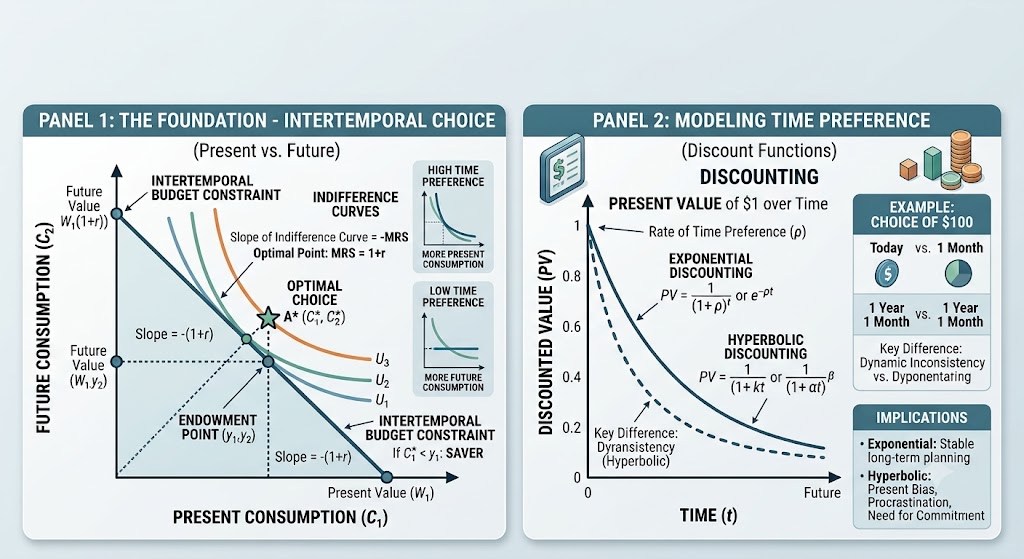
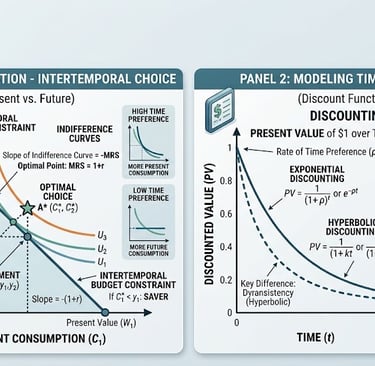
Time Preference Theory is one of the foundational concepts in economics, describing how individuals value present consumption relative to future consumption. At its core, time preference reflects the idea that people generally prefer benefits sooner rather than later, a principle that underlies savings behavior, investment decisions, consumption patterns, and intertemporal choice. In classical economic models, this tendency is represented through exponential discounting, where individuals apply a constant discount rate to future utility (Samuelson, 1937). The assumption is simple: a dollar today is worth more than a dollar tomorrow because the present is certain, accessible, and immediately useful. However, real human behavior rarely follows the smooth, rational pattern predicted by exponential discounting. Behavioral economists have shown that individuals often exhibit hyperbolic discounting, meaning they disproportionately devalue rewards that are even slightly delayed (Laibson, 1997). A reward available now feels dramatically more valuable than the same reward available tomorrow, even when the difference is trivial. This steep discounting reveals that time preference is not merely a rational calculation; it is deeply psychological.
Time preference theory therefore sits at the intersection of economics and human behavior. It explains why individuals struggle to save money, procrastinate on long-term goals, make impulsive purchases, or fail to invest in their future selves. It also explains why policies such as automatic enrollment in retirement plans or commitment devices are effective: they help individuals overcome the natural tendency to prioritize immediate gratification. The modern behavioral interpretation of time preference emphasizes that individuals do not discount the future uniformly. Instead, discount rates vary depending on emotional state, cognitive load, environmental stability, and socioeconomic conditions (Frederick, Loewenstein, & O’Donoghue, 2002). People living in unstable environments, characterized by poverty, violence, or unpredictability, tend to discount the future more steeply because waiting feels risky. Conversely, individuals in stable environments exhibit lower discount rates because the future feels trustworthy and attainable. This insight aligns with Amartya Sen’s (1999) Human Capability Theory, which argues that development is fundamentally about expanding people’s real freedoms, their ability to plan, act, and pursue long-term goals. Time preference is therefore not just an economic parameter; it reflects the capabilities individuals possess within their environments. When people have stability, safety, and opportunity, they can afford to value the future. When they do not, impatience becomes an adaptive response.
Introducing time preference theory at the outset allows us to understand patience not as a moral virtue but as a behavioral outcome shaped by psychology, environment, and structural conditions. The sections that follow explore these dynamics in depth, examining the neuroscience of impulse and discipline, the role of environmental stability, and the real-world consequences of how humans emotionally discount the future.
Human beings live inside the present moment. The present is vivid, sensory, emotionally charged, and neurologically dominant. The future, by contrast, is abstract, imagined, and psychologically distant. This fundamental asymmetry shapes how individuals make decisions over time, and it lies at the heart of time preference, the tendency to value immediate rewards more than future ones. Economists have long recognized that people discount future utility, but behavioral science reveals that this discounting is not merely rational calculation; it is deeply emotional, cognitive, and shaped by environmental conditions (Laibson, 1997). Time preference is one of the most powerful forces in human behavior. It influences savings, health choices, education, relationships, and long‑term planning. It determines whether individuals invest in their future selves or prioritize immediate gratification. In classical economic theory, time preference is modeled using exponential discounting, which assumes that individuals apply a constant discount rate over time. But real human behavior does not follow this pattern. Instead, people exhibit hyperbolic discounting, meaning they disproportionately devalue rewards that are even slightly delayed (Ainslie, 2001). A reward available today feels dramatically more valuable than the same reward tomorrow, even if the difference is trivial.
This steep discounting reflects the psychology of immediacy. Immediate rewards activate the brain’s dopaminergic pathways, producing anticipation, pleasure, and motivation. Future rewards require cognitive simulation, an imaginative process that is weaker, more fragile, and more easily disrupted by stress, uncertainty, or distraction (McClure et al., 2004). The emotional vividness of the present overwhelms the cognitive subtlety of the future. As a result, individuals consistently choose smaller‑sooner rewards over larger‑later ones, even when doing so undermines their long‑term well‑being. The emotional discounting of the future is not irrational; it is adaptive. Throughout human evolution, immediate rewards were often more reliable than distant ones. Food available now was safer than food that might be available later. Shelter today was more valuable than shelter tomorrow. In environments characterized by uncertainty, scarcity, or instability, steep discounting was a survival strategy. Modern humans inherit this psychological architecture, even though contemporary life often rewards long‑term planning more than short‑term consumption (Kidd, Palmeri, & Aslin, 2013). Yet time preference varies dramatically across individuals and contexts. People living in stable environments, safe neighborhoods, predictable routines, reliable institutions, tend to exhibit lower discount rates. They trust the future. They believe that waiting will pay off. Conversely, individuals in unstable environments, high crime, economic volatility, unpredictable living conditions, tend to discount the future more steeply (Haushofer & Fehr, 2014). When the future feels uncertain, waiting feels risky. This environmental influence on time preference aligns with Amartya Sen’s (1999) capability framework: people’s ability to make long‑term decisions depends on the substantive freedoms and stable conditions available to them.
Time preference is also shaped by cognitive load. Stress, fatigue, and emotional strain increase impulsivity and reduce patience. When individuals are overwhelmed, their ability to simulate future outcomes weakens, making immediate rewards more tempting (Shah, Mullainathan, & Shafir, 2012). This is why poverty, instability, and chronic stress are associated with higher discount rates. The psychological cost of waiting becomes too high, and the future becomes too faint to influence behavior. The psychology of patience emerges from the interplay between impulse and discipline. Impulse is the desire to resolve tension now, to satisfy curiosity, hunger, desire, or discomfort immediately. It is fast, emotional, and limbic. Discipline, by contrast, is the ability to tolerate tension, to hold the present moment open long enough for a future reward to materialize. Discipline is slow, effortful, and prefrontal. It requires emotional regulation, attentional control, and the suppression of instinctive reward‑seeking (Duckworth & Seligman, 2005). Patience is not passive; it is an active psychological effort.
Waiting carries a cost. This cost is emotional discomfort. When individuals wait, they experience uncertainty, anticipation, and delayed gratification. These sensations require cognitive resources to manage. The more stressful or unstable a person’s environment, the higher the emotional cost of waiting becomes. This is why patience is easier for individuals with stable routines, supportive social structures, and predictable environments. Their emotional cost of waiting is lower, making long‑term planning more feasible. Time preference also interacts with identity. People who have a strong sense of future self, who can vividly imagine who they will become, tend to exhibit lower discount rates (Hershfield, 2011). When the future self feels like a stranger, individuals are less willing to invest in that person. When the future self feels like a continuation of the present self, individuals are more willing to sacrifice immediate pleasure for long‑term benefit. This psychological connection between present and future selves is a powerful determinant of patience.
Ultimately, time preference reveals a deep truth about human behavior: individuals are not simply choosing between “now” and “later.” They are choosing between emotionally certain rewards and emotionally uncertain possibilities. The future becomes real only when individuals can imagine it vividly, trust it reliably, and regulate their impulses effectively. Patience emerges when the future becomes emotionally credible; impatience dominates when the future feels distant, unstable, or unreliable.
This section establishes the foundation for understanding time preference as both an economic and psychological phenomenon. In the next section, we will explore the neuroscience of impulse, discipline, and the emotional cost of waiting.
The Neuroscience of Time Preference: Impulse, Discipline, and the Emotional Cost of Waiting
Time preference is not simply a matter of economic calculation; it is a reflection of how the human brain processes reward, evaluates risk, and manages emotional tension. The psychology of patience emerges from the interplay between two major neural systems: the limbic system, which drives impulse and immediate reward-seeking, and the prefrontal cortex, which governs discipline, planning, and long-term decision-making. Understanding this neurological architecture is essential for explaining why humans discount the future so steeply and why patience is often difficult to sustain.
The limbic system is evolutionarily ancient. It includes structures such as the amygdala, nucleus accumbens, and ventral striatum, regions responsible for emotional processing, reward anticipation, and motivational drive. When individuals encounter an immediate reward, these regions activate rapidly, producing a surge of dopamine that creates pleasure, excitement, and urgency (Schultz, 2015). This activation is fast, automatic, and difficult to suppress. It is the biological foundation of impulse. The prefrontal cortex, by contrast, is evolutionarily newer. It is responsible for executive functions such as planning, self-control, working memory, and long-term reasoning. When individuals consider future rewards, the prefrontal cortex must simulate outcomes that do not yet exist, evaluate trade-offs, and regulate emotional impulses (Miller & Cohen, 2001). This process is slower, more effortful, and more vulnerable to disruption. It is the biological foundation of discipline.
The tension between these two systems explains why humans often struggle with patience. Immediate rewards trigger strong limbic activation, while future rewards require prefrontal simulation. The limbic system says, “Take it now.” The prefrontal cortex says, “Wait for something better.” Time preference reflects which system dominates at the moment of decision. Neuroscientific research demonstrates that when individuals choose immediate rewards, limbic regions show heightened activation. When individuals choose delayed rewards, prefrontal regions show stronger activation (McClure et al., 2004). This dual-system model explains why time preference is not constant across situations. It fluctuates depending on stress, fatigue, emotional state, and environmental stability. Stress is one of the most powerful disruptors of patience. Under stress, the brain shifts toward limbic dominance. Cortisol, the primary stress hormone, reduces prefrontal functioning and increases impulsivity (Arnsten, 2009). This means that individuals under stress discount the future more steeply. They choose immediate rewards not because they lack discipline, but because stress biologically impairs the neural systems responsible for patience.
This insight has profound implications for understanding socioeconomic behavior. Individuals living in unstable or high-stress environments, poverty, violence, food insecurity, or unpredictable living conditions often exhibit higher discount rates (Haushofer & Fehr, 2014). Their brains are constantly managing stress, which weakens prefrontal control and strengthens limbic impulses. As a result, waiting becomes psychologically expensive. The emotional cost of patience rises, making long-term planning more difficult.
This is not a moral failing; it is a neurological response to environmental conditions. When the future feels uncertain or unsafe, the brain prioritizes immediate rewards as a protective strategy. This aligns with evolutionary logic: in unstable environments, immediate consumption increases survival odds. Modern humans inherit this adaptive architecture, even when the environment no longer requires such steep discounting. The emotional cost of waiting is another critical factor in time preference. Waiting is not passive; it requires active emotional regulation. When individuals wait for a reward, they experience anticipation, uncertainty, and delayed gratification. These sensations activate the anterior cingulate cortex and insula, regions associated with discomfort and conflict monitoring (Botvinick et al., 2004). The longer the delay, the greater the emotional discomfort.
This discomfort explains why discipline feels effortful. Discipline is not simply the ability to say “no” to immediate rewards; it is the ability to tolerate the emotional tension of waiting. Individuals with strong emotional regulation skills, often developed through stable environments, supportive relationships, and consistent routines, exhibit lower discount rates because they can manage the discomfort of waiting more effectively (Duckworth & Seligman, 2005). Impulse, on the other hand, is emotionally easy. It resolves tension quickly. When individuals choose immediate rewards, they eliminate uncertainty and discomfort. This is why impulsive decisions often feel relieving, even when they are harmful in the long run. The limbic system rewards immediacy with dopamine, creating a sense of satisfaction that reinforces short-term behavior. The neuroscience of time preference also reveals why patience varies across developmental stages. Children exhibit extremely steep discount rates because their prefrontal cortex is not fully developed. They struggle to simulate future outcomes and regulate impulses (Mischel, Shoda, & Rodriguez, 1989). Adolescents show similar patterns due to heightened limbic sensitivity and incomplete prefrontal maturation. Adults exhibit more stable discounting, but stress, fatigue, and environmental instability can temporarily revert them to more impulsive patterns.
This developmental perspective highlights the importance of early-life stability. Children raised in chaotic or unpredictable environments often develop higher discount rates that persist into adulthood (Evans & Kim, 2013). Their brains adapt to instability by prioritizing immediate rewards. Conversely, children raised in stable environments develop stronger prefrontal regulation and lower discount rates, making patience easier and long-term planning more natural.
Neuroscience also explains why individuals differ in their ability to imagine the future. The capacity to simulate future outcomes, known as episodic future thinking, depends on the hippocampus and medial prefrontal cortex (Benoit, Gilbert, & Burgess, 2011). Individuals who can vividly imagine future rewards exhibit lower discount rates because the future feels emotionally real. Those who struggle with future simulation exhibit higher discount rates because the future feels abstract and disconnected. This insight connects directly to identity. When individuals feel a strong sense of continuity with their future selves, they are more willing to invest in long-term goals (Hershfield, 2011). When the future self feels like a stranger, individuals prioritize immediate gratification. Strengthening the connection between present and future selves, through visualization, planning, or narrative identity work, can reduce discount rates and increase patience.
Ultimately, the neuroscience of time preference reveals that patience is not simply a matter of willpower. It is a complex interplay between neural systems, emotional regulation, environmental stability, and identity. Impulse arises from limbic activation; discipline arises from prefrontal control. The emotional cost of waiting determines which system dominates. Understanding this architecture allows us to see patience not as a moral virtue but as a psychological skill shaped by biology and environment.
In the next section, we will explore how environmental stability, socioeconomic conditions, and structural inequality shape time preference across populations.
Environmental Stability, Socioeconomic Conditions, and Structural Inequality in Time Preference
Time preference does not emerge in a vacuum. It is shaped by the environments people inhabit, the socioeconomic conditions they navigate, and the structural inequalities that define their lived experiences. Although economists often treat discount rates as individual parameters, behavioral science shows that time preference is profoundly contextual. People do not simply choose between “now” and “later”; they choose between certainty and uncertainty, stability and instability, security and vulnerability. These contextual forces shape how individuals perceive the future, how they value delayed rewards, and how they regulate impulse. Environmental stability is one of the strongest predictors of patience. Individuals living in stable environments, safe neighborhoods, predictable routines, reliable institutions, and consistent social structures, tend to exhibit lower discount rates. They trust the future. They believe that waiting will pay off. In contrast, individuals living in unstable environments, high crime, economic volatility, unpredictable housing, or inconsistent access to basic resources, tend to discount the future more steeply (Haushofer & Fehr, 2014). When the future feels uncertain, waiting feels risky. The emotional cost of patience rises, and immediate rewards become more attractive. This relationship aligns closely with Amartya Sen’s (1999) Human Capability Theory, which argues that development should be understood as the expansion of people’s substantive freedoms—their real opportunities to achieve valued ways of living. Environmental stability expands these freedoms by making the future emotionally credible. Instability restricts them by making the future emotionally distant. Time preference, therefore, is not merely a psychological trait; it is a reflection of the capabilities individuals possess within their environments.
Socioeconomic conditions further shape time preference by influencing stress levels, cognitive load, and perceived opportunity. Poverty, in particular, has a powerful effect on discounting behavior. Individuals living in poverty often exhibit higher discount rates because their environments impose chronic stress, uncertainty, and scarcity (Shah, Mullainathan, & Shafir, 2012). Scarcity consumes cognitive bandwidth, leaving fewer mental resources available for long-term planning. When individuals must constantly manage immediate needs, food, rent, safety, transportation—they have less capacity to simulate future outcomes or tolerate the emotional discomfort of waiting. This phenomenon is known as the scarcity mindset, and it has measurable effects on cognitive functioning. Scarcity reduces working memory, impairs executive control, and increases impulsivity (Mani, Mullainathan, Shafir, & Zhao, 2013). These cognitive effects make patience more difficult and immediate rewards more tempting. Importantly, this is not a moral failing; it is a psychological adaptation to environmental conditions. When life is unstable, prioritizing the present is rational.
Structural inequality amplifies these effects by creating environments where the future is systematically less reliable for certain populations. Inequality shapes access to education, healthcare, safe neighborhoods, stable employment, and social mobility. Individuals in marginalized communities often face higher levels of environmental instability, chronic stress, and economic volatility. These conditions increase discount rates and reduce patience, not because individuals lack discipline, but because their environments make long-term planning more costly and less credible (Banerjee & Duflo, 2011). This insight challenges traditional economic narratives that attribute impulsive behavior to personal shortcomings. Instead, it reveals that time preference is deeply intertwined with structural conditions. When institutions are unreliable, when opportunities are scarce, when safety is inconsistent, and when social mobility is limited, the future becomes emotionally discounted. People invest less in long-term goals because the future feels less accessible.
Environmental stability also influences time preference through the predictability of reward. In stable environments, delayed rewards are more likely to materialize. In unstable environments, delayed rewards are more likely to be disrupted. This difference shapes how individuals perceive risk. Waiting is inherently risky because it requires trust in future conditions. When individuals cannot trust their environment, they choose immediate rewards as a protective strategy. This dynamic is evident in financial behavior. Individuals in stable environments are more likely to save, invest, and engage in long-term financial planning. Individuals in unstable environments are more likely to consume immediately, avoid long-term commitments, and prioritize short-term security (Carvalho, Meier, & Wang, 2016). These patterns reflect environmental influences on time preference, not inherent differences in discipline.
Environmental stability also shapes educational outcomes. Children raised in stable environments develop stronger executive functioning, lower stress levels, and greater capacity for delayed gratification (Evans & Kim, 2013). Children raised in unstable environments develop higher stress reactivity, weaker impulse control, and steeper discount rates. These developmental differences persist into adulthood, influencing long-term behavior, decision-making, and socioeconomic mobility. Structural inequality compounds these developmental effects by creating unequal environments. Wealthier families can provide stability, predictability, and safety. Poorer families often face instability, unpredictability, and chronic stress. These environmental differences shape time preference across generations. Children raised in unstable environments inherit higher discount rates, making long-term planning more difficult and perpetuating cycles of poverty. Environmental stability also interacts with identity and future self-concept. Individuals who can vividly imagine their future selves exhibit lower discount rates (Hershfield, 2011). But environmental instability weakens future self-concept by making the future feel less predictable. When individuals cannot imagine a stable future, they struggle to invest in it. This weakens patience and increases impulsivity.
Structural inequality also influences time preference through access to opportunity. When individuals perceive that long-term investments, education, savings, and health behaviors will not yield meaningful returns due to systemic barriers, they discount the future more steeply. This phenomenon is known as learned futility. It occurs when individuals believe that their efforts will not change their outcomes due to structural constraints (Mullainathan & Shafir, 2013). Learned futility increases discount rates and reduces patience because the future feels inaccessible.
Environmental stability, socioeconomic conditions, and structural inequality therefore form a powerful triad that shapes time preference across populations. Time preference is not simply a psychological trait; it is a reflection of environmental conditions, structural forces, and lived experiences. Patience emerges when the future is emotionally credible, cognitively accessible, and structurally attainable. Impatience emerges when the future is unstable, uncertain, or systematically restricted.
Time Preference in Real‑World Behavior: Health, Finance, Education, Relationships, and Public Policy
Health decisions are among the clearest expressions of time preference. Many health behaviors involve a trade‑off between immediate pleasure and long‑term benefit. Eating unhealthy food provides immediate sensory reward; exercising requires effort now for benefits later. Smoking delivers instant relief or stimulation; quitting offers long‑term health gains. The steep discounting of future health outcomes explains why individuals often struggle to adopt healthy habits even when they understand the long‑term consequences (Loewenstein, 1996). Hyperbolic discounting plays a central role in health behavior. Because individuals disproportionately value immediate rewards, they often choose behaviors that satisfy present desires at the expense of future well‑being. This is why people procrastinate on exercise, skip medical appointments, or fail to adhere to medication regimens. The emotional vividness of the present overwhelms the cognitive subtlety of the future.
Stress further amplifies unhealthy behavior. Under stress, individuals experience reduced prefrontal functioning and increased impulsivity (Arnsten, 2009). This makes immediate comfort, food, alcohol, smoking, and avoidance more appealing. Health behaviors, therefore, cannot be understood solely as matters of discipline; they are shaped by environmental stability, emotional regulation, and cognitive load.
Socioeconomic conditions also influence health-related time preference. Individuals in unstable environments often prioritize immediate relief because the future feels uncertain. This explains why poverty is associated with higher rates of smoking, obesity, and chronic disease (Haushofer & Fehr, 2014). These patterns reflect environmental influences on time preference, not inherent differences in motivation.
Financial Behavior: Saving, Spending, and the Psychology of Future Wealth
Financial decisions are deeply intertwined with time preference. Saving requires sacrificing present consumption for future benefit. Investing requires tolerating uncertainty and delaying gratification. Debt often reflects the desire to consume now and pay later. Individuals with lower discount rates tend to save more, invest more, and accumulate wealth over time. Individuals with higher discount rates tend to spend more immediately, save less, and struggle with long-term financial planning (Carvalho, Meier, & Wang, 2016). Hyperbolic discounting explains why people often fail to save even when they intend to. The future feels distant, and the emotional cost of waiting is high. This is why automatic savings programs, where money is saved without requiring active decision-making, are so effective. They bypass the psychological tension between impulse and discipline.
Financial instability increases discount rates. When individuals face unpredictable income, job insecurity, or volatile expenses, they prioritize immediate consumption because the future feels unreliable. This is rational behavior in unstable environments. Saving becomes psychologically costly because delayed rewards feel less certain. Structural inequality also shapes financial time preference. Individuals with limited access to financial institutions, credit, or investment opportunities often discount the future more steeply because long-term financial gains feel inaccessible. Learned futility, believing that effort will not change outcomes, reduces patience and increases impulsivity (Mullainathan & Shafir, 2013).
Education: The Long Road of Delayed Gratification
Education is one of the most powerful examples of long-term investment. It requires sustained effort, delayed rewards, and consistent discipline. Students must sacrifice leisure, comfort, and immediate gratification for future opportunities. Time preference therefore, plays a central role in educational outcomes.
Children and adolescents exhibit steep discount rates because their prefrontal cortex is still developing (Mischel, Shoda, & Rodriguez, 1989). This makes long-term academic planning difficult. Environmental stability helps reduce discount rates by providing predictable routines, supportive structures, and safe learning environments (Evans & Kim, 2013). Socioeconomic conditions also influence educational time preference. Students from unstable environments often struggle with long-term planning because their cognitive resources are consumed by stress and uncertainty. This explains why poverty is associated with lower academic achievement, not because students lack ability, but because their environments increase discount rates and reduce patience. Identity also plays a role. Students who can vividly imagine their future selves, graduating, succeeding, and achieving, exhibit lower discount rates and greater academic persistence (Hershfield, 2011). Episodic future thinking strengthens patience by making the future emotionally real.
Relationships: Patience, Impulse, and Long‑Term Commitment
Time preference influences interpersonal relationships by shaping how individuals manage conflict, commitment, and emotional regulation. Healthy relationships require patience, listening, compromise, forgiveness, and long-term investment. Impulsive behavior, reactivity, avoidance, and emotional outbursts often undermine relationship stability. Individuals with lower discount rates tend to exhibit greater emotional regulation, making them more capable of sustaining long-term relationships. Individuals with higher discount rates may struggle with patience, leading to impulsive decisions that damage relational stability (Duckworth & Seligman, 2005). Environmental stability also influences relational time preference. Individuals raised in stable environments often develop stronger attachment security and lower discount rates. Individuals raised in unstable environments may develop higher discount rates and struggle with long-term relational planning.
Public Policy: Designing Systems That Align with Human Time Preference
Time preference has profound implications for public policy. Many policy goals, such as saving for retirement, investing in education, improving health, reducing crime, require long-term planning. But individuals often discount the future too steeply to engage in these behaviors without support.
Effective policy design must align with human psychology. Programs that reduce cognitive load, increase environmental stability, or make future rewards more vivid can reduce discount rates and increase patience. Examples include:
Automatic enrollment in savings plans
Conditional cash transfers for education
Early childhood interventions
Behavioral nudges that make future outcomes more salient
Policies that reduce environmental instability
Public policy can also reduce structural inequality, thereby lowering discount rates across populations. When individuals trust institutions, perceive opportunity, and experience stability, they invest more in their future.
The Psychology of Patience: Building the Capacity to Value the Future
Patience is often described as a virtue, but behavioral science reveals that it is far more than a moral trait. Patience is a psychological capability, one shaped by cognitive architecture, emotional regulation, environmental stability, and learned habits. It is the ability to tolerate the tension between present desire and future reward. It is the skill of holding the present moment open long enough for long-term benefits to materialize. Understanding the psychology of patience allows us to see why some individuals invest heavily in their future while others struggle to delay gratification, even when doing so would improve their lives. At its core, patience is the ability to regulate impulse. Impulse arises from the limbic system, which seeks immediate reward, emotional relief, and tension resolution. Patience arises from the prefrontal cortex, which simulates future outcomes, evaluates trade-offs, and suppresses limbic impulses (Miller & Cohen, 2001). The balance between these systems determines whether individuals choose smaller-sooner rewards or larger-later ones. When the limbic system dominates, patience collapses. When the prefrontal cortex dominates, patience strengthens.
But patience is not simply a matter of neural strength. It is shaped by emotional regulation, the ability to manage discomfort, uncertainty, and anticipation. Waiting is emotionally taxing. It activates regions of the brain associated with conflict monitoring and discomfort (Botvinick et al., 2004). Individuals with strong emotional regulation skills can tolerate this discomfort more effectively, making patience easier. Those with weaker emotional regulation struggle to manage the tension of waiting, making immediate rewards more appealing. Environmental stability plays a central role in the psychology of patience. When individuals live in stable environments, safe neighborhoods, predictable routines, reliable institutions, they experience lower stress and greater cognitive bandwidth. This stability reduces limbic activation and strengthens prefrontal control, making patience more feasible (Haushofer & Fehr, 2014). In contrast, unstable environments increase stress, weaken prefrontal functioning, and heighten impulsivity. Waiting becomes psychologically expensive because the future feels uncertain.
This insight aligns with Amartya Sen’s (1999) capability framework. Patience is a capability that depends on environmental conditions. Individuals cannot be expected to invest in their future when their present is unstable, unsafe, or unpredictable. The ability to value the future is itself a product of structural conditions. When environments expand substantive freedoms, patience becomes easier. When environments restrict those freedoms, patience becomes harder. Socioeconomic conditions further shape the psychology of patience. Poverty imposes chronic stress, scarcity, and uncertainty. These conditions weaken prefrontal control and increase discount rates (Mani et al., 2013). Individuals living in poverty often prioritize immediate needs because their environments make long-term planning risky. This is not a failure of discipline; it is a rational response to instability. When the future is unreliable, patience becomes maladaptive. Structural inequality amplifies these effects by creating environments where the future is systematically less accessible for certain populations. Individuals facing discrimination, limited opportunity, or institutional barriers often discount the future more steeply because long-term investments feel less likely to pay off (Banerjee & Duflo, 2011). Learned futility, believing that effort will not change outcomes, reduces patience and increases impulsivity. This dynamic perpetuates inequality across generations.
The psychology of patience is also shaped by identity. Individuals who feel connected to their future selves exhibit lower discount rates and greater willingness to delay gratification (Hershfield, 2011). This connection strengthens episodic future thinking, the ability to vividly imagine future outcomes. When the future self feels real, patience becomes easier. When the future self feels distant or disconnected, patience becomes harder.
This insight has practical implications. Interventions that strengthen future self-connection, such as visualization exercises, narrative identity work, or exposure to age-progressed images, can reduce discount rates and increase patience. These interventions make the future emotionally vivid, reducing the psychological distance between present and future selves. Habits also play a role in the psychology of patience. Patience is not simply a trait; it is a learned behavior. Individuals who practice delayed gratification, through saving, studying, exercising, or long-term planning, strengthen the neural pathways associated with prefrontal control. Over time, patience becomes easier because the brain becomes more efficient at regulating impulses. This is why routines, structure, and practice are essential for developing patience. Cultural norms further shape patience. Some cultures emphasize long-term planning, intergenerational investment, and future-oriented thinking. Others emphasize immediacy, spontaneity, and present-oriented behavior. These cultural differences influence discount rates and patience across populations (Hofstede, 2001). Understanding cultural influences allows policymakers and educators to design interventions that align with cultural values rather than impose external norms.
The psychology of patience also has implications for public policy. Many policy goals, saving for retirement, investing in education, improving health, and reducing crime, require patience. But individuals often discount the future too steeply to engage in these behaviors without support. Effective policy design must align with human psychology by reducing cognitive load, increasing environmental stability, and making future rewards more vivid. For example, automatic enrollment in savings plans increases long-term investment by bypassing the psychological tension between impulse and discipline. Conditional cash transfers for education reduce discount rates by providing immediate rewards for long-term behavior. Early childhood interventions strengthen executive functioning, making patience easier later in life. Behavioral nudges, such as reminders, framing, or visualization, make future outcomes more salient, reducing psychological distance.
Ultimately, the psychology of patience reveals that time preference is not simply an economic parameter; it is a reflection of human experience. Patience emerges when individuals trust the future, feel connected to their future selves, and possess the cognitive and emotional resources to regulate impulse. Impatience emerges when environments are unstable, stress is high, and the future feels inaccessible.
Time preference and patience therefore lie at the intersection of psychology, neuroscience, economics, and sociology. They reveal how individuals navigate the tension between present desire and future reward. They show how environments shape behavior, how structural inequality influences decision-making, and how human capability depends on stability, opportunity, and emotional regulation. Understanding the psychology of patience allows us to design better policies, build stronger communities, and support individuals in developing the capacity to value their future. It allows us to see human behavior not as a series of isolated choices but as a reflection of the environments, structures, and psychological forces that shape those choices.
Time preference is not destiny. Patience can be cultivated. The future can be made vivid. Stability can be built. And when individuals gain the capability to value the future, they gain the power to transform their lives.
Related Article: https://enomaojo.com/the-minds-hidden-ledger
References
Ainslie, G. (2001). Breakdown of will. Cambridge University Press.
Arnsten, A. F. T. (2009). Stress signalling pathways that impair prefrontal cortex structure and function. Nature Reviews Neuroscience, 10(6), 410–422.
Banerjee, A. V., & Duflo, E. (2011). Poor economics: A radical rethinking of the way to fight global poverty. PublicAffairs.
Benoit, R. G., Gilbert, S. J., & Burgess, P. W. (2011). A neural mechanism mediating the impact of episodic prospection on farsighted decisions. Journal of Neuroscience, 31(18), 6771–6779.
Botvinick, M. M., Braver, T. S., Barch, D. M., Carter, C. S., & Cohen, J. D. (2004). Conflict monitoring and cognitive control. Psychological Review, 111(3), 624–652.
Carvalho, L. S., Meier, S., & Wang, S. W. (2016). Poverty and economic decision-making: Evidence from changes in financial resources at payday. American Economic Review, 106(2), 260–284.
Duckworth, A. L., & Seligman, M. E. P. (2005). Self-discipline outdoes IQ in predicting academic performance of adolescents. Psychological Science, 16(12), 939–944.
Evans, G. W., & Kim, P. (2013). Childhood poverty, chronic stress, self-regulation, and coping. Child Development Perspectives, 7(1), 43–48.
Evans, G. W. (2016). Environmental stress and human functioning. Annual Review of Psychology, 67, 1–26.
Frederick, S., Loewenstein, G., & O’Donoghue, T. (2002). Time discounting and time preference: A critical review. Journal of Economic Literature, 40(2), 351–401.
Haushofer, J., & Fehr, E. (2014). On the psychology of poverty. Science, 344(6186), 862–867.
Hershfield, H. E. (2011). Future self-continuity: How conceptions of the future self transform intertemporal choice. Social and Personality Psychology Compass, 5(1), 30–43.
Hofstede, G. (2001). Culture’s consequences: Comparing values, behaviors, institutions, and organizations across nations (2nd ed.). Sage.
Kidd, C., Palmeri, H., & Aslin, R. N. (2013). Rational snacking: Young children’s decision-making on the marshmallow task is moderated by beliefs about environmental reliability. Cognition, 126(1), 109–114.
Laibson, D. (1997). Golden eggs and hyperbolic discounting. Quarterly Journal of Economics, 112(2), 443–478.
Loewenstein, G. (1996). Out of control: Visceral influences on behavior. Organizational Behavior and Human Decision Processes, 65(3), 272–292.
Mani, A., Mullainathan, S., Shafir, E., & Zhao, J. (2013). Poverty impedes cognitive function. Science, 341(6149), 976–980.
McClure, S. M., Laibson, D., Loewenstein, G., & Cohen, J. D. (2004). Separate neural systems value immediate and delayed monetary rewards. Science, 306(5695), 503–507.
Miller, E. K., & Cohen, J. D. (2001). An integrative theory of prefrontal cortex function. Annual Review of Neuroscience, 24, 167–202.
Mischel, W., Shoda, Y., & Rodriguez, M. L. (1989). Delay of gratification in children. Science, 244(4907), 933–938.
Mullainathan, S., & Shafir, E. (2013). Scarcity: Why having too little means so much. Times Books.
Samuelson, P. A. (1937). A note on measurement of utility. Review of Economic Studies, 4(2), 155–161.
Schultz, W. (2015). Neuronal reward and decision signals: From theories to data. Physiological Reviews, 95(3), 853–951.
Sen, A. (1999). Development as freedom. Alfred A. Knopf.
Shah, A. K., Mullainathan, S., & Shafir, E. (2012). Some consequences of having too little. Science, 338(6107), 682–685.
© 2026 Enoma Ojo. All rights reserved. No part of this publication may be reproduced, distributed, or transmitted in any form or by any means, including photocopying, recording, or other electronic or mechanical methods, without the prior written permission of the author, except in the case of brief quotations embodied in critical reviews and certain other noncommercial uses permitted by copyright law.