The Silent Collapse: How Societies Decay Long Before Anyone Notices
The Silent Collapse is a gripping, almost cinematic journey into the unseen forces that cause nations to rot from the inside long before the world realizes something is wrong. This article exposes the slow violence of institutional decay, the normalization of corruption, the rise of fragile states, and the quiet erosion of public trust, the psychological and structural failures that accumulate silently until a society wakes up to find itself broken. It is a piece that names the unease people feel but rarely understand, revealing why collapse is not an event but a process, and why the warning signs are emotional long before they are political. This will be one of your most-read works because it articulates the truth people sense but cannot yet express.
enoma ojo (2026)
3/29/202622 min read
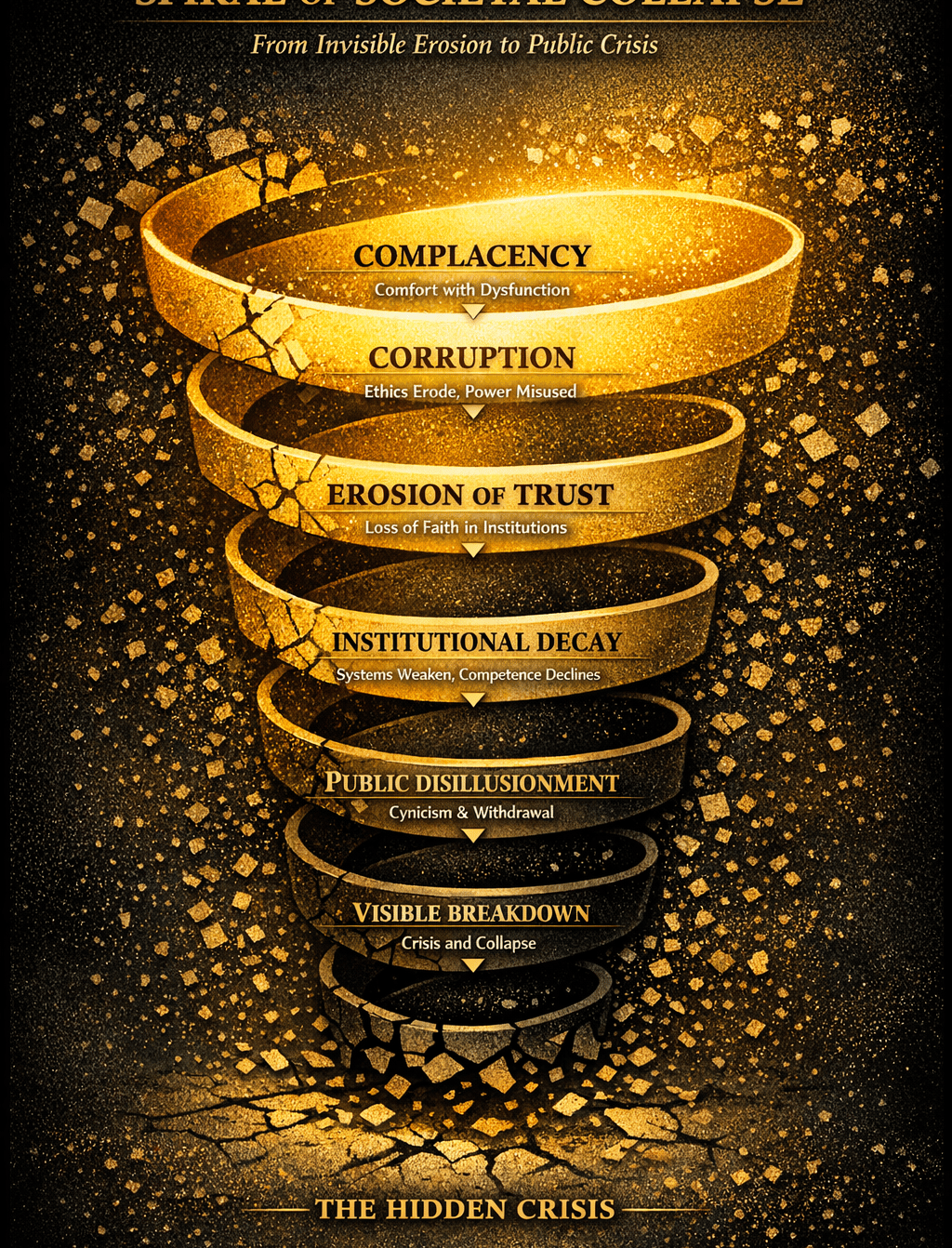
It never begins with explosions. Collapse starts quietly, so quietly that most people mistake it for background noise. A delayed government service here, a bribed official there. A school that no longer teaches, a hospital that no longer heals, a police force that no longer protects. Institutions don’t fall in a single moment; they rot slowly, invisibly, from the inside. By the time the public senses that something is wrong, the foundations have already been hollowed out. What looks like a crisis is merely the moment the decay becomes impossible to ignore. Collapse rarely announces itself. It begins quietly, in subtle shifts that most people overlook because they seem too small to matter. The early signs resemble background noise, not warning sirens. A society does not fall apart through explosions but through slow erosion. Institutions weaken long before anyone recognizes the danger. What looks like stability is often just inertia. The first cracks appear in everyday interactions: a missing official, a rule bent for convenience. These moments seem harmless, but they signal deeper structural fatigue.
Corruption rarely starts as grand theft. It begins with small favors, quiet shortcuts, and unspoken exchanges. Over time, these behaviors become normalized, forming a culture of compromise. The first acts of corruption are almost always subtle, a waived requirement, a harmless “connection,” a small rule bent for convenience. No one imagines they are participating in decay; they tell themselves they are simply helping a friend, speeding up a process, or doing what “everyone else already does.” These early compromises feel too minor to matter, but they are the cracks through which larger corruption eventually enters. The danger lies in how quickly these small acts reshape expectations. Once a shortcut works, it becomes a precedent. Once a favor is granted, it becomes an obligation. Once a rule is bent, it becomes negotiable. People begin to see integrity not as a standard but as an inconvenience. The boundary between right and wrong doesn’t break all at once; it erodes grain by grain, decision by decision, until the original line is no longer visible.
As these behaviors repeat, they create a new social logic. Corruption becomes less about greed and more about survival. People learn that honesty slows them down, that transparency isolates them, and that playing by the rules makes them the exception rather than the norm. In such an environment, refusing to participate feels naïve, even self‑destructive. The system quietly teaches citizens that integrity is a disadvantage. This is how a culture of compromise forms: not through dramatic scandals, but through thousands of small, unchallenged deviations. Each person tells themselves their actions are insignificant, but collectively, these actions rewrite the moral code of a society. What was once unthinkable became tolerable. What was once tolerable is expected. And what becomes expected eventually becomes required. Sen (1999) argues that true development is impossible without expanding human freedoms, strengthening institutions, and protecting the conditions that allow individuals to participate fully in society.
By the time corruption reaches the level of grand theft, society has already accepted the logic that made it possible. The big crimes are simply the natural evolution of the small ones. Leaders who steal millions are operating in a culture shaped by citizens who learned to look the other way when someone stole a little. Collapse begins not with the largest abuses of power, but with the quiet moments when people decide that a small compromise is harmless. This is why early vigilance matters. A society that tolerates small corruption is preparing itself for larger corruption. A society that excuses minor dishonesty is training itself to accept major dishonesty. And a society that normalizes compromise is already on the path to collapse, long before anyone realizes how far it has fallen. As corruption spreads, institutions lose their moral authority. People stop believing that systems are fair, and once trust evaporates, compliance becomes optional.
Fragile states do not emerge overnight. They are built slowly through decades of neglect, mismanagement, and the steady hollowing out of public institutions. When schools fail to educate, hospitals fail to heal, and law enforcement fails to protect, citizens begin to adapt to dysfunction. They lower their expectations and adjust their behavior. This adaptation is subtle at first. Parents stop expecting quality education and begin searching for tutors or private alternatives. Patients stop expecting competent care and start relying on informal networks, self‑medication, or traveling abroad. Communities stop expecting safety and begin creating their own parallel systems of protection. Each adjustment feels rational in the moment, but collectively these shifts signal a society quietly abandoning its institutions. As expectations fall, so does accountability. When people no longer believe schools can teach, they stop demanding reform. When they no longer trust hospitals, they stop fighting for better funding or oversight. When they no longer expect justice, they stop reporting crimes. The system decays not only because it is failing, but because citizens have stopped believing it can succeed. This psychological withdrawal is one of the earliest and most dangerous markers of collapse.
Over time, this adaptation reshapes behavior. Citizens learn to navigate around broken institutions rather than through them. They rely on personal connections instead of public systems, bribes instead of procedures, private solutions instead of collective ones. The public sphere shrinks as people retreat into individual survival strategies. What begins as adaptation becomes a new social logic: trust the system less, trust yourself more. This shift also erodes the social contract. When people stop expecting fairness, they stop offering it. When they stop expecting competence, they stop valuing it. When they stop expecting justice, they stop believing in the rule of law. A society that adapts to dysfunction becomes a society where cynicism replaces citizenship, and where the idea of a shared future feels increasingly unrealistic. The tragedy is that this adaptation feels like resilience, but it is actually surrender. Citizens believe they are coping, but they are quietly participating in the dismantling of the very institutions meant to protect them. The more they adapt, the less pressure there is for reform. The less pressure there is for reform, the deeper the dysfunction becomes. Collapse accelerates not because the system fails suddenly, but because people gradually stop expecting anything better.
Ultimately, this lowering of expectations is not just a response to decay; it is a driver of it. A society that expects nothing from its institutions will eventually get exactly that. Renewal becomes possible only when citizens reverse this psychological retreat, reclaim their expectations, and demand that public institutions serve the public again. This adaptation is one of the most dangerous phases of collapse. When people normalize the unacceptable, decay accelerates because no one is resisting it. The greatest threat to a society is not the moment corruption appears, but the moment citizens begin to treat corruption as ordinary. Once dysfunction becomes familiar, it stops triggering an alarm. People adjust their expectations downward, recalibrate their sense of what is “normal,” and quietly absorb conditions they would have once rejected outright. This psychological shift is the fuel that allows collapse to deepen without opposition. Normalization is dangerous because it transforms structural failure into background noise. Power outages become “just how things are.” Bribery becomes “the cost of getting things done.” Incompetence becomes “the system we have.” Each concession seems small, but together they create a culture where nothing shocks, nothing mobilizes, and nothing provokes collective action. A society that stops being surprised by decay is a society that has already surrendered to it.
This phase of societal, socio-political, and economic development is also perilous because it creates a false sense of stability. People tell themselves that if they can adapt, then the system must still be functioning. But adaptation is not resilience; it is resignation dressed as survival. When citizens learn to navigate broken institutions instead of demanding their repair, they unintentionally reinforce the very forces undermining their future. Collapse accelerates not because the problems grow faster, but because the resistance grows weaker. Worse still, normalization spreads socially. When enough people accept dysfunction, others follow. Social pressure discourages outrage. Cynicism becomes a badge of maturity. Hope is mocked as naïve. In this environment, even those who see danger begin to silence themselves, fearing isolation or futility. The collective moral compass bends, not through force, but through quiet, repeated compromise. This is why the normalization phase is so deadly: it erodes the psychological immune system of a society. A nation can survive corruption, inequality, and incompetence, but it cannot survive the belief that these things are inevitable. Once people stop believing that change is possible, collapse becomes self‑fulfilling. The system doesn’t need to overpower the public; it only needs the public to stop caring. Reversing this phase requires a cultural jolt, a reawakening of outrage, a refusal to accept the unacceptable, and a collective decision to see clearly again. Collapse thrives in silence, but renewal begins the moment people rediscover their capacity to say, “This is not normal.”
The erosion of trust is the silent engine of societal decline. Once people stop believing in institutions, they stop participating in them. Democracy, justice, and governance weaken from within. Trust is not merely emotional; it is structural. It determines whether people cooperate, follow rules, and invest in the future. Without trust, even well-designed systems fail. As trust collapses, parallel systems emerge. People rely on personal networks, informal markets, and private arrangements to survive. These alternatives weaken the state further. The middle class, which anchors stability, begins to shrink. Economic stagnation sets in, and opportunities become scarce. Inequality widens, fueling resentment and despair. Brain drain follows. The most capable citizens leave in search of stability elsewhere, taking with them the skills and energy needed to rebuild. Those who remain often feel trapped. They lose faith in the possibility of change and retreat into survival mode. This psychological shift is a key marker of silent collapse. Public discourse deteriorates. Cynicism replaces hope, and outrage becomes the dominant language. People stop believing in collective solutions. Leaders respond to this environment with short-term fixes rather than long-term reforms. They prioritize political survival over national renewal, deepening the crisis. Fragile states become vulnerable to external pressures. Foreign influence, economic shocks, and global instability hit harder when internal foundations are weak. Insecurity rises. Crime increases, social cohesion weakens, and communities become more fragmented. Fear becomes a daily companion.
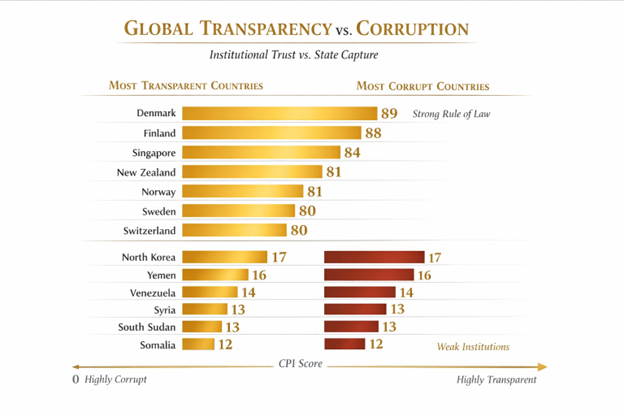
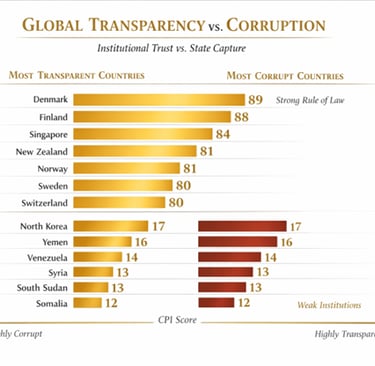
Global corruption remains deeply entrenched, with the 2025 Corruption Perceptions Index showing that 122 out of 182 countries score below 50, indicating serious corruption challenges worldwide. The global average score dropped to 42, the lowest in more than a decade, signaling a broad decline in governance integrity and public‑sector accountability. This downward trend reflects growing political instability, weakened oversight institutions, and increasing tolerance for opaque decision‑making. The cleanest countries, those with the highest levels of transparency and institutional trust, continue to be Denmark (89), Finland (88), Singapore (84), New Zealand (81), Norway (81), Sweden (80), and Switzerland (80). These nations consistently demonstrate strong rules of law, independent judiciaries, and robust anti‑corruption frameworks. Their high scores illustrate that corruption is not inevitable; it is the result of deliberate institutional design, political will, and a culture of accountability.
In contrast, the most corrupt countries, those scoring below 20, include Somalia, South Sudan, Venezuela, Syria, Yemen, and North Korea. These states typically suffer from conflict, authoritarian governance, weak institutions, and widespread state capture. Low scores in this range reflect environments where bribery, embezzlement, and abuse of power are systemic, and where citizens have little to no access to justice or transparent governance. These fragile states illustrate how corruption and instability reinforce one another.Figure 1. Global
Figure 1: Transparency vs. Corruption
Source: Author’s Illustration
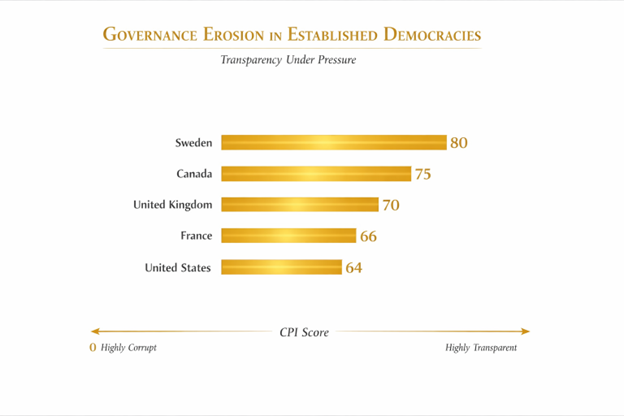
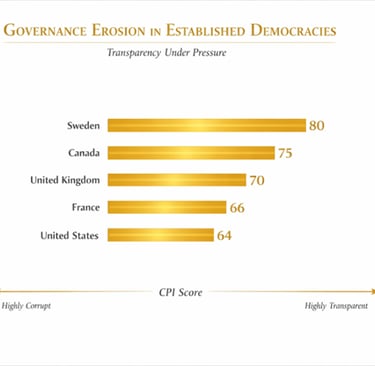
A troubling trend is the decline in perceived integrity among established democracies. Countries such as the United States (64), the United Kingdom (70), France (66), Canada (75), and Sweden (80) have all experienced downward pressure on their scores. This erosion is linked to political polarization, weakened checks and balances, attacks on independent media, and growing public distrust in institutions. The CPI data suggest that even long‑standing democracies are not immune to governance decay when transparency and accountability are compromised. Mauro (1995) found that corruption significantly undermines economic growth by distorting investment, weakening institutions, and reducing the efficiency of public spending. Transparency International (2024) reports that corruption remains deeply entrenched in many countries, with stagnation or decline in governance scores signaling heightened risks of institutional erosion.
Figure 2. Governance Erosion in Established Democracies
Source: Author’s Illustration
The CPI also highlights the connection between corruption and inequality. Countries with higher levels of corruption tend to experience weaker public services, greater economic disparities, and reduced social mobility. Corruption diverts resources away from health, education, and infrastructure, disproportionately harming the poor. Transparency International notes that corruption undermines justice systems, fuels political capture, and erodes democratic norms, all of which accelerate institutional decay and public distrust. Overall, the global data shows that corruption is both a symptom and a driver of societal decline. Nations with strong institutions, independent oversight, and civic trust consistently outperform those with weak governance and opaque systems. The CPI makes clear that corruption is not merely a moral issue but a structural one, shaping economic performance, political stability, and social cohesion. For societies seeking renewal, the data underscores a simple truth: reform is impossible without transparency, accountability, and the restoration of public trust. Acemoglu and Robinson (2012) argue that nations decline when institutions weaken, when accountability erodes, and when political incentives reward extraction rather than development.
The public often misinterprets this moment as the beginning of decline, not realizing it is the final stage of a long, silent process. By the time collapse becomes visible, the real damage has already been done. What people perceive as the “start”- the protests, the shortages, the scandals, the sudden breakdowns- is merely the point at which the decay can no longer hide behind routine. For years, sometimes decades, institutions have been eroding quietly, hollowed out by corruption, weakened by neglect, and drained of competence. But because the early stages of collapse look like inconvenience rather than crisis, most citizens fail to recognize them as symptoms of something deeper. People assume societies fall the way buildings do, suddenly, dramatically, with a single catastrophic event. But real collapse is geological, not explosive. It is the slow shifting of foundations, the gradual weakening of beams, the quiet cracking of structures long before the roof caves in. By the time the public sees the cracks, the internal support has already disintegrated. What appears to be the beginning is the end of a long, invisible deterioration.
This misinterpretation is not accidental; it is psychological. Humans are wired to normalize gradual change. When dysfunction increases slowly, people adjust their expectations downward without noticing. They tolerate delays, accept corruption as “how things work,” and adapt to declining services. Each small failure becomes part of the new normal. This adaptive blindness allows collapse to advance without resistance, because no single moment feels alarming enough to provoke collective action. Leaders often exploit this blindness. They downplay early warnings, distract the public with short-term narratives, or blame external forces. If daily life remains superficially functional, people assume the system is stable. But stability is not the same as health. A society can appear calm even as its institutions rot from within. The absence of a visible crisis is not evidence of strength; it is often evidence of decay that has not yet surfaced. By the time the public finally recognizes the severity of the situation, the collapse has already matured. The talent has left, the institutions are brittle, the trust is gone, and the social fabric is frayed. What they interpret as the “start” of decline is simply the moment the mask falls off. The real collapse happened quietly in the years when no one was paying attention.
Rebuilding requires more than policy changes. It demands a restoration of trust, a renewal of civic culture, and a reawakening of collective responsibility. Policies can adjust rules, but they cannot repair the psychological fractures that collapse leaves behind. A society cannot legislate its way out of decay if its people no longer believe in the institutions meant to serve them. Trust must be rebuilt through visible integrity, consistent fairness, and leadership that earns legitimacy rather than demands obedience. Without this emotional foundation, even the most well‑designed reforms will fail to take root. Rebuilding also requires the revival of civic culture, the shared norms, values, and expectations that make cooperation possible. When societies decay, people retreat into private survival strategies, abandoning the public sphere. They stop participating, stop believing, and stop imagining a collective future. Renewal begins when citizens rediscover the idea of “us,” when they see themselves not as isolated individuals navigating a broken system but as co‑owners of a shared destiny. Civic culture is the invisible glue that holds nations together; without it, policies are just words on paper. Most importantly, recovery demands a reawakening of collective responsibility. Collapse thrives in environments where everyone waits for someone else to fix the problem, the government, the elites, or the next generation. But societies are rebuilt when ordinary people reclaim agency, when they decide that decline is not inevitable and that their actions matter. Collective responsibility is not about blame; it is about ownership. It is the moment a society realizes that the future is not something that happens to them but something they shape.
This kind of rebuilding is slow, uncomfortable, and deeply human. It requires confronting painful truths, repairing broken relationships, and restoring the moral fabric that corruption and decay have shredded. It requires leaders who model accountability and citizens who demand it. It requires institutions that serve competence and transparency. And above all, it requires a renewed belief that a society can be better than its past, that collapse is not the end, but a warning. When trust is restored, civic culture revived, and collective responsibility awakened, policies finally have something to stand on. They become tools of transformation rather than symbols of dysfunction. Only then can a society move from silent collapse to genuine renewal.
Societies recover only when citizens believe again, in institutions, in leadership, and in one another. Without this belief, reforms fail. Recovery is not simply a technical process; it is a psychological one. A nation can rewrite laws, restructure agencies, and announce ambitious reforms, but if the public no longer trusts the people implementing those changes, the reforms will collapse under the weight of skepticism. Belief is the oxygen of collective progress. Without it, even the most well‑designed policies suffocate. Rebuilding begins when citizens rediscover the possibility that their institutions can serve them rather than exploit them. This belief cannot be demanded; it must be earned through transparency, competence, and moral consistency. People must see leaders who act with integrity, not rhetoric. They must witness institutions that deliver results, not excuses. Trust grows when actions align promises, when accountability replaces impunity, and when fairness becomes visible in everyday life. But belief in institutions is only one layer. Societies also recover when people begin to believe in one another again. Collapse fractures the social fabric, turning neighbors into competitors and communities into isolated survival units. Renewal requires reversing this psychological fragmentation. Citizens must relearn cooperation, rebuild social bonds, and recognize that their future is intertwined. A nation cannot heal if its people remain suspicious, divided, or emotionally withdrawn.
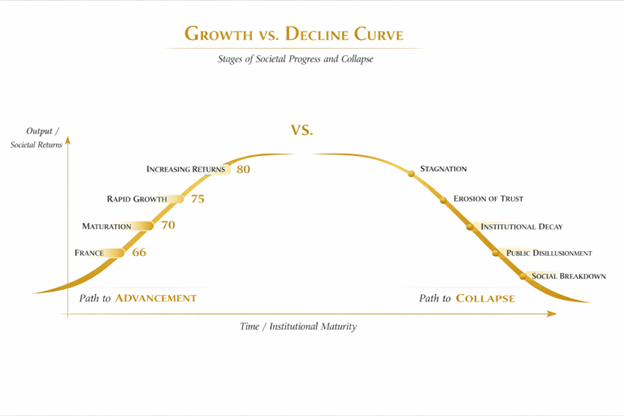
Figure 3. Growth vs Decline Curve
Source: Author’s Illustration
Figure 3 presents a dual narrative of societal transformation: the left arc traces the path to advancement, while the right arc mirrors the descent into collapse. On the ascent, progress begins with a take-off stage marked by reform and awakening, followed by increasing returns as institutions strengthen and public trust grows. Rapid growth emerges when systems align, and innovation flourishes, culminating in a peak of maturation, a period of stability, and high output. This upward trajectory reflects the compounding benefits of transparency, competence, and deliberate institutional design. The mirrored descent begins with stagnation, often masked by surface-level continuity. As trust erodes and institutional decay sets in, the curve steepens into public disillusionment and ultimately social breakdown. This decline is not sudden; it is the reversal of the same forces that once built progress. The curve’s symmetry reinforces your thesis: collapse is not chaos, it is the predictable outcome of neglected accountability, weakened oversight, and systemic fragility. The visual invites reflection on where a society stands along the arc, and whether its trajectory is still rising… or quietly beginning to fall.
Belief in leadership is equally essential. Leaders must embody the values they ask the public to uphold. They must demonstrate competence, humility, and a willingness to confront uncomfortable truths. When leaders model accountability, citizens follow. When leaders deflect blame, citizens disengage. Recovery demands leadership that inspires confidence rather than fear, unity rather than division, and long‑term vision rather than short‑term political survival. Without this multilayered belief, in institutions, in leadership, and in one another, reforms remain hollow. They become paperwork without power, policies without legitimacy, and strategies without public participation. Societies rise not because governments decree it, but because citizens decide it. Belief is the engine of national renewal, and without it, no reform can take root, no institution can be rebuilt, and no future can be secured.
This article argues that collapse is not inevitable. It is preventable when early signs are recognized and addressed with courage and clarity. Societies do not fall because decline is unavoidable; they fall because warning signs are ignored, minimized, or explained away. Every nation receives early signals, small failures, rising corruption, weakening institutions, and declining trust, but only those willing to confront these signals honestly have a chance at reversing the trajectory. Collapse is not destiny; it is the consequence of denial. Preventing decline requires courage because the earliest signs of decay are politically inconvenient and emotionally uncomfortable. Leaders must be willing to acknowledge problems before they become crises, even when doing so threatens their popularity or exposes their own failures. Citizens must be willing to demand accountability rather than settle for comforting illusions. Courage is the willingness to face reality without flinching, to name the rot even when others insist everything is fine.
Clarity is equally essential. Societies cannot fix what they refuse to understand. Collapse accelerates when people misdiagnose symptoms, blame the wrong causes, or cling to narratives that protect their pride rather than reveal the truth. Clarity means seeing the system as it is, not as we wish it to be. It means distinguishing between temporary inconvenience and structural decay, between isolated scandals and systemic corruption, between noise and signal. When courage and clarity come together, societies can interrupt the cycle of decline. They can strengthen institutions before they fail, reform systems before they break, and rebuild trust before it disappears. They can invest in competence, enforce accountability, and restore the moral foundations that corruption erodes. They can choose renewal over resignation. The World Bank (2023) reports that governance performance varies widely across countries, with declines in accountability, regulatory quality, and control of corruption often preceding broader institutional deterioration.
We insist that collapse is not a natural disaster; it is a human-made process, and therefore a human-reversible one. The question is not whether societies can prevent decline, but whether they will act early enough, boldly enough, and honestly enough to change course. Collapse is silent, but so is recovery at first. It begins with a decision: to see clearly, to speak truthfully, and to act before the damage becomes irreversible. But prevention requires honesty. Nations must confront uncomfortable truths about corruption, inequality, and institutional decay before they metastasize. Decline accelerates when societies choose denial over diagnosis. Problems that could have been corrected early become entrenched when leaders hide them, citizens minimize them, and institutions pretend they do not exist. Honesty is the first act of national self-preservation, the willingness to look directly at the rot without flinching, without excuses, and without the comforting illusion that “things will fix themselves.” Corruption cannot be addressed if society refuses to admit how deeply it has spread. Inequality cannot be reduced if people cling to myths that justify it. Institutional decay cannot be reversed if leaders insist that failures are isolated incidents rather than symptoms of systemic dysfunction. Honesty forces a nation to acknowledge the gap between what it claims to be and what it has become. That gap is where collapse begins, and where renewal must start.
Honesty is uncomfortable because it threatens pride, power, and political narratives. It exposes the failures of past leadership, the complacency of citizens, and the fragility of institutions. It demands that societies abandon denial, confront their own complicity, and accept that decline is not caused by outsiders but by internal choices. Honesty is painful, but it is also liberating. It clears the fog, reveals the real terrain, and allows a nation to act with precision rather than illusion. Without honesty, reforms become cosmetic. Leaders pass laws that look impressive but change nothing. Institutions adopt new slogans while maintaining old habits. Citizens demand accountability from others but not from themselves. In this environment, decay continues beneath the surface, untouched by superficial solutions. A society cannot heal from a wound it refuses to acknowledge. Honesty is the turning point, the moment a nation stops pretending and starts repairing. It is the moment leaders stop performing and start governing. It is the moment citizens stop blaming and start participating. When a society confronts its uncomfortable truths early, it gains the power to change its trajectory. When it avoids them, those truths grow, spread, and eventually overwhelm the system.
Ultimately, The Silent Collapse is a call to awareness. It urges readers to see the invisible forces shaping their societies and to understand that decline is not an event but a process, one that can be reversed only if people wake up before it is too late. Collapse thrives in the shadows, feeding on the things people refuse to notice: the small compromises, the quiet corruption, the gradual weakening of institutions, the slow erosion of trust. Awareness is the first act of resistance. It is the moment a society stops sleepwalking through dysfunction and begins to recognize the patterns that have been unfolding in plain sight. Awareness is not passive observation; it is a form of civic awakening. It requires citizens to question what they have normalized, to interrogate the stories they have been told, and to see the difference between stability and stagnation. It demands that people look beyond headlines and political theater to the deeper structural realities shaping their daily lives. When citizens become aware, they stop accepting decline as inevitable and start recognizing their own power to interrupt it.
We therefore urge readers, leaders, civil society, and interest groups to develop a new kind of societal literacy, the ability to read the early signs of decay, to understand how trust is built or broken, and to recognize when institutions are drifting away from their purpose. It invites everyone to see that collapse is not a sudden catastrophe but a long accumulation of ignored warnings, and we insist that awareness must come before action, because no society can fix what it refuses to see. But awareness also carries responsibility. Once people understand the forces at work, they can no longer claim ignorance. They must decide whether to participate in renewal or remain complicit in decline. Awareness transforms collapse from something that “happens to a nation” into something a nation can confront, challenge, and reverse.
In the end, The Silent Collapse is a warning, but it is also an invitation. It asks readers to lift their eyes from the noise of daily life and notice the deeper currents shaping their world. It reminds us that societies do not fall in a single moment; they fall in stages, through choices made and choices avoided, through truths ignored and truths denied. And yet, it insists that decline is not destiny. The future is still malleable, still open to those willing to see clearly and act courageously. If a nation can awaken before the final cracks appear, if its people can reclaim trust, responsibility, and collective purpose, then even a society on the brink can turn back from the edge. Collapse is silent, but so is the first moment of renewal. The question is whether we will hear it in time. In the end, the greatest danger facing any society is not the dramatic crisis that erupts on the surface; it is the slow, invisible decay that unfolds beneath it. Long before institutions fail publicly, they fail privately. Long before trust collapses in the streets, it collapses in the quiet corners of daily life. And long before a nation reaches the point of visible breakdown, it has already endured years of erosion that most people never recognized as erosion at all. Collapse is not an event; it is a long time to forget, forgetting how to govern, how to cooperate, how to tell the truth, how to care for one another, and how to see reality without distortion.
What makes this decay so dangerous is its subtlety. Societies rarely fall because of a single catastrophic blow; they fall because the small fractures were ignored. The normalization of incompetence. The quiet acceptance of corruption. The slow retreat of shared purpose. The rise of cynicism disguised as realism. These forces accumulate quietly, almost politely, until one day the system can no longer carry its own weight. By the time the public finally notices, the collapse has already happened, and the visible crisis is merely the final stage of a long‑unseen decline. Yet awareness is not a passive act; it is a form of resistance. To see clearly is to refuse the comfort of denial. To name the early signs is to interrupt the cycle of decay, and to acknowledge the fragility of a society is to reclaim the possibility of strengthening it. Renewal begins not with grand reforms or sweeping revolutions, but with the simple, disciplined act of paying attention to the quality of leadership, to the integrity of institutions, to the health of public trust, and to the moral habits that hold a society together. A culture that learns to see itself honestly is a culture that can still be repaired.
If collapse is silent, then repair must be deliberate. It requires citizens who refuse to be numbed by spectacle, leaders who understand that legitimacy is earned rather than inherited, and institutions that remember their purpose rather than their power. It requires a collective willingness to confront uncomfortable truths before they become irreversible realities. Societies do not heal by accident; they heal because people choose to intervene early, consistently, and courageously. The work is slow, often unglamorous, and rarely celebrated, but it is the only work that prevents decline from becoming destiny. Collier (2007) explains that the world’s most fragile states fall into predictable “traps”, conflict, corruption, weak governance, and economic stagnation, but also shows that targeted reforms and disciplined leadership can reverse decline.
This article ends where responsibility begins: with the reader. The silent collapse can be reversed, but only by those willing to see what others ignore. Only by those who understand that vigilance is not paranoia, that accountability is not hostility, and that truth is not optional. The future belongs to societies that recognize the early signs of decay and act before the damage becomes permanent. Awareness is not the end of collapse; it is the beginning of repair, and the moment a society chooses to see clearly is the moment it begins to rise again. History reminds us that collapse is not a full stop; it is a turning point. Countries such as Rwanda, which rebuilt from genocide into one of Africa’s most stable and efficient states, and Vietnam, which rose from war, isolation, and poverty to become one of the fastest‑growing economies in the world, show what disciplined national renewal looks like. Georgia confronted corruption head‑on and transformed its public institutions. Colombia pushed back against decades of internal conflict and criminal capture. South Korea evolved from authoritarian rule and economic fragility into a resilient democracy, while Estonia emerged from post‑Soviet dysfunction to become a global model of digital governance. These recoveries were not accidental; they were the result of societies choosing clarity, discipline, and collective responsibility over resignation. Kaufmann and Kraay (2008) highlight that governance quality, including accountability, political stability, regulatory effectiveness, and control of corruption, is a central determinant of whether nations strengthen or slide toward institutional decline.
The story of these countries reinforces the central message of this article: the silent collapse ends the moment a society decides to see clearly. Nations rise again when vigilance replaces complacency, when accountability becomes non‑negotiable, and when truth is treated as a public good rather than an inconvenience. The countries that stepped back from the brink did so because citizens and leaders refused to accept decline as destiny. The same choice stands before every society today. The moment we choose responsibility is the moment the rise begins, and while history offers examples of nations that rose from the edge, it also offers a quieter warning: many countries today stand at that same precipice. Societies strained by polarization, weakened institutions, corruption, or eroding public trust are not experiencing isolated problems; they are exhibiting the early signatures of decline. The patterns are familiar, the signals unmistakable. Collapse does not announce itself; it gathers slowly, in the places where vigilance fades, and accountability becomes negotiable. The question is not whether collapse is possible, but whether a society chooses to recognize the signs before the damage becomes irreversible.
Declaration of generative AI and AI‑assisted technologies in the manuscript preparation process
During the preparation of this work, the author used Microsoft Copilot to assist with tasks such as Infographics, Images, and wording. After using this tool, the author reviewed, edited, and approved all tasks and took full responsibility for the final version of the manuscript.
References
1. Acemoglu, D., & Robinson, J. A. (2012). Why nations fail: The origins of power, prosperity, and poverty. Crown Publishers.
2. Collier, P. (2007). The Bottom Billion: Why are the poorest countries failing and What Can Be Done About it. Oxford University Press.
3. Fukuyama, F. (2014). Political order and political decay: From the industrial revolution to the globalization of democracy. Farrar, Straus and Giroux.
4. Kaufmann, D., & Kraay, A. (2008). Governance indicators: Where Are We, Where Should We Be Going? The World Bank Research Observer, 23(1), 1–30.
5. Mauro, P. (1995). Corruption and growth. The Quarterly Journal of Economics, 110(3), 681–712.
6. North, D. C., Wallis, J. J., & Weingast, B. R. (2009). Violence and social orders: A conceptual framework for interpreting recorded human history. Cambridge University Press.
7. Rodrik, D. (2007). One economics, many recipes: Globalization, institutions, and economic growth. Princeton University Press.
8. Sen, A. (1999). Development as freedom. Alfred A. Knopf.
9. Transparency International. (2024). Corruption Perceptions Index 2023. Transparency International.
10. World Bank. (2023). Worldwide Governance Indicators: 2023 update. World Bank Group.
© 2026 Enoma Ojo. All rights reserved. No part of this article may be reproduced, distributed, or transmitted without prior written permission.