Personal Growth & Development: The S-curve
The S‑curve shows that personal growth begins slowly, accelerates as skills compound, and eventually plateaus as mastery is reached. It reminds us that progress is nonlinear, and that every new level of life requires a new curve, a new challenge, and a new commitment to becoming more.”
enoma ojo (2023)
1/15/20263 min read
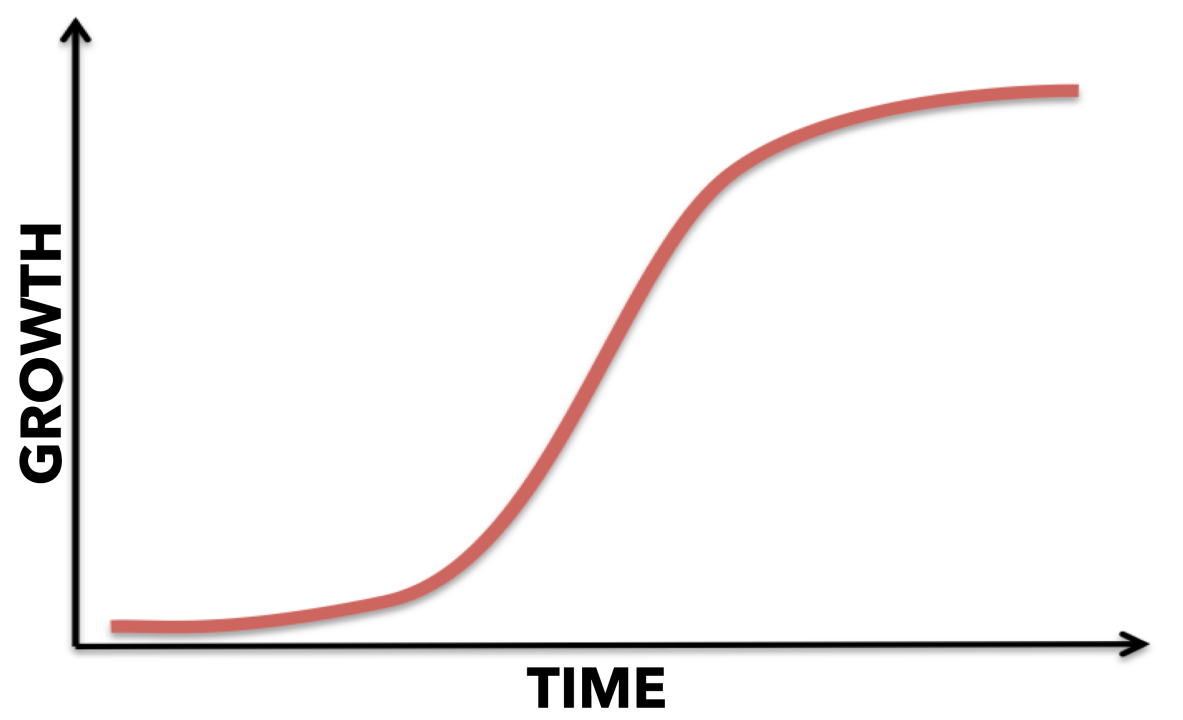
The S-curve framework has been used in multi-disciplinary analysis and framework to depict the Begin-Growth-Decline phase of human biology, production theory in economics, project evaluation, performance evaluation, cash flow forecast, and a wide range of measurement factors that utilize a cumulative distributive chart with growth and time. It is used for measuring the start, growth, maturity, and decline of a given entity or project. The S-shaped curve helps us to understand the nature and performance of a given project or role, and outcomes can help in forecasting and learning for corporate and personal growth and development. The S-curve is likened to the three stages of production in economic theory were the average and marginal contribution of factor inputs determine the output in the production function. At stage one, the average product is rising, sat tage two average product is rising but declining, and at stage three, the marginal product is negative, and the total product is declining. The relationships between the average and marginal contributions of factor inputs can be used to define employee contributions to total output. Invariably, an employee's role to the total output will be relevant as long as his marginal contribution is positive.
The Begin Phase shows the early years in an organization, and this phase portrays slow growth, and at this phase, personal growth is rising at a slow rate. Over time, with training, new skills, and personal development, growth in the organization would begin to rise at an increasing rate. This phase is the rapid growth stage that is not permanent and requires constant training, L&D, and the insight to factor in the indicators of change in the workplace. The third phase is the growth stage that is rising, but at a constant rate. In this stage, personal growth slows, creating a gradual slope, and this is the stage an individual needs to evaluate their potential and analyse the needs and requirements in the workplace. This is the phase were we upland, becoming too comfortable with our work processes, and this is often characterized by repetitive task which often results in tasks becoming mundane. Employees often overlook the importance of acquiring new skills and knowledge that aligns with organizational needs. This is the crucial stage of work life that determines further growth or decline. This decision stage ultimately determines if the employee will create another S-curve from an inflection point or allow the organization to determine his fate.
Inflection/ Strategic Decision Point
Successful people are able to determine and evaluate every point on the S-curve by analyzing industry trends, organizational requirements, acquiring new skills and knowledge, intraprenuership, training and retraining, and organizational change. Employers also gauge the competence levels of employees by the regular analysis of key performance indicators and appraisals, and by plotting the cumulative S-curves of the employee over time. Faster growth or rise along the S-curve could also be determined by other factors other than rapid self-development, and acquisition of new skills. However, every employee will ultimately get to the end of the S-curve or inflection point, and the strategic decision taken at this stage will eventually determine the success and future outcomes of our personal growth and development.
At the inflection point, every individual is faced with the ultimate decision of acquiring new skills, new training, new industry, entrepreneurship, or retiring from work life. Our personal life is massed with inflection points. There are decisions to be made, course of action to be undertaken, and direction to take for our personal growth and to change the direction of our personal lives. These points on the S-curve have the potential to change the direction of our lives, as we are constantly faced with life’s up and down swings. In mathematics, inflection point shows the moment when a line’s curvature or derivative alters. Lines that are normally moving in convex direction, suddenly moves in concave direction. Most individuals do not know how to analyze their S-curves and or determine how, and when they get to the inflection points of their work life. Ultimately, we must change our course of direction to achieve a highly fulfilling, successful, and satisfying life.
In moving through inflection points, employees must constantly evaluate if current roles are providing opportunities and other range of options, or teaching new skills, and providing the knowledge that teaches something new. Inflection points can dramatically alter the direction of our lives and careers, and decisions taken at these points does not often results in successes or failures. However, employees who take the ultimate steps are those who are able to analyze these critical moments, take the bold steps of moving ahead, rather than allowing organizations to determine their fate, and succeed in the area of personal growth and development.