The Psychology of Scarcity: Behavioral Economy
This first installment examines what happens when the human mind operates under conditions of shortage — not just of money, but of time, stability, and emotional bandwidth. It reveals how scarcity rewires cognition, narrowing attention to the immediate and shrinking the field of imagination. Part 1 of our Behavioral Economy Series explores how poverty, uncertainty, and instability distort judgment, forcing people into short‑term decisions that are often misread as weakness or irresponsibility. It reframes these behaviors as rational adaptations to pressure, the mind’s attempt to survive when its cognitive resources are depleted. Readers are invited to see scarcity as a psychological condition as much as an economic one. When the mental field contracts, empathy, foresight, and creativity fade; when margin and safety return, those capacities re‑emerge. Part 1 sets the foundation for the series by showing that human behavior cannot be understood apart from the environments that shape mental bandwidth. It is a call to leaders, educators, and designers to build systems that restore the space for thought, because when people have room to breathe, they have room to become.
BEHAVIORAL ECONOMY
enoma ojo (2026)
4/11/202613 min read

Economics begins with a simple truth: scarcity defines value. When resources are limited, every choice becomes a negotiation between what we want and what we can afford to lose. But scarcity is not confined to markets; it lives inside the mind. When time feels short, when attention is divided, when emotional reserves run low, the psyche begins to mirror the economy. It starts to ration energy, hoard certainty, and trade curiosity for control. The result is not just a lack of resources, but a contraction of possibility, a psychological recession that shapes how we think, decide, and connect. This is the unseen marketplace within us, where fear sets the price and imagination becomes the rarest commodity.
Economists define scarcity as the tension between limited resources and unlimited wants. Psychologists experience it as the tension between limited mental bandwidth and unlimited demands. When the external economy contracts, the internal one does too; attention narrows, emotion becomes volatile, and the mind begins to trade in survival rather than possibility. The Psychology of Scarcity explores this invisible marketplace within us, where fear, time, and uncertainty become currencies that shape how we think, decide, and live. Scarcity is often described as an economic condition, a simple mismatch between limited resources and unlimited wants. But in human life, scarcity is far more than a mathematical imbalance. It becomes a psychological environment, one that reshapes how people think, feel, and behave. When resources tighten, whether money, time, energy, or emotional support, the mind reorganizes itself around survival. This reorganization is not a choice; it is an adaptation. The first transformation scarcity initiates is a narrowing of attention. Economists call it “tunneling.” When the mind perceives a shortage, it locks onto the immediate problem with laser-like intensity. This can be useful in the short term, but it comes at a cost: everything outside the tunnel becomes blurry. Long-term planning, creativity, and strategic thinking weaken because the mind is consumed by the urgency of now. Tunneling explains why people under financial pressure often miss deadlines, forget appointments, or make avoidable mistakes. It is not a lack of discipline. It is the cognitive tax of scarcity. The brain is so overloaded by the urgent that it cannot allocate bandwidth to the important. The tunnel steals attention from anything that does not solve the immediate crisis.
Scarcity also increases cognitive load, the mental effort required to process information and make decisions. When resources are abundant, decisions feel lighter. But when resources are scarce, every choice carries weight. Every decision becomes a trade-off. This constant mental arithmetic drains energy and reduces the mind’s capacity to think clearly. Cognitive load explains why people in scarcity often appear inconsistent or irrational. They are not irrational; they are overloaded. The mind is juggling too many constraints at once. Even simple tasks feel heavy. The brain is functioning like a computer with too many tabs open, slow, reactive, and prone to errors.
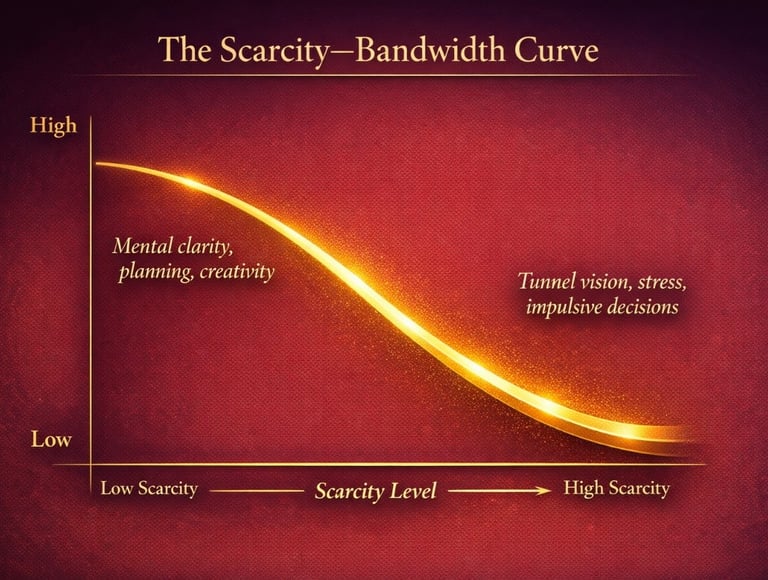
Figure 1. The Scarcity Bandwidth Curve
Source: Author’s Illustration
In Figure 1, scarcity taxes the mind as surely as it taxes the market. As external limits tighten, the internal economy of thought begins to contract. Attention narrows, creativity declines, and the mind trades long‑term vision for short‑term survival. The curve reveals this invisible exchange: when scarcity rises, cognitive bandwidth falls. What begins as a lack of resources becomes a lack of perspective, a psychological recession where clarity, patience, and imagination become the rarest commodities. Another psychological effect of scarcity is the amplification of stress. Scarcity activates the body’s threat response system. Cortisol rises. The nervous system becomes hyper vigilant. The mind becomes more sensitive to risk and more reactive to uncertainty. This biological shift makes people more impulsive, more anxious, and more prone to short-term decisions. This stress response is not a moral failing; it is a survival mechanism. When the environment becomes unstable, the brain prioritizes immediate safety over long-term goals. This is why people under scarcity often struggle to save money, maintain routines, or stick to long-term plans. The brain is not wired for future optimization when the present feels dangerous. Scarcity also distorts time perception. The future shrinks. The present expands. People begin to discount future rewards more heavily, a phenomenon economists call “hyperbolic discounting.” In psychological terms, scarcity compresses the horizon. The mind becomes trapped in the urgency of the moment, unable to invest in the future. This time distortion explains why people in scarcity often make decisions that appear short-sighted. They are not choosing poorly; they are choosing within a compressed time frame. When tomorrow feels uncertain, today becomes everything. The future loses its emotional weight.
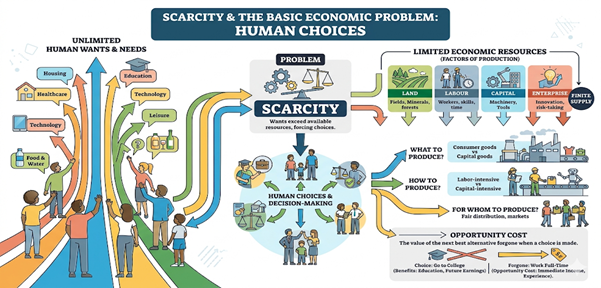
Figure 2. Scarcity and Human Nature
Source: Author’s Illustration
Figure 2 represents the fundamental economic problem, which is essentially a clash between human nature and physical reality. At the heart of human nature is the tendency for our desires to expand. As soon as one need is met (like food or water), we move on to higher-level wants (like technology, leisure, or education). We are inherently aspirational and rarely "satisfied" in a static sense. The reality is, the world has a fixed amount of land, labor, and capital. This imbalance creates scarcity, the central gear in the diagram that forces us to act. Because we cannot have everything, we are forced to be decision-makers. What to produce, how to produce, and for whom? We are constantly performing a "cost-benefit analysis," even if we do it subconsciously. Choosing one path means killing off another, which is why human decision-making is often fraught with hesitation or regret.
Scarcity increases the frequency of trade-off thinking. People in scarcity make more trade-offs in a single day than the wealthy make in a week. Every decision, what to buy, what to postpone, what to sacrifice, becomes a negotiation. This constant evaluation drains willpower and increases the likelihood of mistakes. Trade-off thinking is exhausting because it forces the mind to constantly calculate opportunity costs. But unlike economists, who calculate opportunity cost with numbers, humans calculate it with emotion. Every trade-off carries guilt, fear, or regret. The emotional burden compounds the cognitive burden. Scarcity also reduces working memory, the mental space used to hold and manipulate information. When the mind is overloaded, working memory collapses. This leads to forgetfulness, disorganization, and difficulty focusing. Again, these are not character flaws. They are cognitive consequences of scarcity. Working memory depletion explains why people under pressure often struggle with tasks that require planning, sequencing, or attention to detail. The mind simply does not have enough bandwidth to hold multiple pieces of information at once. Scarcity shrinks the mental workspace.
Another psychological effect of scarcity is the erosion of self-control. Willpower is not a fixed trait; it is a resource. And like any resource, it can be depleted. Scarcity drains willpower faster because the mind is constantly battling stress, uncertainty, and trade-offs. This makes people more vulnerable to impulsive decisions. This erosion of self-control is often misinterpreted as irresponsibility. But it is not irresponsibility; it is depletion. The mind under scarcity is fighting too many battles at once. Self-control becomes a luxury. Scarcity also affects identity. When resources are limited, people begin to internalize the scarcity. They start to see themselves as inadequate, incapable, or undeserving. This identity shift is dangerous because it creates a psychological loop: scarcity shapes identity, and identity shapes behavior, reinforcing the scarcity. This identity erosion explains why people in scarcity often feel shame, even when the scarcity is not their fault. Shame is not a rational response; it is an emotional consequence of feeling powerless. Scarcity makes people feel small, even when they are doing everything they can to survive.
Scarcity reduces the margin for error. When resources are abundant, mistakes are recoverable. But when resources are scarce, even small setbacks can be catastrophic. This increases anxiety and makes people more risk-averse. The fear of failure becomes overwhelming. This reduced margin explains why people in scarcity often avoid opportunities that could help them. The risk feels too high. The cost of failure feels unbearable. Scarcity creates a psychological environment where safety becomes more important than growth. Scarcity also affects relationships. When the mind is overloaded, people become less patient, less empathetic, and less emotionally available. This is not because they care less, but because they have less bandwidth to give. Scarcity shrinks emotional capacity. This emotional contraction can strain relationships, create misunderstandings, and increase conflict. People under scarcity often feel isolated, even when surrounded by others. The mind becomes too consumed by survival to fully engage with connection.
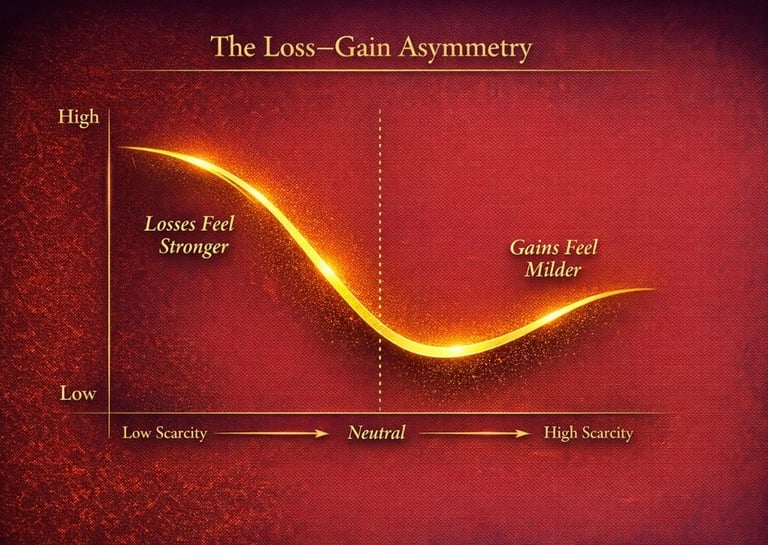
Decision-making through what psychologists call “loss framing.” When resources are limited, people become more sensitive to losses than gains, is also greatly influenced by scarcity. This makes human nature more cautious, more defensive, and more reactive. The mind becomes oriented toward avoiding loss rather than pursuing opportunity.
Figure 3. The Loss-Gain Asymmetry
Source: Author’s Illustration
In Figure 3, Loss–Gain Asymmetry describes the unequal weight the human mind assigns to losses and gains. In behavioral economics, this principle reveals that the pain of losing something is psychologically more severe than the pleasure of gaining something of equal value. This imbalance is not a flaw but an adaptive mechanism, a survival bias that evolved to protect us from risk. Yet in modern life, it often distorts perception, making us more reactive to threat than responsive to opportunity. When scarcity enters the picture, whether of time, money, or emotional bandwidth, this asymmetry intensifies. The mind becomes a defensive marketplace, where every decision is framed around avoiding loss rather than pursuing growth. Fear becomes the dominant currency. Even small setbacks feel amplified, while potential gains appear distant or uncertain. This shift explains why people under pressure often make conservative, short‑term choices that preserve stability but sacrifice progress.
Understanding loss–gain asymmetry allows leaders, educators, and thinkers to see how scarcity reshapes human behavior. It reminds us that rationality is not purely logical; it is emotional and contextual. When people feel secure, they think expansively. When they feel deprived, they think defensively. The challenge of transformation, personal or national, lies in reversing this framing: creating environments where opportunity feels safer than loss, and imagination becomes the most valuable asset in the human economy. This loss orientation explains why scarcity often leads to stagnation. People become trapped in a cycle of avoidance. They protect what little they have instead of reaching for more. The mind becomes a defensive economy.
Ultimately, scarcity is not just an economic condition; it is a psychological ecosystem. It affects attention, memory, emotion, identity, and behavior. It reshapes how people see themselves and the world. Understanding scarcity through this lens allows us to see human behavior with compassion rather than judgment. The central truth is this: scarcity is not a moral failure; it is a cognitive condition. It is the architecture of pressure built into the human mind when resources, time, or stability become limited. Scarcity reshapes perception, compresses attention, and forces the brain to operate in survival mode. It is not about weakness or irresponsibility; it is about bandwidth. When the mind is overloaded by uncertainty, it reallocates its energy toward immediate problems, leaving little room for imagination, empathy, or long‑term planning. The result is not moral collapse but cognitive contraction. Understanding this shift changes everything. It means that the antidote to scarcity is not judgment but design. Systems, policies, and personal strategies must be built to restore bandwidth, to give people the mental margin required for foresight and creativity. Stability is not a luxury; it is a cognitive resource. Predictability, safety, and time are the infrastructure of human potential. When we design environments that reduce cognitive load, we do more than help people survive; we enable them to think expansively again.
Scarcity shrinks the mind, but stability expands it. When the mind expands, it begins to see options instead of obstacles, patterns instead of chaos, and futures instead of fears. Expansion is not just psychological; it is generative. It allows human intellect to reconnect with its natural state: curiosity, innovation, and compassion. A stable mind is not passive; it is creative. It is capable of building, imagining, and transforming. And that is the moral pivot of this idea: human potential is not lost under scarcity, it is hidden. When we restore cognitive space, we do not give people new abilities; we reveal the ones that were always there. Scarcity may distort the lens, but it never destroys the light. The task of society, leadership, and design is to widen that lens, to create conditions where the mind can breathe, and where the future becomes visible again. When cognitive pressure decreases, people regain the ability to plan, imagine, and choose with intention. Loss aversion still shapes behavior, losses continue to loom larger than gains (Tversky & Kahneman, 1979), but the emotional intensity of those losses becomes manageable rather than overwhelming. Under stable conditions, the mind shifts from defensive decision‑making to opportunity‑oriented thinking (Zhao & Tomm, 2018).
In the end, the great revelation of this series is simple but transformative: human behavior is not random, irrational, or mysterious. It is patterned. It is shaped. It is influenced by the invisible economics of the mind, the incentives, scarcities, biases, and emotional markets that govern how people think, choose, and act. When we understand these internal forces, we stop treating behavior as a moral verdict and begin seeing it as a response to conditions. People are not broken; the environments around them are misaligned with how the mind actually works. Scarcity, in all its forms, is the clearest example. It does not diminish character; it diminishes bandwidth. It compresses attention, narrows imagination, and forces the mind into short‑term survival mode. But when stability returns, the mind expands again. Possibility reappears. Creativity resurfaces. The internal economy reopens. This is the central truth: human potential is not destroyed by scarcity; it is simply hidden beneath the weight of it. The central truth is this: scarcity is not a moral failure; it is a cognitive condition. Research shows that when resources run thin, the mind shifts into a compressed state where attention narrows, and executive function declines (Mani et al., 2013; Shah et al., 2012). Scarcity reshapes perception, not character. It forces the brain to prioritize immediate threats over long‑term goals, creating what Mullainathan and Shafir (2013) describe as a “tunneling effect” that consumes mental bandwidth. This is not about irresponsibility; it is about cognitive load (Baumeister, 2002).
The task of leadership, policy, education, and design is to create conditions where human potential can breathe. Potential is not unlocked by pressure or scarcity; it is unlocked by environments that give the mind room to operate at its full capacity. Systems must be intentionally built to reduce cognitive load, restore margin, and widen the mental field. This is not a luxury of advanced societies; it is the foundation of any society that expects people to think clearly, act wisely, and contribute meaningfully. When people have time, safety, and emotional liquidity, they make better choices and decisions. Not because they suddenly become different people, but because they finally have the bandwidth to be themselves. Bandwidth is the invisible currency of human functioning. Without it, even the most capable individuals shrink into reactive versions of themselves. With it, they regain the ability to plan, reflect, empathize, and imagine. This is why stability is not just a social good; it is a cognitive resource. It is the mental oxygen that allows the prefrontal cortex, the seat of judgment, foresight, and self-regulation, to come back online. Stability gives the mind the space to shift from survival mode to generative mode. It transforms decision-making from impulsive to intentional, from short-term to strategic, from fear-driven to possibility-driven.
Stability is also the infrastructure of human flourishing. Just as roads, power grids, and clean water systems enable physical life, cognitive infrastructure enables psychological life. Predictable routines, safe environments, supportive relationships, and clear information flows form the scaffolding that allows people to think expansively. Without this scaffolding, human potential collapses under the weight of constant vigilance and chronic uncertainty. The deeper truth is this: flourishing is not an individual achievement; it is a systemic outcome. People rise when the environments around them are designed to support clarity rather than chaos, margin rather than overload, and coherence rather than fragmentation. Leadership that understands this does not merely manage people; it cultivates the conditions in which people can become fully human again.
Behavioral Economy Series Part 1 ends where it began: with the belief that understanding the mind is the first step toward transforming the world. When we see the psychological forces that shape behavior, we gain the power to design environments that elevate rather than constrain. We learn to build systems that honor how humans actually think, feel, and decide. And in doing so, we make space for something rare, a future where human potential is not an exception, but an expectation. The economy within is vast. When it is nurtured, the world outside changes with it.
This journey has also revealed a deeper truth, one that traditional economics has never fully accounted for. Humans do not live by optimization alone. We do not wake up each day seeking to maximize utility in the mathematical sense. We seek meaning, coherence, dignity, belonging, and purpose. We chase stories that make our lives feel whole. We pursue futures that feel worth living. The internal economy is not governed by numbers; it is governed by narrative. And narrative, unlike currency, cannot be measured, only understood. This is where the next chapter begins. If scarcity shows us how the mind contracts, meaning shows us how it expands. If behavioral economics explains why people struggle under pressure, the next frontier explains why they rise when given purpose. The question is no longer just why humans deviate from rational models, but why humans transcend them. Why do we sacrifice for ideals? Why do we choose identity over efficiency? Why do we endure hardship for the sake of something larger than ourselves?
This Series continues with Part 2: Utility Beyond Numbers: Why Humans Chase Meaning, Not Maximization, an exploration of the emotional, psychological, and existential forces that shape human value. It is an inquiry into the deeper calculus of the human condition: why we choose what we choose, not because it is optimal, but because it is ours. If the Behavioral Economy Series mapped the architecture of the mind, the next Part maps the architecture of the soul, the place where meaning is made, and where the true economy of human life unfolds.
References
1. Baumeister, R. F. (2002). Ego depletion and self-control failure: An energy model of the self’s executive function. Self and Identity, 1(2), 129–136.
2. Haushofer, J., & Fehr, E. (2014). On the psychology of poverty. Science, 344(6186), 862–867.
3. Kahneman, D. (2011). Thinking, fast and slow. Farrar, Straus and Giroux.
4. Mani, A., Mullainathan, S., Shafir, E., & Zhao, J. (2013). Poverty impedes cognitive function. Science, 341(6149), 976–980.
5. Mullainathan, S., & Shafir, E. (2013). Scarcity: Why having too little means so much. Times Books.
6. Shah, A. K., Mullainathan, S., & Shafir, E. (2012). Some consequences of having too little. Science, 338(6107), 682–685.
7. Tversky, A., & Kahneman, D. (1979). Prospect theory: An analysis of decision under risk. Econometrica, 47(2), 263–291.
8. Vohs, K. D. (2013). The psychological consequences of money scarcity. Current Directions in Psychological Science, 22(3), 169–175.
9. Zhao, J., & Tomm, B. (2018). Psychological responses to scarcity. In Oxford Research Encyclopedia of Psychology. Oxford University Press.
10. Psychology Today. (n.d.). Scarcity psychology: Must we compete for the good things in life? https://www.psychologytoday.com
© 2026 Enoma Ojo. All rights reserved.
No part of this series may be reproduced, distributed, or transmitted in any form or by any means without prior written permission from the author, except for brief quotations used in reviews or scholarly work.