The Poverty Trap: Why Small Barriers Create Lifelong Disadvantages
This investigation exposes the hidden mechanics of poverty, not through dramatic collapse, but through the quiet erosion of time, dignity, and opportunity. It reveals how poverty is engineered not only by lack of money, but by the accumulation of tiny frictions: the missed bus that costs a job, the delayed paperwork that blocks access to aid, the confusing form that shuts someone out of a program designed to help them. These are not isolated incidents; they are systemic design flaws that disproportionately affect the poor. For those with resources, setbacks are temporary. For those without, every delay compounds. Bureaucratic hurdles, unreliable transportation, and digital exclusion create a “time tax” that drains hours from the lives of low-income individuals, hours that could be used to work, rest, or plan. This time loss translates into lost income, missed opportunities, and chronic instability.
enoma ojo (2023)
1/24/20267 min read


Poverty rarely begins with dramatic events; instead, it grows from small, persistent frictions that accumulate over time. These everyday obstacles, missed buses, delayed documents, unexpected fees- shape people’s lives long before major crises appear. For individuals with financial stability, small setbacks are temporary inconveniences. But for those living on the margins, these same setbacks can derail progress for months or even years, creating a cycle that is difficult to escape. Poverty functions as a system, not a single condition. It is built from layers of small disadvantages that compound over time, forming an invisible architecture that limits opportunity and mobility. One of the most damaging elements of this system is the “time tax.” Low‑income individuals lose hours each week to slow bureaucracies, unreliable transportation, and long queues, time that could otherwise be used for work, rest, or planning. These time losses translate directly into lost income and missed opportunities. When every hour matters, a two‑hour delay can mean losing a job, missing a class, or falling behind on essential tasks. Financial frictions deepen the trap. The poor often pay more for basic goods and services due to a lack of access to credit, bulk purchasing, or affordable transportation. This “poverty premium” forces them to spend more simply because they have less. Information gaps also play a major role. Without reliable internet, clear guidance, or access to networks, people miss deadlines, misunderstand requirements, or fail to access programs designed to help them.
These gaps are intensified by the digital divide, which leaves many low‑income households without the tools needed to navigate modern systems. A single missed message or misunderstood instruction can close the door to opportunity. The emotional and cognitive load of poverty further compounds these barriers. Constant stress reduces mental bandwidth, making it harder to plan, make decisions, or respond effectively to setbacks. Over time, these small barriers accumulate into lifelong disadvantages. In education, missed school days due to fees or transportation issues reduce long‑term academic performance and future earnings. In employment, unreliable transportation, lack of childcare, and untreated health issues push people into unstable, low‑wage work. These jobs offer little security and few pathways to advancement. Health challenges deepen the cycle. Without affordable healthcare, minor illnesses become major crises. Medical expenses are one of the leading causes of downward mobility, pushing families deeper into poverty. These disadvantages do not end with one generation. Children inherit the structural barriers their parents face, making poverty a predictable outcome rather than a personal failure. The belief that “hard work” alone can break the poverty trap ignores the reality of these structural barriers. Effort matters, but it cannot overcome systems designed with friction, inequality, and exclusion built into their foundations.
The poverty trap is not a marginal issue affecting a small segment of humanity; it is a global reality shaping the lives of hundreds of millions. According to the most recent World Bank (2025) estimates, approximately 692 million people around the world live below the international poverty line of $3.00 per day. This number represents not just a statistic but a vast population navigating daily life with almost no margin for error. When the World Bank updated the poverty threshold to $3.00 per day in 2025 to reflect rising costs and new purchasing‑power data, early estimates suggested that the true number of people living in poverty is likely well above 800 million. This means nearly a billion human beings are living in conditions where a missed bus, a medical bill, or a bureaucratic delay can determine whether they eat, work, or survive. These numbers matter because they reveal the scale of the structural problem. Poverty is not an individual failure; it is a global system of exclusion. And the same small barriers that trap families in Lagos, Nairobi, Dhaka, or Rio are replicated across continents. The poverty trap is not local; it is universal. It is the architecture of inequality reproduced at a planetary scale.
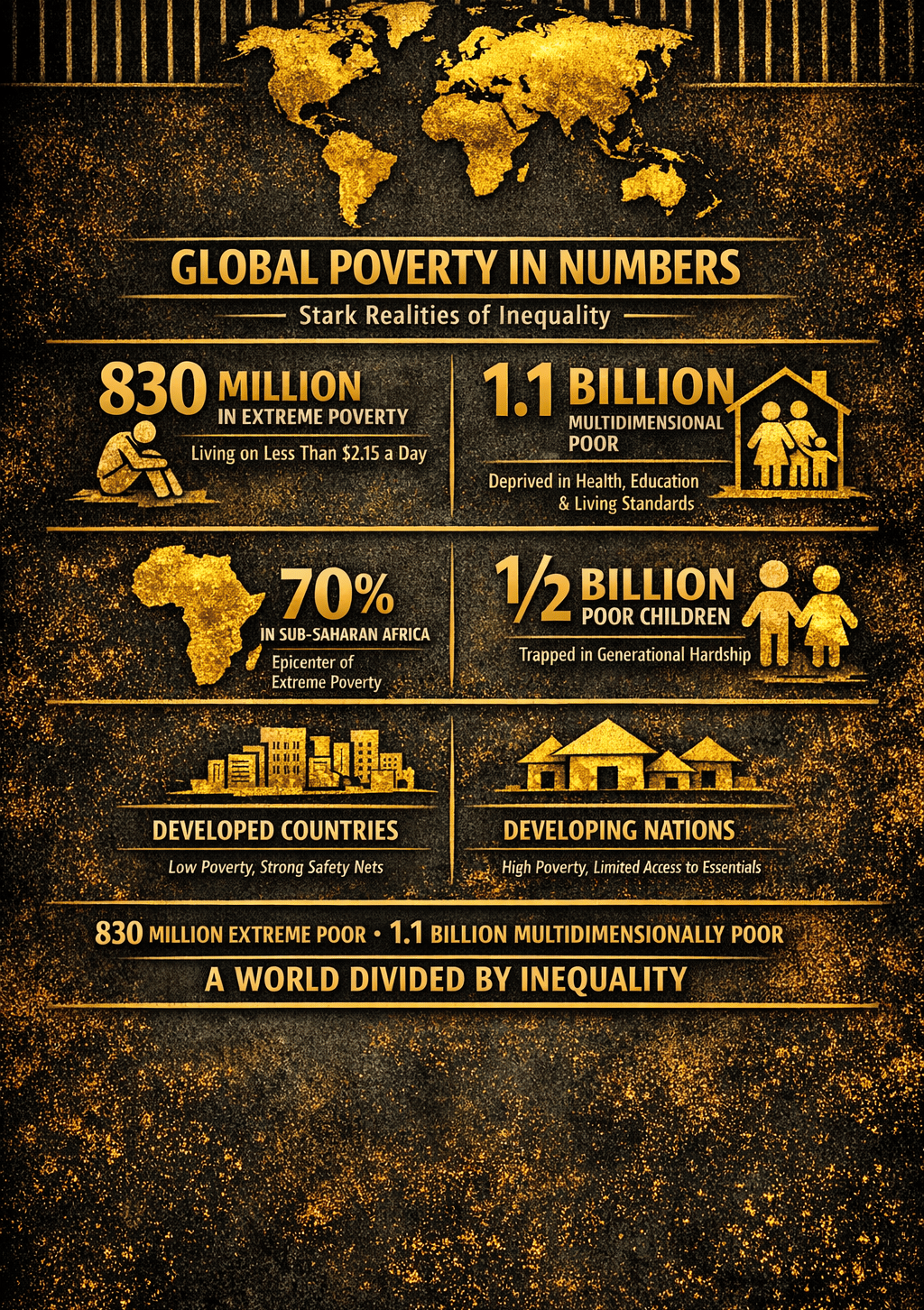
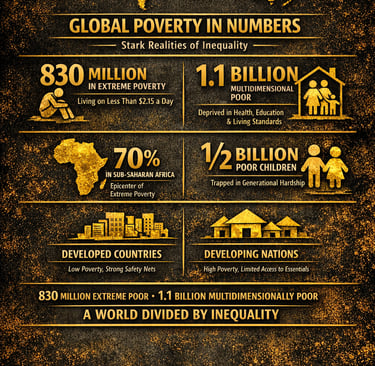
The world today faces a poverty crisis that is both vast and deeply uneven. According to the latest global estimates, over 830 million people live in extreme poverty, surviving on less than the international poverty line. This number represents not just a statistic but a global reality in which millions struggle daily for food, shelter, and basic security. Despite decades of progress, the pace of poverty reduction has slowed significantly, especially in regions affected by conflict, climate shocks, and economic instability.
Beyond income poverty lies a deeper and more complex reality: multidimensional poverty. The UNDP’s Multidimensional Poverty Index (MPI) shows that 1.1 billion people across 109 developing countries experience overlapping deprivations in health, education, nutrition, sanitation, and living standards. This means that even when income rises slightly, millions still lack the foundational conditions needed to live with dignity. More than half a billion of the multidimensionally poor are children, revealing how poverty is inherited long before adulthood.
Global poverty rates vary sharply by region. Sub‑Saharan Africa remains the epicenter, home to over 70% of the world’s extreme poor. South Asia, while making significant progress, still accounts for hundreds of millions living in deprivation. In contrast, poverty rates in East Asia, Latin America, and the Middle East have declined unevenly, often rising again during economic downturns or political instability. The global average masks these regional disparities, hiding the fact that poverty is increasingly concentrated in fragile and conflict‑affected states.
The contrast between developed and developing nations is stark. In high‑income countries, extreme poverty is statistically rare, and multidimensional poverty is minimal due to strong social safety nets, universal education, and robust healthcare systems. Meanwhile, in low‑income countries, poverty is not only widespread but structurally embedded. Limited access to quality schools, healthcare, clean water, and stable employment creates a cycle where small disadvantages compound into lifelong barriers.
One of the most striking differences between developed and developing nations is the rate at which people escape poverty. In wealthy countries, upward mobility is supported by institutional stability, predictable markets, and accessible public services. In developing nations, however, even minor shocks, a medical bill, a drought, a job loss, can push families back into poverty for years. This vulnerability is a defining feature of the global poverty landscape.
Multidimensional poverty also reveals how deprivation clusters. In developing nations, a child may be simultaneously undernourished, out of school, and living without electricity or sanitation. These overlapping disadvantages create a poverty trap that is far more difficult to escape than income poverty alone. In contrast, poor households in developed nations typically face fewer simultaneous deprivations, allowing targeted interventions to be more effective.
The global comparison also highlights the role of governance and public investment. Countries that have invested in digital identity systems, universal education, primary healthcare, and social protection have seen dramatic reductions in poverty. Meanwhile, nations with weak institutions, corruption, or political instability struggle to deliver even basic services. The divide is not simply economic; it is structural, institutional, and systemic.
Ultimately, global poverty is not just a matter of income but of opportunity, access, and resilience. The world’s poorest populations face a web of disadvantages that begin at birth and often persist across generations. Understanding the scale, 830 million in extreme poverty, 1.1 billion multidimensionally poor, and poverty rates that diverge sharply between developed and developing nations, is essential for shaping policies that address not only what people earn, but what they can become. Poverty is not inevitable; it is the result of systems that can be redesigned, rebuilt, and reimagined.
Breaking the poverty trap requires structural justice, reducing frictions, expanding safety nets, and investing in human dignity. When society removes the hidden barriers that exhaust the poor, opportunity becomes a right rather than a privilege, and mobility becomes possible for all. Poverty is not simply a lack of money; it is a lack of margin. A lack of room to breathe, to fail, to recover, to dream. When small barriers accumulate, they strip people of dignity long before they strip them of opportunity. And when society treats these barriers as personal failures rather than structural design flaws, injustice becomes invisible. Breaking the poverty trap requires more than charity or motivational slogans. It demands a commitment to structural justice, removing the hidden frictions that make ordinary life exhausting for some and effortless for others. Opportunity should not depend on luck, geography, or the ability to navigate broken systems. It should be a birthright rooted in dignity.
In the end, poverty is not a mystery, and it is not a moral failing. It is a predictable outcome of systems designed with friction, delay, and exclusion built into their foundations. People do not remain poor because they lack ambition or discipline; they remain poor because the path out is littered with obstacles that wealthier people never have to see, let alone overcome. Every missed bus, every denied form, every unexpected fee, every hour lost in a queue is a reminder that the world is not structured for everyone equally. If society truly wants mobility, it must stop demanding superhuman resilience from those who already carry the heaviest burdens. Justice begins with removing the small, grinding barriers that steal time, dignity, and opportunity from millions. It begins with recognizing that fairness is not achieved by telling people to “work harder,” but by ensuring that their hard work is not constantly undermined by broken systems.
The poverty trap is not inevitable. It is engineered, and anything engineered can be redesigned. When we choose to build systems that honor human dignity, reduce friction, and expand opportunity, we do more than fight poverty. We create a society where people can rise not because they are lucky, but because the structure itself is fair. That is the work of justice. That is the work of a society that believes in its people.
References
1. Banerjee, A. V., & Duflo, E. (2011). Poor economics: A radical rethinking of the way to fight global poverty. PublicAffairs.
2. Mullainathan, S., & Shafir, E. (2013). Scarcity: The new science of having less and how it defines our lives. Times Books.
3. Chetty, R., Hendren, N., Kline, P., & Saez, E. (2014). Where is the land of opportunity? The geography of intergenerational mobility in the United States. Quarterly Journal of Economics, 129(4), 1553–1623.
4. Desmond, M. (2016). Evicted: Poverty and profit in the American city. Crown.
5. Haushofer, J., & Fehr, E. (2014). On the psychology of poverty. Science, 344(6186), 862–867.
6. Kahneman, D. (2011). Thinking, fast and slow. Farrar, Straus and Giroux.
7. World Bank. (2015). World Development Report 2015: Mind, society, and behavior. World Bank Publications.
8. Enoma Ojo. (2026). The Poverty Trap: Why Small Barriers Create Lifelong Disadvantages. Inquiry & Insight.
© 2026 Enoma Ojo — All rights reserved.