The Mind and Power (Human Mind Series part 10)
This article explores the hidden architecture of the human mind by examining how we negotiate power, carry pressure, and navigate the forces that shape our inner world. It reveals that power is not merely influence, it is perception, clarity, and the ability to act with intention. Pressure, in contrast, exposes what we can withstand and what we must release. Together, these forces uncover a deeper truth: we are shaped not only by what we control, but by what we carry. This piece closes Part 10 of the Human Mind Series and opens the door to Part 11, The Psychology of Change, where the mind’s capacity for transformation takes center stage.
enoma ojo
3/28/20268 min read


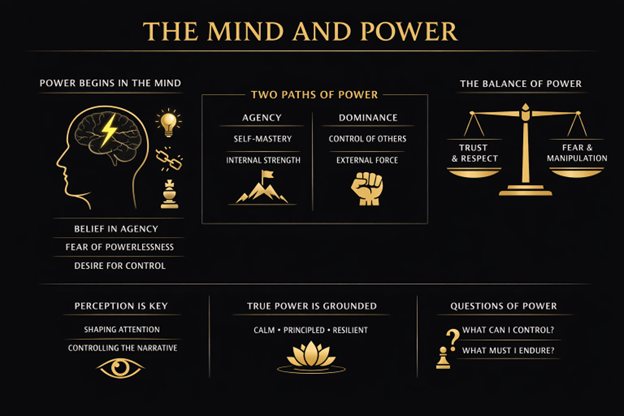
Power does not announce itself with noise. It enters the mind quietly, like a shift in temperature, subtle at first, then unmistakable. You feel it before you name it. A tightening in the chest. A sharpening of attention. A sudden awareness of what is possible, and what is at stake. Most people think power begins in the world, in titles, positions, wealth, or influence. But the truth is simpler and far more unsettling: Power begins in the mind, long before it ever appears in public. It begins the moment a person realizes they can shape an outcome. It begins the moment they recognize they can say no, or yes, and that their choice will alter the path ahead. It begins the moment they understand that their voice, their presence, their decisions carry weight, and once the mind recognizes its own capacity to influence reality, everything changes, and most importantly, it is about the truth that every society, every relationship, every institution, and every individual must eventually confront.
Power without trust becomes violence. Trust without power becomes vulnerability. Part 10 begins here, at the intersection of influence and identity, where the mind decides not only what it can do, but who it will become when it does it. Power begins long before it becomes visible. It starts as a quiet shift inside the mind, a subtle recognition that one’s choices matter, that one’s presence carries weight, that one’s voice can alter the direction of events. Before power becomes a structure, a title, or an institution, it is first a psychological awakening.
Most people misunderstand power because they only see its external expressions: authority, influence, dominance, and control. But these are merely the shadows cast by something deeper. The true origin of power is internal, a belief about one’s capacity to act, to resist, to shape, or to endure. Power is a mental posture before it is a social position. This internal posture is shaped by early experiences. A child who is heard learns that their voice matters. A child who is dismissed learns that silence is safer. A child who is punished for initiative learns that power is dangerous. A child who is rewarded for agency learns that power is a possibility. These early lessons become the architecture through which adults interpret influence.
Power is also shaped by fear, specifically, the fear of powerlessness. Few experiences destabilize the mind more than the sense that one has no control over what happens next. Powerlessness creates anxiety, hypervigilance, and a desperate search for anchors. It is not surprising that many people pursue power not out of ambition, but out of self‑protection. But the pursuit of power can take two forms: the pursuit of agency and the pursuit of dominance. Agency is the desire to shape one’s own life. Dominance is the desire to shape the lives of others. Agency is rooted in self‑respect. Dominance is rooted in insecurity. Agency builds stability. Dominance builds fear.
The mind that seeks agency becomes stronger. The mind that seeks dominance becomes fragile. This is the paradox: the more a person relies on controlling others to feel powerful, the weaker their internal foundation becomes. Their power depends on compliance, not confidence. Their influence depends on fear, not respect. Greene (1998), a psychologist and strategists have long noted this internal dimension of power. Robert Greene, whose work examines historical patterns of influence, argues that power is less about force and more about perception, emotional discipline, and the ability to shape context. His viewpoint reinforces the idea that the mind negotiates power long before the world recognizes it.
True power, therefore, is not the ability to force outcomes; it is the ability to remain grounded regardless of outcomes. It is the capacity to stay centered when circumstances shift. It is the strength to choose rather than react. It is the discipline to act without being driven by fear, ego, or insecurity. But power does not exist in isolation. It is always relational. Every relationship, personal, professional, or political, contains a power dynamic. The question is not whether power is present, but how it is used. Power can protect or exploit. It can elevate or diminish. It can create safety or create fear.
This is where trust reenters the conversation. Trust and power are not opposites; they are interdependent forces. Trust determines whether power is accepted. Power determines whether trust is safe. When trust and power reinforce each other, relationships become strong. When they contradict each other, relationships fracture. Power without trust becomes coercion. It forces compliance rather than earning cooperation. It creates silence rather than openness. It produces obedience rather than commitment. People may follow, but they do so out of fear, not respect. And fear is the most unstable foundation for influence.
Keltner et al.'s (2003) research shows that as individuals gain power, their capacity for empathy often decreases, making it harder to perceive the emotional states of others. This reduction in empathic attunement is not simply a behavioral shift; it reflects measurable changes in the brain’s approach–inhibition system, which becomes more activated in states of power and less responsive to social cues. As a result, powerful individuals may overlook subtle emotional signals, underestimate the needs of others, or misinterpret intentions, creating a widening psychological distance between themselves and the people they lead. This distance can destabilize trust, because trust depends on emotional awareness, reciprocity, and the ability to accurately read another person’s internal state.
Trust without power becomes vulnerability. It exposes a person to manipulation, exploitation, and disappointment. It creates openness without protection. It invites connection without boundaries. And while trust is essential for human connection, trust without agency becomes a form of self‑abandonment. Healthy power requires balance, the ability to hold influence without abusing it, and the ability to trust without surrendering autonomy. This balance is rare because it requires emotional maturity, self‑awareness, and the discipline to confront one’s own insecurities.
Azab (2020) explains that power alters brain function, reducing empathy and increasing psychological distance. This neurological shift is not merely behavioral; it is structural. When individuals gain power, the brain’s mirror neuron system, which supports empathy and social attunement, becomes less active. The result is a diminished capacity to perceive others’ emotions, intentions, and vulnerabilities. Power, in this sense, does not just change how people act — it changes how they feel, how they see, and how they connect. Azab’s findings reinforce the central thesis of this chapter: that power is not only a social force, but a cognitive transformation — one that reshapes perception, rewires emotional regulation, and redefines the boundaries of human connection. Eisenberger’s (2012) research reveals that the human brain does not treat social rejection, betrayal, or loss of trust as abstract emotional events; it processes them as pain. Her work shows that the same neural circuits activated during physical injury, particularly the dorsal anterior cingulate cortex and anterior insula, are also activated when trust is broken or when individuals experience exclusion or disconnection. This means that violations of trust are not merely psychological; they register as a form of neurological harm. In the context of power, this becomes especially significant: when power is used carelessly, unpredictably, or coercively, it can trigger these social pathways, creating long‑lasting emotional and cognitive consequences. Eisenberger’s findings underscore a central truth of this chapter, that trust is not just a social preference but a biological necessity, and when power disrupts it, the brain responds as if the body has been wounded.
The mind is always negotiating power, even in moments that appear quiet or ordinary. Beneath every decision, every hesitation, every surge of confidence or doubt, the mind asks four fundamental questions: What can I control? What must I accept? Where must I adapt? Where must I resist? These questions operate like an internal compass, shaping behavior long before logic or personality enter the scene. A person who believes they can control nothing drifts toward passivity, not because they lack intelligence, but because their internal map tells them the world is fixed and unchangeable. A person who believes they must control everything becomes aggressive, not because they are strong, but because fear drives them to dominate what they cannot trust. And a person who learns to distinguish between what is theirs to influence and what is beyond their reach becomes grounded, not by accident, but through psychological clarity. This internal negotiation is the true architecture of power. It determines how people respond to pressure, how they interpret threats, how they navigate relationships, and how they carry themselves in the world. Long before power becomes external, a title, a role, a position, it is internal: a pattern of perception, a way of interpreting reality, a stance toward uncertainty. And it is this inner stance, more than intelligence, personality, or circumstance, that shapes who rises, who collapses, and who remains steady.
In institutions, power becomes formalized. Titles, roles, and hierarchies create predictable structures of influence. But even here, the psychological dimension remains. A leader who lacks internal stability will misuse authority. A leader who possesses internal stability will use authority responsibly. The title does not create the leader; the mind does. Societies legitimize power through laws, norms, and shared beliefs. But legitimacy is fragile. When people believe power is fair, they cooperate. When they believe power is corrupt, they resist. The stability of any system depends not on force, but on perceived fairness, a psychological contract between the governed and the governing. This is why revolutions begin in the mind long before they begin in the streets. People revolt when they no longer believe that existing power structures serve them. They revolt when the psychological contract breaks. They revolt when the gap between authority and legitimacy becomes too wide to ignore. On a personal level, power shapes identity. People with healthy power develop confidence, boundaries, and clarity. People with unhealthy power develop entitlement, arrogance, and fragility. People without power develop resentment, fear, or learned helplessness. Power is not just a social force; it is a psychological mirror.
This is where Part 10 ends and Part 11 begins. If power is the mind’s relationship to influence, pressure is the mind’s relationship to weight. Power asks, “What can I do?” Pressure asks, “What can I withstand?” One measures our reach; the other measures our resilience. One expands our world outward; the other tests the world we have built within.
Together, they reveal a deeper truth at the center of the human mind: we are shaped not only by what we control, but by what we carry. The responsibilities we shoulder, the expectations we navigate, the burdens we refuse to collapse under, these forces sculpt identity just as much as ambition, talent, or opportunity. Power shows us who we are when we act. Pressure shows us who we are when life acts upon us, and it is in the tension between these two forces, influence and endurance, that the architecture of the self is exposed. Some people rise under power but break under pressure. Others shrink under power but become unshakeable when the weight increases. A rare few learn to hold both: the clarity to act and the strength to endure. These are the individuals who become steady, grounded, and internally sovereign. But the story does not end with power or pressure. There is a third force, quieter, deeper, more transformative, that determines whether a person remains who they have always been or becomes someone new. That force is change.
In the end, the story of the human mind is not written only in moments of triumph or authority, but in the quiet, unseen negotiations between power and pressure. It is written in the choices we make when no one is watching, in the burdens we carry without applause, and in the strength we discover only when life demands more than we expected. True resilience is not the absence of strain; it is the ability to remain whole under its weight. True power is not domination; it is clarity, steadiness, and the disciplined use of influence. When we understand both forces, what we can shape and what shapes us, we step into a deeper form of mastery. Not the mastery of the world, but the mastery of the self. And that is where every meaningful transformation begins. Power shapes what we reach for. Pressure shapes what we can hold. But change, the force waiting in the Part Series, shapes who we ultimately become.
References
1. Greene, R. (1998). The 48 laws of power. Penguin Books.
2. Gruenfeld, D. (2022). The psychology of power & influence. Stanford Graduate School of Business.
3. Azab, M. (2020). The brain under the influence of power. Psychology Today.
4. Aanstoos, C. M. (2023). Power and social psychology. EBSCO Research Starters.
5. Weber, M. (1978). Economy and society: An outline of interpretive sociology. University of California Press.
6. Foucault, M. (1980). Power/knowledge: Selected interviews and other writings. Pantheon Books.
7. Keltner, D., Gruenfeld, D. H., & Anderson, C. (2003). Power, approach, and inhibition. Psychological Review, 110(2), 265–284.
8. Galinsky, A. D., Magee, J. C., Inesi, M. E., & Gruenfeld, D. H. (2006). Power and perspectives not taken. Psychological Science, 17(12), 1068–1074.
9. Eisenberger, N. I. (2012). The pain of social disconnection: Examining the shared neural underpinnings of physical and social pain. Nature Reviews Neuroscience, 13(6), 421–434.
© 2026 Inquiry & Insight — Enoma Ojo. All rights reserved.
This article is original intellectual property. No portion may be copied, reproduced, or republished without explicit written consent.