
The Internal Economics of Certainty
Every day, the mind performs its most convincing act: the feeling that you are in control. You plan, you decide, you steer. But beneath that surface, a far more complex negotiation is taking place, between instinct and intention, between pattern and presence, between what you think you chose and what was chosen for you long before you arrived. Drawing on foundational research in cognitive psychology and behavioral science, this piece explores why the brain manufactures the experience of control, what happens when we cling to it too tightly, and the quiet revolution that begins when we learn to hold our plans loosely. It is a meditation on uncertainty, not as the enemy of wisdom, but as its birthplace. If you have ever felt the weight of needing everything to go according to plan, this reflection is for you.
REFLECTIONS
enoma ojo (2026)
4/18/20266 min read
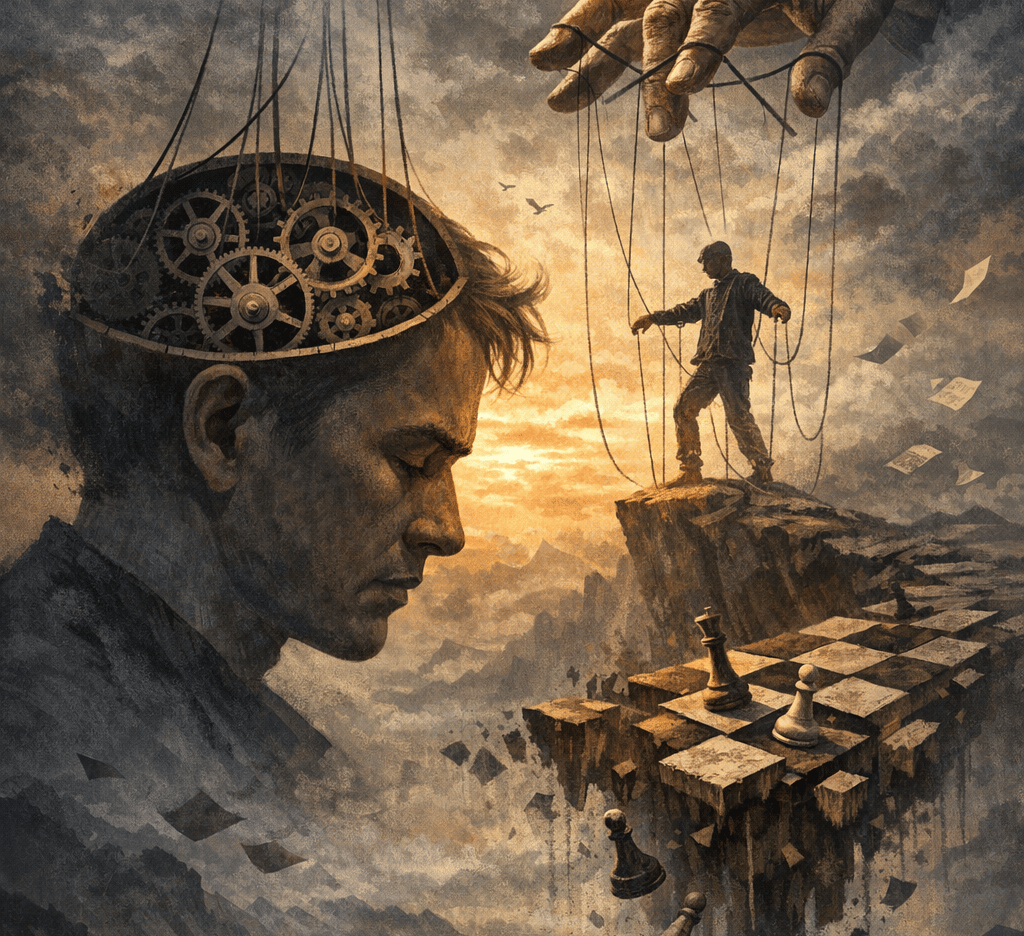
We wake each morning and reach for the day as though it belongs to us. We set alarms, draft plans, arrange our hours into neat architectures of intention, and in doing so, we convince ourselves that we are the authors of what comes next. There is a quiet certainty in this ritual, a faith so deep it rarely announces itself: the belief that we are in control. That our choices carve the path. That our will shapes the outcome. But what if this feeling, this steady, comforting hum of agency, is the mind's most elegant performance? What if the sensation of steering is itself the illusion, and the wheel we grip so tightly is connected to nothing at all? This is not a question designed to unsettle. It is an invitation to look closer. Because the illusion of control is not a flaw in human cognition, it is, perhaps, its greatest masterpiece, a story so well told that the storyteller forgets it is fiction. This internal economics of certainty is just an illusion.
The architecture of this illusion is breathtaking in its precision. Neuroscience has begun to pull back the curtain, and what it reveals is humbling. Studies in brain imaging have shown that neural activity associated with a decision can precede conscious awareness of that decision by several seconds. The brain decides. Then it tells you that you decided. The sequence is inverted from what we assume; we do not think and then act; we act, and then construct the narrative of deliberate thought around the action. The mind does not hand us the reins; it hands us a screenplay, already written, and lets us believe we are improvising. We are not the directors of our inner lives. We are the narrators, arriving after the scene has already been shot, adding voiceover to footage we did not film. This is not to say that consciousness is meaningless, far from it. But its role is different from what we imagine. It is less a command center and more an editing room, where raw experience is shaped into a coherent story, and the story it tells, above all others, is this: you are in charge.
If we are honest, truly, unflinchingly honest, we do not control our thoughts. We negotiate with them. Sit quietly for sixty seconds and observe what arises. A fragment of a song. A flash of worry. A memory you did not summon. An impulse that seems to come from nowhere and everywhere at once. The mind is not a command center with a single authority issuing orders from above. It is a negotiation table, crowded and noisy, where impulses, memories, fears, desires, and half-formed intuitions all arrive uninvited, each claiming urgency, each demanding attention. Consciousness does not rule this assembly. It mediates. It listens. It chooses, not with the absolute power of a king, but with the careful discernment of a diplomat navigating competing interests. And here lies a quiet, radical truth about the art of living: it is not found in controlling the mind. It is found in learning which voices to honor and which to let pass. The thought that arrives is not yours to prevent. But the thought you follow, that is where your freedom lives. Not in silencing the noise, but in choosing which note to carry forward into the world.
There is a cost to gripping the illusion too tightly, and it is steep. When we insist on control, truly insist, with white knuckles and clenched jaw, something inside us hardens. Anxiety is, at its root, the distance between what we demand of reality and what reality delivers. The more rigid our need for certainty, the more brittle we become. The paradox is devastating in its simplicity: the tighter we hold, the more we break. A clenched fist cannot receive. A mind that insists on knowing the outcome before taking the step will eventually stop stepping altogether. We call this discipline. We call it preparedness. But strip away the noble language and what remains is fear, raw, unadorned fear of uncertainty, dressed in the uniform of control. The person who must control every variable is not strong; they are afraid. And the tragedy is not the fear itself, which is human and understandable, but the way the pursuit of control slowly closes every door through which surprise, wonder, and genuine transformation might enter. We build walls and call them plans. We construct rigidity and call it strength. And we wonder why, behind all that armor, we feel so profoundly fragile.
Surrender has been misunderstood. We have been taught to associate it with defeat, with weakness, with the white flag of a spirit that has given up. But there is another kind of surrender, one that requires more courage than control ever demanded. It is the surrender of the mind that can hold uncertainty without collapsing into panic. The mind that can say, I do not know what comes next, and still move forward. This is not passivity. This is presence. It is the ability to act without needing to know the outcome, to commit without guarantees, to step into the fog and call it courage rather than recklessness. The most extraordinary people are not those who have mastered certainty. They are those who have made peace with its absence. They carry their plans loosely, like lanterns rather than maps, enough light to see the next step, but no pretense of seeing the whole road. This is the highest form of intelligence: not the accumulation of answers, but the willingness to remain in the question. To stay open when every instinct screams to close down. To breathe in the space between knowing and not knowing, and to find, in that space, something that feels less like fear and more like freedom.
The internal economics of certainty does not confine itself to the individual mind. It scales. It builds institutions. It writes policy. It designs economies. Our civilizations are constructed on the premise that human behavior can be predicted, managed, and directed, that if we gather enough data, build enough models, write enough laws, we can engineer outcomes. And yet history, that great and unruly teacher, tells a different story. The most transformative moments in human civilization, the revolutions that reshaped nations, the innovations that redefined possibility, the awakenings that altered the course of thought. arose not from what was controlled, but from what no one predicted. The printing press was not part of a strategic plan. The fall of empires was not scheduled. The ideas that changed everything emerged from the margins, the accidents, the beautiful failures that no committee approved. Chaos is not the enemy of progress. It is its birthplace. The systems that endure are not those that eliminate uncertainty but those that learn to dance with it, adaptive, responsive, humble enough to be surprised. And the systems that shatter are invariably those that mistook their models for reality, their projections for prophecy, their control for truth.
So what does it mean to live with this awareness? Not as a philosophy to admire from a distance, but as a practice, a daily, breathing, embodied practice? It means holding your plans loosely. It means making the appointment and accepting that the day may have other ideas. It means trusting the process without demanding to see the destination, understanding that the most profound growth happens not when you are steering but when you are listening. It means catching yourself in the act of grasping, grasping for certainty, for approval, for the assurance that you have not made a mistake, and gently, without judgment, letting go. The mind that watches itself is performing an act of extraordinary courage. To observe your own thoughts without being consumed by them. To notice the impulse to control and choose, instead, to be curious. This is the invitation: not to abandon intention, not to drift aimlessly through your days, but to hold your intentions with open hands. To act with purpose while releasing your grip on outcomes. The freedom that control promises but never delivers, presence delivers. The mind that stops insisting on mastery and begins practicing awareness discovers something it could never have engineered: a peace that does not depend on circumstances, a steadiness that does not require certainty, a home that was always already there.
We began with a morning. The alarm sounds. The hand reaches. The day assembles itself around us, and we believe, as we have always believed, that we are the ones assembling it. The illusion of control is not something to destroy. You cannot wage war against a story the brain has spent millennia learning to tell. But you can see through it. And in the seeing, something shifts. It is subtle at first, a softening at the edges, a breath where there used to be a brace. You stop fighting the river. You stop clenching the fist. You notice the current and, for once, you let it carry you, not because you are weak, but because you have finally understood that the river was never your enemy. The water knows the way to the sea. You do not need to direct it. You need only to trust it. And so you breathe, and perhaps for the very first time, the mind, uncontrolled, unmastered, beautifully uncertain, feels like home.
References
1. Langer, E. J. (1975). The illusion of control. Journal of Personality and Social Psychology, 32(2), 311–328. https://doi.org/10.1037/0022-3514.32.2.311
2. Kahneman, D. (2011). Thinking, fast and slow. Farrar, Straus and Giroux.
3. Wegner, D. M. (2002). The illusion of conscious will. MIT Press. https://doi.org/10.7551/mitpress/3650.001.0001. MIT Press
4. Thompson, S. C. (1999). Illusions of control: How we overestimate our personal influence. Current Directions in Psychological Science, 8(6), 187–190. https://doi.org/10.1111/1467-8721.00044
5. Thompson, S. C., Armstrong, W., & Thomas, C. (1998). Illusions of control, underestimations, and accuracy: A control heuristic explanation. Psychological Bulletin, 123(2), 143–161. https://doi.org/10.1037/0033-2909.123.2.143
© 2026 Inquiry & Insight. All rights reserved.