
The Geography of Opportunity: Why Our Birthplace Still Shapes Our Future.
The Geography of Opportunity exposes a simple but uncomfortable truth: where we are born still determines how far we can go. This article unpacks the hidden architecture of opportunity, schools, safety, networks, environment, and early childhood conditions, and shows how these forces quietly shape life trajectories long before personal effort enters the story. It argues that mobility is not just about talent or ambition, but about the environments that either expand or restrict human potential.
INSIGHTS
Enoma Ojo (2023)
1/18/20266 min read
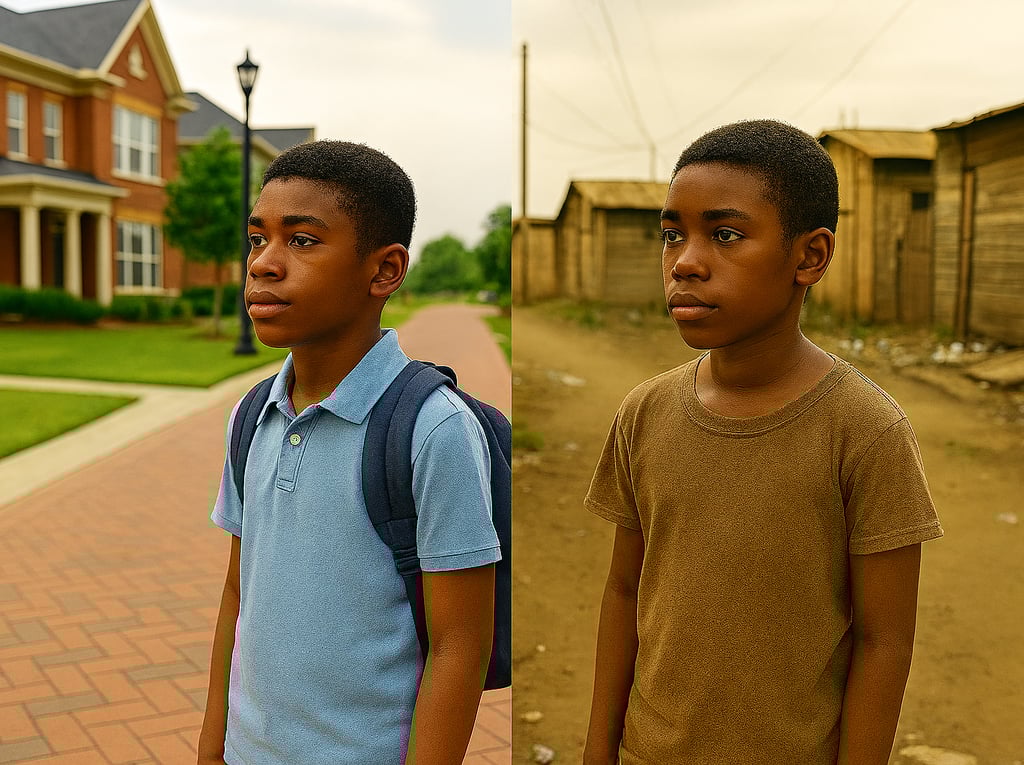
Adebayo Ogundare is the 4th child of a family of 6 children, born to Pa Samuel Ogundare of Ikorodu, Lagos, Nigeria. When Adebayo was eight, he used to sit on the cracked concrete steps outside his apartment in their low‑income neighborhood of Ikorodu, on the outskirts of Lagos, watching planes rise into the sky. He didn’t know where they were going, but he knew they were going somewhere else, somewhere with cleaner streets, quieter nights, and schools that didn’t close when the teachers did not show up for classes, or the roof of the school was blown away due to the rainstorm of the previous day. His mother was the popular neighborhood Akara seller. His father was gone, died 3 years ago from a preventable illness. His teachers rotated so often that he stopped learning their names. Yet every time a plane lifted off, he whispered the same sentence under his breath: “One day, I will rise too.”
Across the city, in Lekki, a gated community less than 15 kilometers away, another eight‑year‑old boy named Tunde Ajibola was learning to code on a tablet his school provided. His classroom had air‑conditioning, a library, and teachers who stayed long enough to know his strengths. His parents had degrees, networks, and the confidence that comes from believing the world will make room for your child. Tunde wasn’t dreaming of rising; he was being prepared for it.
Two boys. Same city. Same age. Same potential.
But two entirely different geographies of opportunity.
This is the uncomfortable truth societies avoid: where we are born still shapes who we become. Not because talent is unevenly distributed, but because opportunity is. The geography of opportunity is the invisible architecture that determines whether a child’s dreams are nurtured or neglected. It is the quiet force that shapes education, health, mobility, safety, and even a child’s sense of what is possible. We like to believe that hard work alone determines success. But the evidence is overwhelming: context precedes effort. A seed cannot choose its soil, yet its soil determines whether it grows.
Birthplace is not destiny, but it is a force. And force, when repeated across generations, becomes structure. Opportunity is not just about resources. It is about exposure, networks, expectations, and the psychological climate a child breathes long before they understand its meaning. A neighborhood can teach a child to expect possibility, or to expect disappointment. This is why geography becomes psychology. Psychology becomes behavior. Behavior becomes outcomes, and outcomes become the story society tells about who is “capable” and who is “not.” But the truth is simpler: people rise when their environment supports their rise. High‑opportunity environments create loops of advantage, access, encouragement, mobility, and reinforcement. Low‑opportunity environments create loops of constraint, scarcity, stress, limited exposure, and low expectations. These loops are not moral judgments. They are structural realities, and they begin with geography. Children who grow up in high‑opportunity neighborhoods earn up to 30% more as adults than those from low‑opportunity areas. Moving to a higher‑opportunity neighborhood before age 13 increases lifetime earnings by $200,000+ on average. Students in affluent neighborhoods receive up to $23,000 more per year in school funding than those in low‑income districts. Teacher turnover is 50% higher in low‑opportunity neighborhoods.
The U.S Census Bureau (2016) provides curated datasets on economic, demographic, and geographic indicators used to understand local opportunity patterns. Life expectancy can vary by 20–30 years between neighborhoods in the same city. Children in low‑opportunity areas are twice as likely to experience chronic stress before age 10. Exposure to neighborhood violence reduces academic performance by up to 10%. Children in unstable housing situations are three times more likely to fall behind in school. Access to professional networks increases job opportunities by up to 80%. Children from high‑opportunity neighborhoods are five times more likely to have mentors in professional fields. These numbers are not fate. They are designed, and design can be changed.
Rich and poor neighborhoods create fundamentally different starting points for children, shaping their development long before personal effort enters the picture. In affluent areas, children grow up with stability, safety, and access to high‑quality early childhood environments that reduce stress and support healthy brain development. In poorer neighborhoods, instability, environmental hazards, and chronic stress undermine cognitive growth and emotional regulation, forcing children to operate in survival mode rather than learning mode. Schools deepen this divide. Wealthier neighborhoods benefit from well‑funded schools, experienced teachers, smaller class sizes, and a wide range of enrichment programs that nurture curiosity and confidence. Poorer neighborhoods face underfunded schools, high teacher turnover, overcrowded classrooms, and limited resources, making it harder for children to receive the individualized attention and encouragement they need. The same child, with the same potential, will be accelerated in one environment and overlooked in the other.
Networks and exposure further widen the gap. Children in affluent neighborhoods grow up surrounded by professionals, mentors, and role models who open doors and expand their sense of what is possible. In low‑income neighborhoods, limited access to professional networks and fewer mentors restrict exposure to opportunity pathways. This difference in social capital shapes aspirations, career trajectories, and long‑term mobility. Ultimately, these environmental differences shape psychological climate, safety, and economic mobility. Rich neighborhoods reinforce confidence, high expectations, and long‑term planning, while poor neighborhoods often expose children to instability, violence, and lower institutional expectations. The result is a predictable pattern: affluent neighborhoods are designed to produce opportunity, while disadvantaged neighborhoods are shaped by neglect and produce constraint. This is not about individual merit, it is about structural design. And design can be changed.
The myth of meritocracy thrives because we celebrate the few who “beat the odds,” instead of questioning why the odds were stacked in the first place. Success stories inspire us, but they also distract us from the deeper truth: no child should have to escape their neighborhood to fulfill their potential. In a world of widening inequality, the geography of opportunity is becoming more entrenched, not less. Where you are born increasingly predicts your lifespan, income, mental health, and mobility. This is not just an economic issue; it is a dignity issue. It is a human rights issue. It is a societal stability issue. We cannot change where people are born, but we can change what their birthplace means.
Redesigning the environments that shape children’s futures begins with acknowledging that opportunity is not an individual trait; it is a collective construction. Children do not rise in isolation. They rise when the ecosystems around them are stable, nurturing, and rich with possibility. This means rethinking the physical, emotional, and social spaces where children grow, and ensuring those spaces communicate one message: your potential is valid here. When environments reinforce dignity, children develop the confidence and agency needed to imagine a future beyond their immediate circumstances.
Investing in early childhood is one of the most powerful ways to shift the trajectory of a life. The first five years shape cognitive development, emotional regulation, and the capacity to learn. High‑quality early childhood programs provide safety, stimulation, and stability, the building blocks of lifelong opportunity. Strengthening schools continues this trajectory by ensuring that every child, regardless of zip code, has access to skilled teachers, modern resources, and learning environments that cultivate curiosity rather than suppress it. Education becomes not just a pathway out of poverty, but a platform for dignity. Expanding networks is equally essential. Opportunity often travels through relationships, mentors, role models, community leaders, and professionals who widen a child’s horizon. When children are connected to people who believe in their potential, they gain access to information, encouragement, and pathways they might never have discovered alone. These networks counteract the isolation that low‑opportunity environments often produce and help children see themselves as participants in a larger world.
Finally, reducing the psychological tax of poverty is critical. Chronic stress, instability, and scarcity drain mental bandwidth and limit a child’s ability to learn, dream, or take risks. By building communities where safety, stability, and dignity are the norm, we create environments where children can focus on growth rather than survival. When dignity is reinforced in homes, schools, neighborhoods, and institutions, children develop the internal freedom to rise. And when they rise, entire communities rise with them. The future will judge us not by the speeches we gave, but by the environments we built. If we want a world where every child can rise, then we must redesign the geography of opportunity now, with courage, with urgency, and with the conviction that human potential is the most valuable resource any nation possesses.
The geography of opportunity is not destiny; it is design, and design is a choice. The leaders who choose to invest in early childhood, strengthen schools, expand networks, and build environments where dignity is reinforced will shape not only individual futures but the stability and prosperity of entire nations. The measure of our leadership will be seen in whether a child’s birthplace remains a boundary or becomes a beginning. Opportunity should not depend on coordinates; it should be the birthright of every human being.
The names used in this article have been changed to protect the privacy of the individuals involved
.© 2026 Inquiry & Insight by Enoma Ojo. All rights reserved.