
The Education Gap: How Early Opportunity Shapes Lifelong Inequality
This article explores how early educational gap, in funding, access, safety, and support, shape lifelong outcomes. It draws on global data, psychological research, and lived experience to show that inequality begins in childhood, and unless we intervene, it compounds across generations. Because when a child is denied the chance to learn, they are denied the chance to rise.
ARTICLES & ESSAYS
enoma ojo (2025)
1/27/20269 min read
A child’s future should not be determined by the ZIP code they’re born into, but it often is. Before a child learns to read, before they take a standardized test, before they ever step into a classroom, the architecture of their opportunity has already been built. Some inherit stability, mentorship, and access. Others inherit overcrowded classrooms, underpaid teachers, and a daily struggle to survive. Education is not just about learning; it is about possibility. It is the first system that tells a child what they are worth, what they can imagine, and how far they are allowed to go. And when that system is unequal, it becomes the earliest and most powerful mechanism for sorting inequality. Across the globe, millions of children are denied the tools that shape long‑term success. Not because they lack intelligence or ambition, but because the systems around them are designed to reward privilege and punish poverty. The education gap is not a gap in effort; it is a gap in investment, infrastructure, and belief.
A child born in a low‑income community enters the world already carrying an invisible disadvantage. Their schools are often underfunded, overcrowded, and short on the very resources that shape long‑term opportunity: qualified teachers, stable leadership, safe facilities, updated textbooks, functioning technology, and enrichment programs that spark curiosity. These children learn early that their environment sets limits long before their abilities do. Meanwhile, children in wealthy nations, and even wealthy neighborhoods within the same nation, inherit far more than money. They inherit networks, stability, and access. Their schools are well‑resourced, their teachers supported, and their classrooms equipped with the tools that prepare them for a global economy. They grow up surrounded by adults who have navigated higher education, who can open doors, who can translate opportunity into a roadmap.
This is the invisible infrastructure of success, the safety that allows a child to focus, the mentorship that expands imagination, the stability that frees the mind to plan, and the networks that turn potential into mobility. The education gap is not simply about test scores or graduation rates. It is about the environments that shape a child’s sense of what is possible. It is about the difference between learning in survival mode and learning in a system designed for growth. It is about how early investment, or early neglect, compounds over a lifetime. And this gap does not stay in childhood. It becomes adulthood’s income gap, health gap, opportunity gap, and wealth gap. It becomes the difference between communities that rise and communities that remain trapped in cycles of scarcity. Education is the first sorting mechanism of inequality. It is where the future is quietly decided. Education is often described as the great equalizer, but global data tells a different story. The locality a child lives in, country of birth, and family income remain among the strongest predictors of educational outcomes and, by extension, lifetime earnings, health, and mobility. The education gap is not just an academic issue; it is one of the most powerful engines of global inequality.
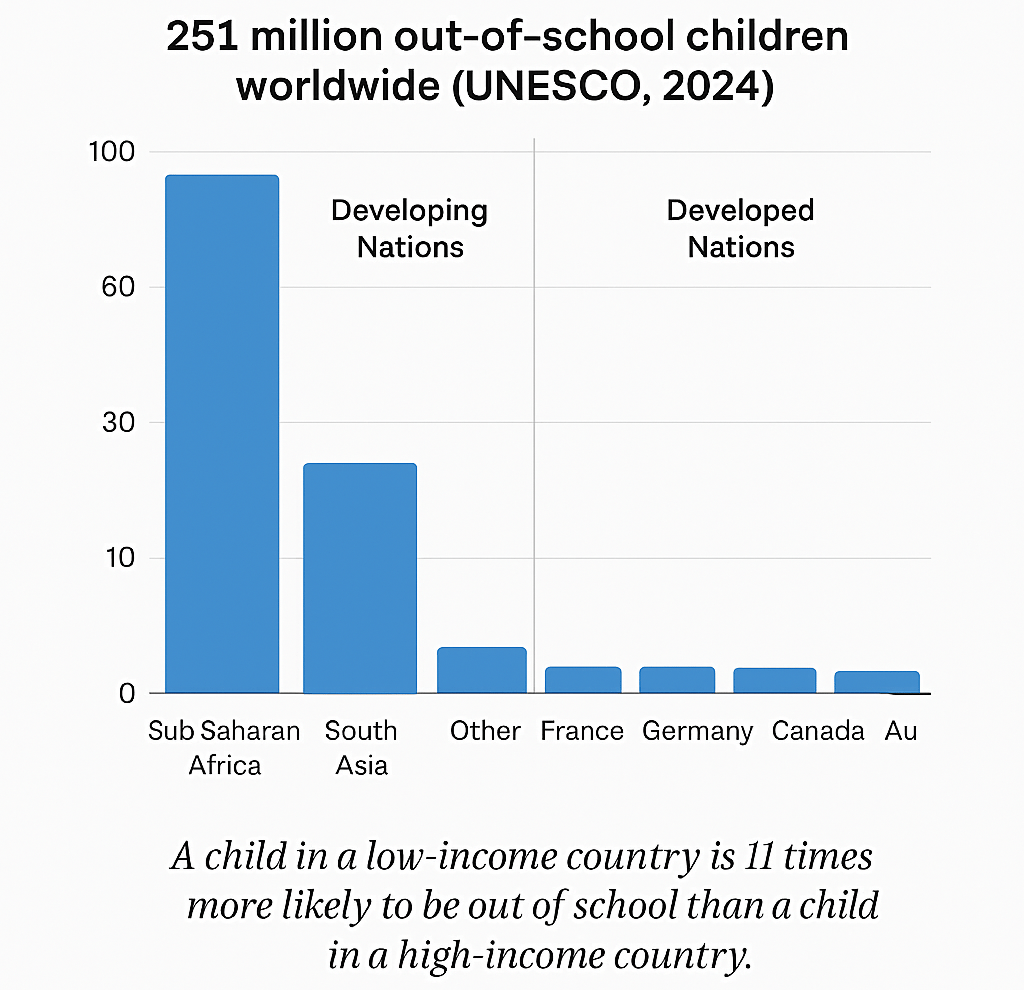
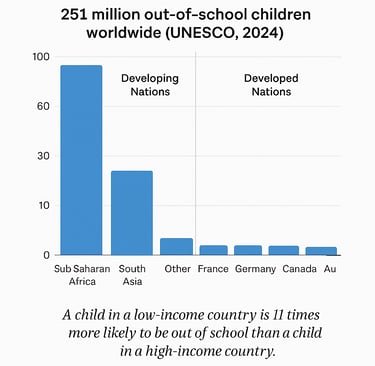
UNESCO (2024), 250 million children and youth worldwide are out of school, with the highest concentrations in sub‑Saharan Africa and South Asia. Even among those who attend school, the quality of education varies dramatically. Global education data reveals a stark divide between high‑income (developed) and low‑income (developing) nations. UNESCO reports that more than half of all out‑of‑school children and adolescents live in sub‑Saharan Africa, the region with the highest concentration of learning poverty. Even among those who attend school, the quality of instruction, infrastructure, and resources varies dramatically. This early divergence becomes the foundation of lifelong inequality. Funding disparities are one of the most powerful drivers of the education gap. High‑income countries typically invest 4–6% of GDP in education, translating into thousands of dollars per student each year. Low‑income countries often spend less than 3% of GDP, which amounts to only a few dozen dollars per child. The result is predictable: overcrowded classrooms, undertrained teachers, limited technology, and fragile school systems that struggle to support learning.
The gap is not only economic, but it is also psychological. Children living in poverty or instability experience chronic stress that affects memory, attention, and executive function. Learning becomes harder not because of a lack of intelligence, but because the brain is preoccupied with safety. This “stress gap” compounds the education gap, making it even more difficult for disadvantaged children to keep pace with their peers. The digital divide further widens educational inequality. During the COVID‑19 pandemic, 87% of children in high‑income countries had access to online learning, compared to only 6% in low‑income countries. This single disruption erased years of progress and exposed how fragile educational access is for millions of children around the world.
Gender disparities add another layer of inequality. More than 129 million girls are out of school due to early marriage, cultural norms, safety concerns, and lack of resources. When girls are denied education, entire communities lose economic potential, health outcomes worsen, and cycles of poverty deepen across generations. These early educational inequalities shape adulthood. Education determines earning potential, job stability, health outcomes, and political participation. Children who attend well‑resourced schools are more likely to enter higher education, secure stable employment, and accumulate wealth. Those who grow up in underfunded systems face limited mobility, reinforcing the global income and opportunity gap.
Ultimately, the education gap is not a gap in ability or ambition; it is an opportunity gap. It is a structural issue created by policy choices, economic priorities, and social inequities. Unless governments and global leaders commit to equitable investment, digital access, gender inclusion, and early childhood support, the gap will continue to widen. The future of global prosperity depends on the minds we choose to invest in today. This early divergence becomes the foundation of lifelong inequality. In the United States, school funding is tied to local property taxes, creating massive disparities. Wealthy districts spend up to 3 times as much per student as low‑income districts. Globally, high‑income countries invest an average of $8,000–$12,000 per student per year, while low‑income countries invest less than $300. These numbers are not just statistics; they represent access to teachers, technology, safe buildings, and learning environments that support cognitive development. Children in wealthy nations inherit more than financial stability. They inherit what sociologists call “the opportunity infrastructure”: stable housing, educated caregivers, access to books and early learning, safe neighborhoods, extracurricular programs, mentorship, and networks. These invisible advantages compound over time. A child who grows up surrounded by opportunity learns to plan, imagine, and aspire. A child who grows up in scarcity learns to survive.
Research from the World Bank shows that children experiencing chronic poverty or instability have higher cortisol levels, which impair memory, attention, and executive function, the very skills needed for academic success. This means that a child in a conflict‑affected region may struggle to concentrate not because of ability, but because their nervous system is overwhelmed, a child in a violent neighborhood may perform poorly not due to lack of effort, but because their brain is prioritizing safety over learning. During the COVID‑19 pandemic, the digital divide became impossible to ignore. In high‑income countries, 87% of children had access to online learning. In low‑income countries, only 6% did. This single disruption erased years of progress and widened global learning inequalities.
UNICEF (2024) reports that 129 million girls worldwide are out of school. Barriers include: early marriage, cultural norms, safety concerns, and lack of menstrual hygiene resources. Girls who complete secondary education earn up to 50% more over their lifetime, yet millions are denied this pathway. The OECD finds that adults with a college degree earn 56% more on average than those with only a high school education. In low‑income countries, the gap is even wider. Education determines earning potential, job stability, health outcomes, political participation, and intergenerational mobility. The education gap becomes the income gap, which becomes the wealth gap, which becomes the opportunity gap for the next generation.
The World Bank estimates that the global economy loses $21 trillion in lifetime earnings due to learning poverty. Inequality is not just a moral failure; it is an economic one. The education gap is not just about enrollment; it is about the future distribution of opportunity. Children who are out of school today become adults with limited earning potential, reduced political voice, and fewer pathways out of poverty. The divide between developed and developing nations begins in childhood and compounds across generations. The education gap is not simply about who learns more. It is about who gets to imagine a future, who gets to participate in the global economy, and who gets left behind. It is the earliest and most powerful sorting mechanism of inequality, and unless it is addressed, the global income gap will continue to widen. Global education inequality is not a natural outcome; it is the result of policy choices, funding structures, and governance priorities that consistently favor some communities over others. Data from UNESCO and the World Bank show that children in low‑income countries and underserved regions face systemic barriers long before they enter a classroom. Underfunded schools, limited access to trained teachers, inadequate infrastructure, and chronic instability create learning environments where survival competes with education.
High‑income nations invest thousands of dollars per student each year, while low‑income nations invest only a fraction of that amount. This disparity shapes everything from literacy rates to long‑term earnings. The digital divide widens the gap, especially during crises such as the COVID‑19 pandemic, when only 6% of children in low‑income countries had access to online learning, compared with
87% in wealthier nations. Gender inequality compounds the issue. Millions of girls remain out of school due to cultural norms, early marriage, and safety concerns. Meanwhile, children in wealthier nations inherit not only financial stability but also networks, mentorship, and the psychological safety that supports long‑term planning and academic success. The education gap is not merely an academic issue; it is a structural engine of global inequality. It determines who has access to opportunity, who enters the workforce prepared, and who remains trapped in cycles of poverty. Without targeted policy reforms, the gap will continue to widen across generations. If the world is serious about reducing inequality, education must become a global priority, not in rhetoric, but in policy, funding, and measurable action. Leaders must recognize that every child’s potential is shaped by the systems adults create. The responsibility is not on children to overcome broken structures; it is on governments, institutions, and global partners to repair them.
Invest in early childhood education because the first years of life determine cognitive and emotional development. Fund schools equitably, not according to property values or political convenience. Expand digital access so that a child’s ability to learn is not determined by geography. Protect girls’ education through laws, resources, and community partnerships that dismantle the barriers that hold them back. Strengthen teacher training, stabilize school leadership, and ensure that classrooms are safe, functional, and equipped for the future. Support policies that reduce childhood stress and instability, because learning cannot happen in survival mode. And above all, treat education as a public good, not a privilege reserved for the wealthy. The future of global prosperity depends on the minds we choose to invest in today. Education is not just a tool for personal advancement; it is the foundation of stable societies, resilient economies, and ethical leadership. When leaders commit to building equitable education systems, they are not merely closing gaps in access or achievement; they are expanding the boundaries of what humanity can imagine, create, and solve.
This is not a matter of charity; it is a matter of design. The systems we build today will determine whether the next generation inherits opportunity or inequality, dignity or despair. Every policy decision, every budget allocation, every school built or neglected sends a message to the children watching: You matter, or you don’t. The next generation is watching. They are watching how we respond to learning poverty, how we protect girls’ education, how we invest in early childhood, and how we bridge the digital divide. They are watching whether we treat education as a public good or a private privilege. And their future will be shaped by the choices we make now.
To governments, fund education not as a line item, but as a national priority. To institutions, design systems that include uplift and protection. To global leaders, I recognize that the most powerful investment is not in weapons or walls, but in minds. To communities, demand accountability, equity, and dignity in every classroom. Because when we invest in education, we invest in peace, innovation, and shared prosperity. And when we fail to invest, we do not just fail children, we fail the future. Let us choose wisely. Let us choose boldly. Let us choose to build a world where every child, regardless of birthplace or income, has the chance to learn, grow, and lead.
References
1. García, E., & Weiss, E. (2017). Education Inequalities at the School Starting Gate. Economic Policy Institute.
2. National Academies of Sciences, Engineering, and Medicine. (2023). Closing the Opportunity Gap for Young Children.
3. Institute for Fiscal Studies. (2022). Early Childhood Inequalities.
4. Heckman, J. J. (2006). Skill Formation and the Economics of Investing in Disadvantaged Children. Science, 312(5782), 1900–1902.
5. UNICEF. (2021). Early Childhood Development: The Foundation for a Better Future.
6. Reardon, S. F. (2011). The Widening Academic Achievement Gap Between the Rich and the Poor. Community Investments, 23(2), 19–39.
7. OECD. (2020). Equity in Education: Breaking Down Barriers to Social Mobility.
8. UNESCO. (2023). Global Education Monitoring Report.
9. Duncan, G. J., & Murnane, R. J. (2011). Whither Opportunity? Rising Inequality and the Uncertain Life Chances of Low-Income Children. Russell Sage Foundation.
10. Center on the Developing Child at Harvard University. (2022). Three Principles to Improve Outcomes for Children and Families.
© 2026 Enoma Ojo. All Rights Reserved.
No part of this publication may be reproduced, distributed, or transmitted in any form without prior written permission from the