
The Dignity Loop: How Respect, Agency, and Environment Reinforce Each Other.
The Dignity Loop explores how three forces, respect, agency, and environment, continually shape human behavior and potential. The article argues that dignity is not an abstract ideal but a self‑reinforcing system: when people feel respected, they gain agency; when they act with agency, they improve their environment; and a supportive environment, in turn, strengthens respect. The piece shows how this loop can create either an upward spiral of growth or a downward spiral of despair in families, workplaces, schools, and communities.
INSIGHTS
Enoma Ojo (2024)
1/18/20267 min read
This is the story of Amina Silva, The Data Analyst Who Stopped Trying
When Amina joined the consulting firm as a junior analyst, in an upscale consulting firm in downtown New York, she arrived with the kind of quiet brilliance managers dream about. She worked late, asked thoughtful questions, and delivered reports with a level of precision that made her stand out. For the first few months, she was on fire. Then something shifted. Her manager, Mr. Collins, was known for being sharp but dismissive. He rarely greeted his team. He corrected people publicly. He treated mistakes like personal failures. When Amina presented her first major analysis, he flipped through the pages without looking at her and said, “Next time, try not to overthink simple tasks.” It was a small sentence, but it landed like a blow. Over the next few weeks, Amina stopped volunteering ideas. She stopped staying late. She stopped taking the initiative. Her work became mechanical. She did exactly what she was told, nothing more. Her colleagues whispered that she had “lost her spark,” but no one asked why. One afternoon, a senior partner named Elena sat beside her during a break and asked how she was settling in. Amina hesitated, then admitted she felt invisible, like her work didn’t matter, like she was always one mistake away from being embarrassed.
Elena didn’t give a motivational speech. She simply said, “Your mind is an asset to this firm. I see it. I value it. And I want you to use it boldly.” It was the first genuine respect Amina had received in months. The next week, Elena invited her to co‑lead a small project. She gave herself the room to make decisions. She asked for her perspective. She treated her as someone capable, not someone fragile. Slowly, Amina’s agency returned. She started proposing ideas again. She redesigned a client dashboard that ended up being adopted across the firm. As her confidence grew, her environment changed too. Colleagues began seeking her input. Managers noticed her initiative. Even Collins, who had once dismissed her, started relying on her insights.
Amina’s experience is not just a workplace issue; it reflects a deeper truth recognized at the highest level of global consensus. The Universal Declaration of Human Rights, adopted in 1948, begins with a simple but profound principle: every human being is born with inherent dignity and equal worth. This dignity is not earned through performance or position. It is not granted by managers, institutions, or systems. It is inherent, the starting point of all human rights. But dignity does not survive on declarations alone. It must be reinforced through daily interactions, opportunities, and environments. When dignity is honored, people rise. When it is violated, people shrink. Amina’s story shows how quickly dignity can erode, and how powerfully it can be restored, through respect, agency, and supportive conditions. This is the living reality behind the Universal Declaration: dignity is not an abstract ideal. It is a psychological system that shapes human behavior, potential, and well-being. And like any system, it can spiral upward or downward depending on how we treat people.
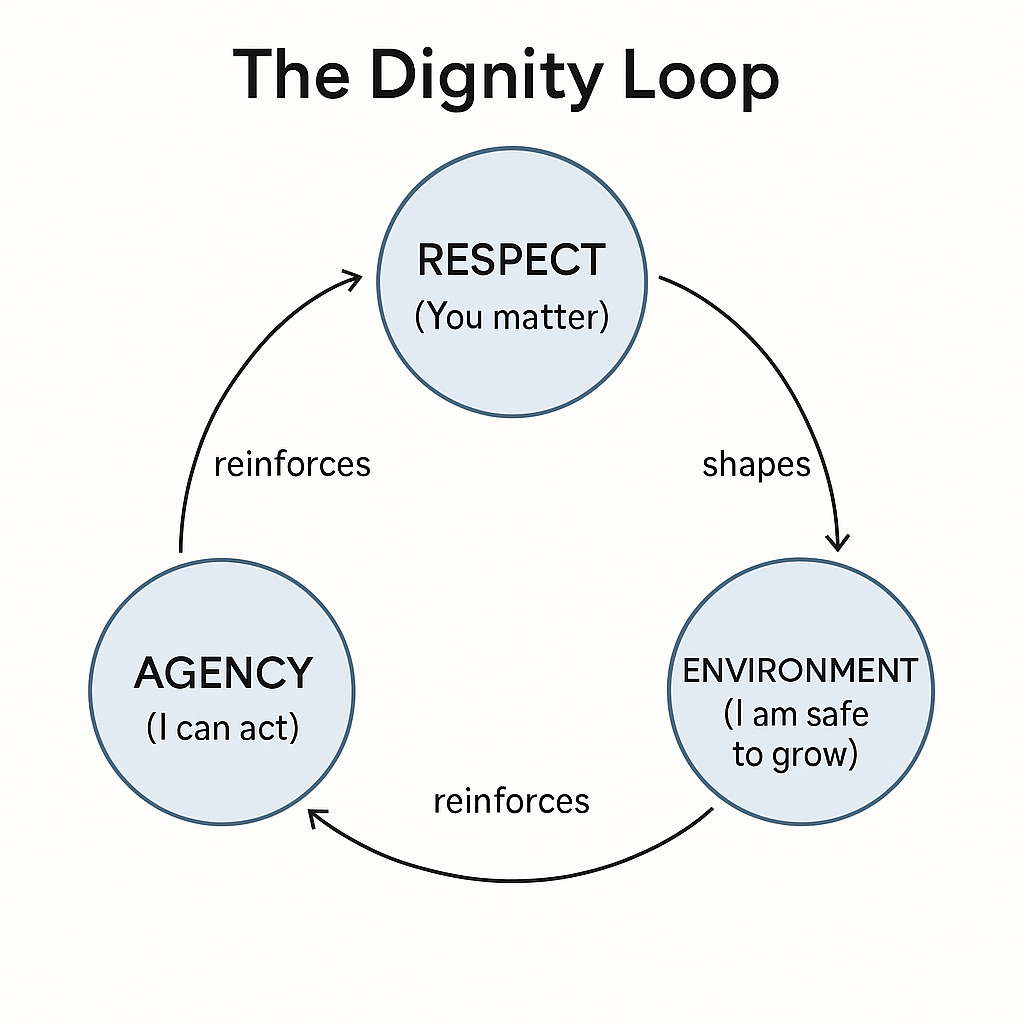
Dignity is often spoken about as a moral virtue, something noble, something aspirational, something we hope societies will uphold. But dignity is far more than a moral ideal. It is a psychological engine, a structural force that determines whether people rise, stagnate, or collapse. When dignity is present, human potential expands. When it is absent, even the most talented individuals shrink into survival mode. Understanding dignity as a system, not a sentiment, changes everything. At the center of this system lies what I call The Dignity Loop: the continuous interaction between respect, agency, and environment. These three forces shape one another in a self‑reinforcing cycle. When the loop is healthy, it produces confidence, creativity, and growth. When the loop is broken, it produces apathy, fear, and decline. Every society, every workplace, every family, and every individual is shaped by the condition of this loop.
Respect is the first spark in the cycle. It is the recognition of a person’s inherent worth, not because of what they produce, but because of who they are. Respect tells a person: You matter. Your presence has weight. This simple recognition has profound psychological consequences. It stabilizes the mind, strengthens self‑perception, and opens the door to possibility. People who feel respected think more clearly, take more initiative, and engage more deeply with the world around them. When respect is absent, the loop collapses before it even begins. Disrespect communicates that a person’s existence is irrelevant. It sends a quiet but devastating message: You do not count. This message erodes confidence, motivation, and the belief that one’s actions can influence outcomes. It is the psychological equivalent of cutting the power supply. No amount of training, opportunity, or discipline can compensate for the absence of respect.
Agency is the second pillar of the dignity loop, the internal belief that I can act, I can influence, I can shape outcomes. Agency is what transforms respect into motion. It is the difference between someone who waits for life to happen and someone who steps forward to shape it. Agency is not arrogance; it is the quiet conviction that effort matters. It is the foundation of responsibility, initiative, and resilience. But agency cannot survive in a vacuum. It needs the fuel of respect and the support of an environment that does not punish effort or curiosity. When people feel respected, they begin to believe in their own capacity. When they believe in their capacity, they begin to act. But if the environment punishes action, through chaos, unfairness, or hostility, agency withers. The loop breaks.
Environment is the third pillar, the external container that either amplifies or suffocates human potential. Cleanliness, order, safety, fairness, opportunity, and predictability are not luxuries; they are psychological infrastructure. They tell the mind: You are safe enough to grow. A supportive environment reinforces agency by rewarding effort, encouraging exploration, and providing stability. A degraded environment sends the opposite message. Chaos, dirt, violence, and unpredictability force the brain into survival mode. In survival mode, long‑term thinking collapses. Creativity collapses. Hope collapses. Even the strongest agency can be crushed by a hostile environment. This is why poverty, whether economic or psychological, becomes generational. The environment keeps resetting the mind to survival mode.
When respect, agency, and environment align, the dignity loop becomes self‑reinforcing. Respect strengthens agency. Agency produces constructive behavior. Constructive behavior improves the environment. A better environment reinforces respect. The cycle repeats, gaining momentum with each turn. This upward spiral explains why some workplaces, schools, and communities thrive even with limited resources. They have mastered the dignity loop. They treat people as capable, give them room to act, and maintain environments that reward effort rather than punish it. The downward spiral works just as powerfully. Disrespect kills agency. Low agency leads to apathy or rebellion. A degraded environment reinforces hopelessness. Hopelessness becomes culture. Culture becomes identity. This is how entire communities, and even nations, become trapped in cycles of stagnation. The dignity loop is not just a psychological model; it is a developmental blueprint.
The dignity loop shows up everywhere. It shows up in the way a manager speaks to an employee. It shows up in the way a teacher treats a struggling student. It shows up in the way a government designs public spaces. It shows up in the way a society treats its most vulnerable members. Every interaction either strengthens or weakens the loop. Every policy either reinforces dignity or erodes it. In a world facing rapid technological change, social fragmentation, and rising anxiety, dignity becomes more than a moral principle; it becomes a strategic necessity. People who feel respected, empowered, and supported are more resilient, more creative, and more capable of adapting to uncertainty. Organizations that understand this will outperform those that rely on fear, control, or transactional relationships. The human mind simply performs better when dignity is intact.
The future of work, leadership, and community building will depend on our ability to repair and reinforce the dignity loop. Leaders who understand the loop will build environments where people can grow. Educators who understand the loop will unlock potential in students who have been written off. Communities that understand the loop will break cycles of hopelessness and rebuild cultures of possibility. Ultimately, dignity is not a gift we give; it is a system we build. Respect is the seed. Agency is the spark. Environment is the soil. When these three elements reinforce each other, people rise, not because they are pushed, but because the loop makes rising possible. The dignity loop is not just a theory; it is a path to human flourishing.
Amina Silva’s transformation didn’t happen because she suddenly became more talented. It happened because someone repaired the dignity loop. Respect restored her agency. Agency reshaped her behavior. Her behavior improved the environment. And the environment reinforced her sense of worth. Amina didn’t rise because she was pushed. She rose because dignity made rising possible. If we want people to rise, we must repair the loop. Respect is the seed. Agency is the spark. Environment is the soil. Dignity is the harvest. Dignity is not a soft ideal. It is the architecture of human possibility. When respect is present, agency awakens. When agency awakens, behavior transforms. When behavior transforms, environments evolve. And when environments evolve, dignity becomes self‑sustaining.
This is why the smallest gesture, a word, a tone, a choice, can alter the entire trajectory of a person’s life. Dignity is not built through grand reforms alone. It is built in the micro‑moments where we choose to see people, value them, and create conditions where they can rise. The Dignity Loop is not a theory to admire. It is a system to practice. Every day. In every interaction. With every human being. Because the truth is simple, People do not flourish because they are pushed. They flourish because the loop makes flourishing possible. In the end, dignity is the one resource that costs nothing to give yet transforms everything it touches. It is the quiet power every human being carries, the ability to reinforce someone’s worth, ignite their agency, and shape an environment where they can grow.
Amina’s story is not rare. It is happening in offices, schools, homes, and communities every day, people shrinking because the loop is broken, and people rising because someone chose to repair it. The Universal Declaration of Human Rights reminds us that dignity is inherent. The Dignity Loop reminds us that dignity is also fragile and must be reinforced through action. So the question is no longer whether dignity matters. The question is whether we will choose to protect it. Because when we honor dignity, we do more than uplift individuals. We rebuild the psychological infrastructure of society itself. And that is how real change begins, not with force, not with creating fear, but with the simple, radical decision to treat every human being as if their rise is possible.
“Where, after all, do universal human rights begin? In small places, close to home.”
— Eleanor Roosevelt
Names and identifying details, used in this article, have been intentionally changed to safeguard the dignity and privacy of those whose experiences are shared.
© 2024 Enoma Ojo. All rights reserved.