Risk Aversion and Emotional Courage (Behavioral Economy Series Part 4)
“Risk Aversion and Emotional Courage” is a deep, eye‑opening exploration of why fear dominates our decisions, and how emotional courage can break that cycle. In this article, we take readers inside the psychology of fear, uncertainty, and avoidance. We explain why the brain reacts to uncertainty as if it were physical danger, why we cling to the familiar even when it limits us, and why the emotional cost of inaction grows heavier over time. Drawing from behavioral economics, neuroscience, and lived human experience, we show how fear shapes careers, relationships, finances, and personal growth far more than most people realize. But this isn’t just an article about fear. It’s an article about courage, not the Hollywood version, but the real, everyday courage required to make decisions that align with your goals instead of your anxieties. I introduce emotional courage as a trainable skill, a psychological asset, and a form of capital that determines who adapts, who innovates, and who remains stuck.
BEHAVIORAL ECONOMY
enoma ojo (2026)
5/25/202618 min read
Why Fear Dominates Rational Decision‑Making
Fear is the oldest operating system in the human brain. Long before logic, planning, or economic reasoning evolved, fear was already fully functional, fast, automatic, and designed to keep us alive. Rational thought is a recent upgrade layered on top of ancient circuitry, and when the two collide, fear almost always wins. Fear dominates decision‑making because it operates on a different timeline. The amygdala reacts in milliseconds, triggering physiological responses, tightened muscles, elevated heart rate, and narrowed attention, before the rational mind even enters the conversation. By the time the prefrontal cortex begins weighing costs and benefits, fear has already framed the decision as a threat. This is why people often avoid opportunities that could improve their lives. The brain treats uncertainty as danger, even when the actual risk is low. Behavioral economists call this loss aversion: losses feel twice as painful as gains feel rewarding. But emotionally, it goes deeper. Loss feels like failure, and failure feels like exposure, an attack on identity, competence, and self‑worth.
Fear also dominates because it simplifies the world. Instead of evaluating probabilities, the brain collapses uncertainty into a binary: safe or unsafe. This shortcut was useful when danger meant predators or starvation. In the modern world, it leads to overly cautious choices, staying in unfulfilling jobs, avoiding investments, delaying decisions, or choosing the familiar over the beneficial. Rationality requires time, information, and emotional stability. Fear requires none of these. It only needs a possibility, real or imagined, to seize control. And because the brain is wired to prioritize survival over optimization, fear’s voice is louder, faster, and more persuasive than logic. The result is a predictable pattern: people do not avoid risk because it is dangerous; they avoid risk because it is uncomfortable. Fear dominates not because it is correct, but because it is immediate. Rationality must be chosen. Fear simply arrives.
Uncertainty is not just a lack of information; it is a lack of control. And for the human brain, control is synonymous with safety. When outcomes are predictable, the nervous system relaxes. When outcomes are unknown, the brain interprets that ambiguity as a potential threat, even when the actual risk is minimal. This is why people often avoid opportunities that could benefit them. The discomfort of “not knowing” feels more dangerous than the discomfort of staying stuck. Behavioral economics calls this ambiguity aversion, the tendency to prefer a known probability over an unknown one, even when the unknown option may offer a better payoff. But psychologically, the roots run deeper.
Uncertainty activates the same neural circuits that respond to physical danger. The amygdala fires, attention narrows, and the mind begins generating worst‑case scenarios. This is the origin of catastrophic thinking, the mental habit of imagining the most extreme negative outcome and treating it as the most likely one. The brain does this not because the danger is real, but because preparing for the worst once increases the odds of survival. Avoiding uncertainty also protects the ego. When people choose the familiar, they avoid the possibility of failure, embarrassment, or exposure. The unknown threatens identity: “What if I’m not good enough? What if I can’t handle it? What if I try and fail?” These questions create emotional friction that feels heavier than the potential rewards of taking the risk. The result is a powerful illusion: that staying where you are is safer than moving forward. But in modern life, the opposite is often true. Avoiding uncertainty leads to stagnation, missed opportunities, and long‑term regret. The cost of inaction compounds quietly, while the brain convinces itself that it is simply “playing it safe.”
The psychology behind avoiding uncertainty is not irrational; it is predictable. The brain is designed to minimize danger, not maximize potential. Understanding this is the first step toward emotional courage: the ability to act even when the outcome is not guaranteed (Kahneman, 2011)
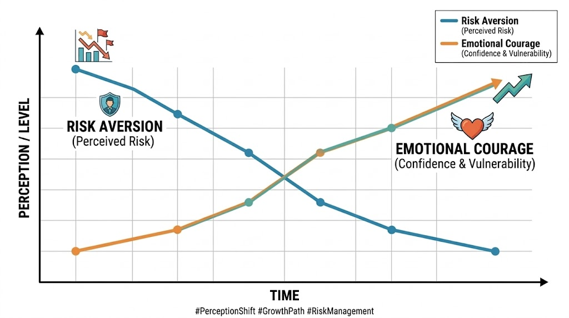
The infographic, on the cover page, illustrates a psychological transformation that unfolds over time, capturing the dynamic relationship between risk aversion and emotional courage. At the beginning of the graph, the line representing perceived risk sits high, reflecting the natural human tendency to overestimate danger when facing uncertainty. This elevated perception of risk is not rooted in objective threat but in the emotional weight of fear, which magnifies the possibility of loss and narrows a person’s willingness to act. In contrast, emotional courage begins at a low point, symbolizing how confidence, vulnerability, and self‑trust are often underdeveloped in the early stages of personal or behavioral change. As time progresses, the two lines move in opposite directions. The risk‑aversion line steadily declines, showing how perceived danger diminishes as individuals gain experience, clarity, and emotional resilience. Meanwhile, the emotional‑courage line rises, reflecting the gradual strengthening of internal resources that allow a person to tolerate uncertainty, confront discomfort, and make decisions aligned with long‑term goals rather than immediate fears. The crossing point of the two lines marks a pivotal psychological shift: the moment when courage overtakes fear, and the individual transitions from avoidance‑based decision‑making to growth‑oriented action.
This intersection is more than a visual crossing; it represents a cognitive and emotional rebalancing. Before this point, fear dominates the internal narrative, shaping choices through caution, hesitation, and the desire to minimize loss. After the crossing, courage becomes the primary driver, enabling the person to reinterpret risk not as a threat but as an opportunity. The graph suggests that emotional courage does not eliminate risk but reframes it, reducing its psychological intensity and allowing rational evaluation to emerge. Over time, as courage continues to rise and perceived risk continues to fall, the individual enters a state where decision‑making becomes more grounded, intentional, and aligned with personal growth.
Overall, it shows that risk aversion and emotional courage are not fixed traits but evolving forces that shift in response to experience, mindset, and self‑awareness. Fear may dominate early, but with time and intentional effort, courage can become the stronger influence, reshaping how a person perceives challenges and ultimately transforming the quality of their decisions.
Fear dominates rational decision‑making because it operates on a fundamentally different timeline than logic. Fear is fast. Rationality is slow. The human brain is built with an ancient alarm system that reacts long before conscious thought has a chance to intervene. When a person encounters uncertainty, the amygdala fires almost instantly, flooding the body with signals to freeze, flee, or avoid. This reaction happens in milliseconds, far faster than the prefrontal cortex, the region responsible for logic, planning, and long‑term thinking, can activate. By the time rational thought arrives, fear has already framed the decision, shaped the narrative, and narrowed the available choices. The mind is no longer evaluating possibilities; it is defending against imagined threats. This neurological sequence explains why people often remain stuck in situations that do not serve them. They stay in jobs they hate, not because the job is safe, but because leaving feels dangerous. They avoid investments that could change their lives, not because the numbers are unfavorable, but because the possibility of loss feels unbearable. They delay starting businesses, even when they have the skills and ideas, because uncertainty triggers the emotional discomfort of vulnerability. They remain in unhealthy relationships because the familiar, even when painful, feels less threatening than the unknown. They choose what is predictable over what is beneficial because predictability calms the nervous system, while possibility activates fear.
Fear is not reacting to the actual risk. Fear is reacting to the possibility of loss. This distinction is crucial. Behavioral economists describe this phenomenon as loss aversion, the tendency for losses to feel twice as intense as gains. But emotionally, the experience goes deeper than a simple imbalance in psychological weighting. Loss does not merely represent a setback; it represents failure. And failure, in the emotional landscape of the human mind, feels like exposure. Exposure to judgment. Exposure to inadequacy. Exposure to the fear that one is not enough. This emotional exposure is what makes fear so powerful. It is not the external risk that paralyzes people; it is the internal meaning they attach to that risk. A failed business is not just a financial loss, it becomes evidence of incompetence. A rejected application is not just a missed opportunity; it becomes proof of unworthiness.
A relationship ending is not just a transition; it becomes a reflection of personal deficiency. Fear transforms uncertainty into a mirror, and most people are terrified of what they might see in their own reflection. Because fear operates so quickly, it shapes perception before rationality can intervene. The brain begins to generate worst‑case scenarios, not because they are likely, but because preparing for danger once increased the odds of survival. This evolutionary bias means that the mind treats uncertainty as inherently threatening, even when the actual stakes are low. The result is a distorted internal landscape where imagined losses overshadow real opportunities. People begin to avoid not just risk, but the emotional discomfort associated with risk. They mistake the feeling of fear for evidence of danger, and in doing so, they allow emotion to override logic.
Over time, this pattern becomes self‑reinforcing. Avoidance temporarily reduces anxiety, which teaches the brain that avoidance is the safest strategy. Each time a person chooses the familiar over the unknown, fear becomes more deeply wired into their decision‑making process. The cost of this pattern is enormous. It leads to stagnation, missed opportunities, and a life shaped more by protection than by potential. Fear becomes the architect of one’s choices, and rationality becomes an afterthought, consulted only after the emotional decision has already been made. Yet the dominance of fear is not inevitable. It is simply the default. When individuals learn to recognize the speed of fear and the slowness of rationality, they can begin to create space between the emotional reaction and the behavioral response. Emotional courage, the willingness to feel discomfort without retreating, becomes the counterweight to fear’s influence. Courage does not eliminate fear; it interrupts its authority. It allows the prefrontal cortex to reenter the conversation, to evaluate risks accurately, and to make decisions based on long‑term goals rather than immediate emotional relief.
Understanding why fear dominates rational decision‑making is the first step toward reclaiming agency. It reveals that fear is not a sign of danger but a sign of meaning. People fear what matters. They fear what could change them. They fear what could expose them. And yet, it is precisely in these spaces, where fear is loudest, that the greatest growth opportunities exist. When individuals learn to move through fear rather than obey it, they shift from a life shaped by avoidance to a life shaped by intention. They stop choosing the familiar simply because it is familiar, and begin choosing the beneficial because it aligns with who they are becoming.
Fear dominates because it protects the ego as much as it protects the body.
Uncertainty is far more than the absence of information; it is the absence of control. When people cannot predict an outcome, the brain interprets that gap not as a neutral space but as a potential threat. Humans are wired to prefer a bad outcome they can anticipate over a good outcome they cannot guarantee. This is why individuals cling to fixed salaries even when variable income could offer greater freedom, why they repeat predictable routines instead of seeking new experiences, and why they tolerate known discomfort rather than stepping into unknown possibilities. The familiar, even when limiting, feels safer than the uncertain, because the nervous system equates predictability with survival.
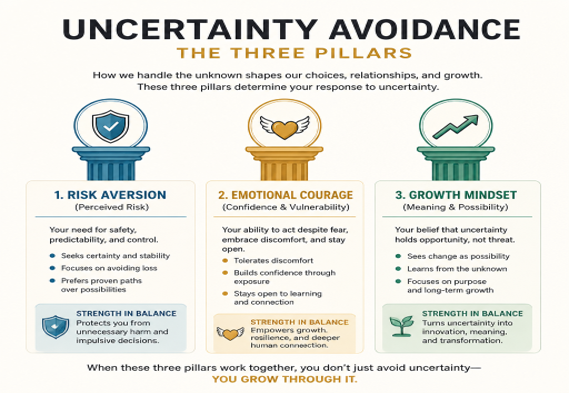
This reaction is rooted in biology. Uncertainty activates the same neural circuits that respond to physical danger. When the brain encounters the unknown, the amygdala fires rapidly, sending signals that something might be wrong. The message is primitive and urgent: “I don’t know what will happen” becomes “I might not survive what happens.” This emotional alarm system evolved to protect early humans from predators and environmental threats, but in modern life, it misfires constantly, triggered not by lions or cliffs, but by job changes, financial decisions, relationships, and personal growth. The body reacts to uncertainty as if it were a physical attack, even when the stakes are psychological or symbolic. Three major psychological forces drive this avoidance of uncertainty, each reinforcing the others and creating a powerful internal barrier to change.
Figure 1: The Three Pillars of Uncertainty Avoidance
The first is ambiguity aversion, the tendency to prefer clear probabilities over unknown ones, even when the unknown option is statistically better. People would rather choose a guaranteed but mediocre outcome than take a chance on something potentially greater but less predictable. The mind craves clarity, and when clarity is absent, it fills the void with fear. Ambiguity feels dangerous because it removes the illusion of control, and without control, the brain assumes vulnerability.
The second force is status quo bias, the deeply ingrained preference for the current state simply because it is familiar. The present may be uncomfortable, unfulfilling, or even harmful, but it is known. The unknown requires cognitive effort, emotional exposure, and the willingness to tolerate temporary instability. The status quo, by contrast, demands nothing. It offers the comfort of routine and the reassurance of predictability. People remain in situations that limit their growth not because those situations are objectively safe, but because they are psychologically stable. Familiarity becomes a substitute for security.
The third force is catastrophic imagination, the mind’s tendency to exaggerate worst‑case scenarios and treat them as likely outcomes. When faced with uncertainty, the brain does not generate a balanced range of possibilities; it gravitates toward the most extreme negative ones. A career change becomes a fear of financial ruin. A new relationship becomes a fear of heartbreak. A business idea becomes a fear of public failure. These imagined catastrophes feel vivid and emotionally real, even when they are statistically improbable. The mind overestimates danger because preparing for the worst once increased the odds of survival. In modern life, however, this instinct leads to paralysis rather than protection.
Together, these forces create a powerful illusion that staying still is safer than moving forward, even when inaction carries its own risks (Slovic, 2000). The brain convinces itself that inaction is the rational choice when in reality it is the emotional choice. Avoiding uncertainty feels like self‑preservation, but it often becomes self‑limitation. People remain in jobs that drain them, relationships that diminish them, and routines that shrink their potential, not because these choices are wise, but because they are predictable. The cost of avoiding uncertainty is rarely immediate, which makes it easy to ignore. But over time, the cost compounds. Opportunities fade, growth stalls, and life becomes defined not by what was pursued, but by what was feared.
The psychology behind avoiding uncertainty reveals a fundamental truth about human behavior: people are not avoiding risk; they are avoiding the emotional discomfort that risk evokes. Uncertainty threatens the illusion of control, and without control, the mind feels exposed. Yet it is precisely in this exposure that transformation becomes possible. When individuals learn to tolerate uncertainty, to sit with the discomfort of not knowing, they unlock the capacity for change, innovation, and self‑actualization. Emotional courage becomes the antidote to ambiguity aversion, the disruptor of status quo bias, and the counterweight to catastrophic imagination. It does not eliminate uncertainty, but it changes the way uncertainty is experienced. Understanding this dynamic is the first step toward reclaiming agency. When people recognize that uncertainty is not inherently dangerous, but simply unfamiliar, they begin to see possibilities where they once saw threats. They learn that the unknown is not a void to fear but a space to grow into. And in that shift, the illusion of safety dissolves, replaced by the deeper truth that movement, not stagnation, is what ultimately protects and expands a life.
Emotional Courage: The Antidote to Risk Aversion
Emotional courage is the antidote to risk aversion because it bridges the gap between fear and action. Courage is not the absence of fear; it is the ability to act while afraid. Every meaningful decision carries uncertainty, and uncertainty inevitably triggers discomfort. Emotional courage is the skill of holding that discomfort long enough to make a choice aligned with one’s goals rather than one’s fears. It is the capacity to tolerate ambiguity without collapsing into avoidance, to remain steady while the mind demands retreat. In this sense, courage is not a personality trait; it is a trained response, a learned capacity that transforms fear from a barrier into a signal for growth. At the neurological level, fear operates faster than reason. The amygdala fires before the prefrontal cortex can evaluate context, flooding the body with signals to protect itself. Emotional courage intervenes in this sequence. It does not silence fear but slows the reaction long enough for rational thought to reenter the process. People with high emotional courage experience fear just as intensely as anyone else, but they have learned to interpret it differently. Instead of treating fear as a stop sign, they treat it as information, a message that something important is at stake. This reframing allows them to act even when the outcome is uncertain. Individuals who cultivate emotional courage invest in themselves, take calculated risks, and leave environments that no longer serve their growth. They pursue opportunities before they feel “ready,” understanding that readiness is often a psychological illusion created by fear to delay progress. They accept that failure is not a verdict on identity but a source of data, a feedback mechanism that refines judgment and strengthens resilience. In behavioral‑economic terms, emotional courage counteracts loss aversion by redefining what constitutes a loss. When failure is viewed as information rather than identity, the emotional cost of risk decreases, and the willingness to act increases.
Developing emotional courage requires deliberate practice. It begins with awareness, recognizing when fear is driving a decision and pausing before reacting. It continues with exposure, taking small, intentional steps into discomfort to build tolerance. Over time, these micro‑acts of bravery accumulate, rewiring the brain’s relationship with uncertainty. The individual learns that discomfort is not danger, that vulnerability is not weakness, and that fear can coexist with forward motion. This training transforms emotional courage from a reactive impulse into a strategic asset. In the broader context of human behavior, emotional courage is what allows rationality to survive under pressure. It is the psychological infrastructure that supports long‑term thinking in the face of short‑term anxiety. Without it, fear dictates choices, and the mind defaults to safety overgrowth. With it, individuals can pursue goals that require patience, resilience, and faith in unseen outcomes. Emotional courage is therefore not just a personal virtue; it is an economic and social force. It drives innovation, leadership, and transformation by enabling people to act in alignment with vision rather than emotion.
Ultimately, emotional courage is the quiet strength that turns uncertainty into possibility. It does not promise comfort, but it guarantees movement. It teaches that fear is not the enemy of progress; it is the energy that fuels it when properly understood. And in a world defined by volatility and change, emotional courage becomes the most valuable form of intelligence: the ability to feel deeply, think clearly, and act decisively, even when the path ahead is unknown.
Avoiding risk feels safe in the moment, but over time, it becomes its own form of suffering. The human mind is wired to seek comfort and predictability, yet the very strategies that protect us from short‑term discomfort often create long‑term pain. When people chronically avoid uncertainty, they trade the possibility of failure for the certainty of stagnation. The emotional cost of inaction compounds quietly, accumulating beneath the surface until it manifests as regret, resentment, and self‑doubt. What begins as self‑protection eventually becomes self‑limitation. At first, avoidance feels rational. The person tells themselves they are being cautious, responsible, or strategic. They wait for the “right time,” the “perfect conditions,” or the “guaranteed outcome.” But the right time never arrives, and the perfect conditions never materialize. Each postponed decision reinforces the illusion that safety lies in waiting. In reality, safety lies in movement. The longer one delays action, the more the mind equates inaction with control, and control with security. Yet this false sense of security erodes confidence. The individual begins to doubt their own capacity to act, to adapt, and to recover. Over time, the fear of risk transforms into a fear of self.
Regret is the first emotional residue of avoided risk. It appears quietly, often disguised as nostalgia or longing. People look back on opportunities they declined and wonder what might have been. Regret is not simply sadness over missed chances; it is grief for the version of oneself that could have existed had courage prevailed. Stagnation follows, as life becomes defined by repetition rather than evolution. Without risk, there is no growth; without growth, there is no renewal. The person begins to feel trapped in a loop of predictability, where each day mirrors the last, and the horizon of possibility narrows. Resentment soon enters the picture. It is directed outward at circumstances, institutions, or other people who seem freer or braver, but beneath that resentment lies self‑betrayal. The individual resents others for doing what they themselves have not allowed. They resent success because it exposes their own avoidance. This emotional friction corrodes relationships and deepens isolation. Self‑doubt grows in the shadow of this resentment, whispering that perhaps the avoidance was justified, that maybe they were never capable of more. Confidence shrinks, ambition contracts, and the person begins to live within the boundaries of their own fear.
The emotional cost of inaction compounds faster than the financial cost of failure because the psychological burden of “what could have been” grows heavier with time (Ariely, 2008). Money lost can be earned again; time lost cannot. The psychological toll of knowing one did not try, of realizing that fear dictated the terms of one’s life, creates a deeper wound than any external setback. Avoidance preserves comfort but sacrifices meaning. It keeps the body safe but leaves the spirit restless. Over the years, this restlessness becomes existential fatigue, a quiet despair that comes not from what was done, but from what was never attempted. From a behavioral‑economic perspective, this dynamic reflects the paradox of loss aversion. People fear losses more than they value gains, yet the greatest loss is often the one they never measure: the loss of potential. Emotional courage reverses this equation. It reframes risk not as a threat but as a transaction, an exchange between comfort and growth. When individuals act despite fear, they incur short‑term discomfort but gain long‑term expansion. When they avoid risk, they gain short‑term relief but accumulate long‑term regret. The emotional ledger always balances, but the side one invests in determines the quality of life.
Avoiding risk may protect the ego from exposure, but it also prevents the self from evolution. The irony is that the pain people fear from failure is finite, while the pain of avoidance is infinite. Failure ends; avoidance endures. Emotional courage, therefore, is not about eliminating fear but about choosing which pain to bear, the temporary discomfort of uncertainty or the lasting ache of unrealized potential. Those who choose courage experience fear as movement; those who choose avoidance experience fear as confinement. Over time, the difference between the two becomes the difference between a life lived and a life postponed.
The people who rise are not the ones who feel less fear. They are the ones who have learned to carry it.
Courage as an Economic Asset
In today’s world, emotional courage has become as valuable as education, skill, or capital. It is no longer a soft trait or an optional virtue; it is a determining factor in who advances and who remains stuck. The modern economy rewards those who can navigate uncertainty, tolerate discomfort, and act without the guarantee of success. In a landscape defined by volatility, rapid change, and constant reinvention, emotional courage functions as a form of psychological capital, one that shapes economic outcomes as powerfully as intelligence or opportunity. Courage determines who leaps when others hesitate. It separates the individuals who adapt from those who cling to outdated structures. It fuels innovation because innovation requires stepping into the unknown without a map. It drives entrepreneurship because building something new demands the willingness to fail publicly and recover quickly. It strengthens leadership, because leading means making decisions before the path is clear. Emotional courage is the internal engine behind every external breakthrough.
Fear will always speak first. It is wired into the human nervous system, designed to protect us from danger long before logic can intervene. Fear is fast, loud, and persuasive. It warns, it cautions, it imagines the worst. But fear does not have to speak last. The presence of fear does not invalidate a decision; it simply signals that the decision matters. Emotional courage is what allows a person to hear fear without obeying it. It creates the psychological space for rationality to reenter the conversation, for long‑term thinking to override short‑term anxiety, and for values to guide action instead of avoidance. When courage becomes part of a person’s behavioral repertoire, it transforms how they engage with opportunity. They no longer wait for certainty before moving; they move and create certainty along the way. They understand that progress is not the result of perfect conditions but of imperfect action. They recognize that failure is not a verdict on identity but a cost of growth. They learn that discomfort is not a sign of retreating but a sign that they are expanding beyond their previous limits.
In this sense, emotional courage is not merely a psychological strength; it is an economic asset. It increases a person’s capacity to take calculated risks, to invest in themselves, to pursue upward mobility, and to withstand the inevitable setbacks that accompany ambition. It shapes career trajectories, financial decisions, entrepreneurial ventures, and personal reinvention. It determines who evolves and who remains confined by the boundaries of their own fear. The future belongs to those who can feel fear without surrendering to it. Emotional courage does not eliminate uncertainty, but it changes a person’s relationship to it. It allows them to move forward even when the outcome is unknown, to trust their ability to adapt, and to build a life defined not by avoidance but by intention. In a world where change is constant and stability is an illusion; emotional courage becomes the most reliable form of security. It is the quiet force that turns potential into reality, possibility into progress, and fear into fuel.
Fear may speak first, but courage decides the final word.
References
Ariely, D. (2008). Predictably irrational: The hidden forces that shape our decisions. HarperCollins.
Bandura, A. (1997). Self-efficacy: The exercise of control. W. H. Freeman.
Baumeister, R. F., Bratslavsky, E., Finkenauer, C., & Vohs, K. D. (2001). Bad is stronger than good. Review of General Psychology, 5(4), 323–370.
Bechara, A., Damasio, H., & Damasio, A. R. (2000). Emotion, Decision Making and the Orbitofrontal Cortex. Cerebral Cortex, 10(3), 295–307.
Damasio, A. (1994). Descartes’ Error: Emotion, Reason, and the Human Brain. Putnam.
Ellsberg, D. (1961). Risk, ambiguity, and the Savage axioms. The Quarterly Journal of Economics, 75(4), 643–669. https://doi.org/10.2307/1884324
Fredrickson, B. L. (2001). The role of positive emotions in positive psychology. American Psychologist, 56(3), 218–226. https://doi.org/10.1037/0003-066X.56.3.218
Gigerenzer, G. (2007). Gut Feelings: The Intelligence of the Unconscious. Viking.
Kahneman, D. (2011). Thinking, Fast and Slow. Farrar, Straus and Giroux.
Kahneman, D., & Tversky, A. (1979). Prospect Theory: An Analysis of Decision Under Risk. Econometrica, 47(2), 263–291. https://doi.org/10.2307/1914185
Kashdan, T. B., & Biswas-Diener, R. (2014). The upside of your dark side: Why being your whole self—not just your “good” self—drives success and fulfillment. Penguin.
LeDoux, J. (1996). The emotional brain: The mysterious underpinnings of emotional life. Simon & Schuster.
Loewenstein, G., Weber, E. U., Hsee, C. K., & Welch, N. (2001). Risk as Feelings. Psychological Bulletin, 127(2), 267–286. https://doi.org/10.1037/0033-2909.127.2.267
Seligman, M. E. P. (2011). Flourish: A visionary new understanding of happiness and well-being. Free Press.
Slovic, P. (2000). The perception of risk. Earthscan.
© 2026 Enoma Ojo. All rights reserved.
No part of this publication may be reproduced, distributed, or transmitted in any form or by any means, including photocopying, recording, or other electronic or mechanical methods, without the prior written permission of the author, except in the case of brief quotations embodied in critical reviews and certain other noncommercial uses permitted by copyright law.
Unauthorized use, reproduction, or distribution of this material is strictly prohibited.
For permission requests, contact: inquiries@enomaojo.com