
Productivity vs Likeability Quotient: The Hidden Equation That Shapes Careers
A strategic look at the two currencies that quietly determine who rises, who stalls, and who gets remembered: Productivity Quotient (PQ) and Likeability Quotient (LQ). This post challenges the myth that performance alone drives success and shows why relational equity is becoming a leadership skill.
INSIGHTS
enoma ojo (2026)
1/26/20266 min read
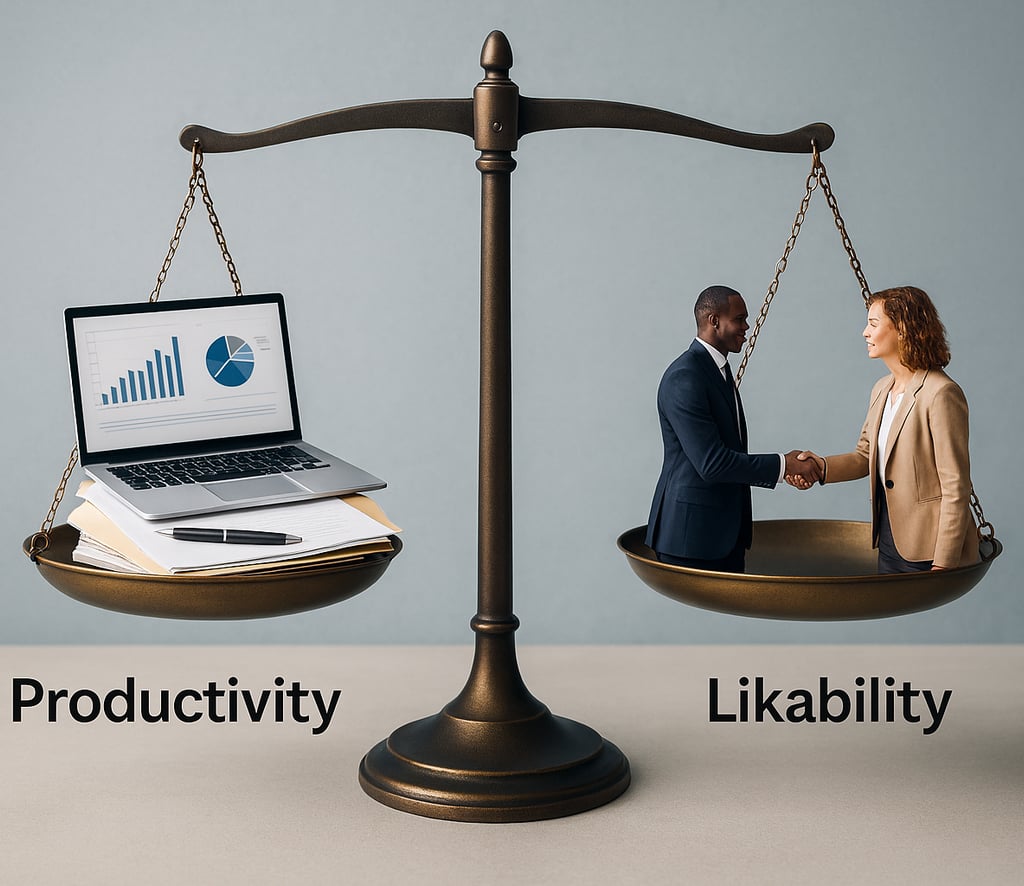
On her first day at the new job, Tasha Williams walked into the office with a résumé that outshined everyone on her team. She had the certifications, the technical mastery, and a track record of delivering results under impossible deadlines. Within weeks, her productivity figures were the highest in the department. She solved problems no one else could touch and consistently carried more weight than her peers.
But something puzzled her. Despite her output, she noticed that the people who were invited into key meetings, consulted on major decisions, and praised publicly by leadership were not always the top performers. They were the ones who laughed easily with colleagues, remembered birthdays, asked about people’s families, and made others feel comfortable. They weren’t always the most productive, but they were undeniably the most liked.
One afternoon, after completing a major project that saved the company thousands of dollars, Tasha overheard her manager praising another colleague for “being such a joy to work with.” The colleague had contributed far less to the project yet received more recognition. That moment stayed with her. It was the first time she realized that in the modern workplace, success wasn’t determined by output alone.
As the months passed, Tasha watched the same pattern repeat itself. The employees who advanced the fastest weren’t always the most competent, they were the ones who built relationships effortlessly, navigated office politics with grace, and made others feel valued. Their likability opened doors that productivity alone could not.
It was then she understood a truth many professionals learn too late: in every organization, two currencies operate simultaneously, productivity and likability. And the balance between them determines who rises, who stalls, and who gets left behind.
Tasha’s experience is not unique. Her story reflects a quiet truth shaping workplaces everywhere: success is no longer determined by productivity alone. Two forces operate side by side in every organization: the measurable output employees produce, and the social capital they build through likability. Understanding how these two currencies interact has become essential for navigating modern work environments because the balance between them often determines who advances, who is overlooked, and how teams function. This tension between productivity and likability is at the heart of today’s workplace dynamics, and it forms the foundation of the discussion that follows.
Weisinger (2015) observed that likability is a key driver of success in life. Put simply, how well an individual is liked has a positive correlation with success in the workplace, relationships, and friendships. Some employees possess qualities that transcend mere popularity. They are agreeable, friendly, respectful, dependable, and consistently follow through on commitments. These individuals are generally well‑liked, and research shows that likability is a necessary ingredient in building and sustaining meaningful relationships. People who display cooperative and friendly attitudes tend to be more socially accepted both in society and in the workplace. They easily endear themselves to others, form friendships quickly, and often exhibit extroverted tendencies. Human nature itself is rooted in the desire for connection, individuals seek attention, love, relationships, romance, and companionship. Humans consistently pursue approval, acceptance, and esteem to survive socially. As HBR (2023) noted, people have a conditioned need to be liked because of their social nature and their desire to belong within a group.
The Likability Quotient (LQ) refers to a person’s ability to bond with others, build relationships, and be well‑regarded by colleagues, associates, and team members. It encompasses qualities such as strong social skills, empathy, and genuineness. LQ can be measured by how well individuals treat others, how effectively they connect, and how engaged they are with the people around them. Key indicators of a high LQ include friendliness, a positive attitude, openness, familiarity, and authenticity. Trust, confidentiality, respect, and reliability are also essential components of a strong LQ. Individuals with a high LQ tend to attract meaningful emotional connections, listen more effectively, collaborate better, and exert greater influence. They often experience improved mental and emotional well‑being and ultimately achieve greater career success. Employees with high LQ frequently receive more recognition, are sought out for team projects, build rapport with leadership, contribute to positive work culture, and navigate office politics with ease. Likability becomes a necessary and sufficient factor for climbing the corporate ladder.
On the other hand, employee productivity is traditionally measured by the ratio of output to hours worked. Increased output translates to increased revenue and profitability. High productivity is essential for corporate growth, competitiveness, operational efficiency, reduced costs, improved morale, better customer engagement, and adaptability to market changes. Organizations drive productivity by setting clear goals, establishing deadlines, allocating resources efficiently, and implementing standardized performance appraisal systems. Employees, in turn, strive to raise their productivity levels to increase their value and contributions to the organization. Sustained productivity ensures long‑term corporate growth.
The Productivity Quotient (PQ) summarizes output relative to input. It measures how efficiently time and resources are used to achieve desired outcomes. PQ reflects the volume of tasks completed within a given timeframe. In performance assessments, PQ has become a critical parameter for evaluating employee contributions. It helps organizations identify areas for improvement, optimize resource allocation, and maximize output. Ultimately, raising productivity and generating profit remain central goals for most businesses. However, likability has increasingly become a dominant factor in performance assessments, employee appraisals, job satisfaction ratings, and career advancement. Leaders often prioritize likability over productivity when evaluating employees. Individuals with strong social skills are sometimes favored over those with higher productivity levels. Studies show that this imbalance can create bias and toxic work environments, where highly productive employees feel undervalued while less productive but more likable individuals are rewarded. A corporate culture that values both likability and productivity fosters more balanced, high‑performing teams. Leaders must address these imbalances by creating fair and objective evaluation systems. While productivity drives corporate growth, likability strengthens teams, relationships, and workplace culture. The right balance between the two produces collaborative, harmonious, and high‑performing employees who embody strong corporate values. Conversely, ineffective leadership — characterized by favoritism, preference for likability over competence, and reliance on office politics — can undermine organizational performance.
Organizations with clear goals, measurable performance criteria, results‑driven evaluations, and equal‑opportunity standards tend to succeed in the marketplace. Leaders should strive to avoid likability bias by encouraging diversity, minimizing favoritism, and emphasizing competence, skills, and achievements over social charm. Data‑driven decision‑making should guide performance evaluations, ensuring employees are assessed based on measurable results. Leaders must cultivate a merit‑based culture, promote the most qualified individuals, welcome diverse perspectives, seek regular feedback, and examine their own biases. While successful organizations value both productivity and social skills, employees ultimately want their contributions to be recognized and respected. When this balance is achieved, employees are more loyal, engaged, and committed to the organization. Yet eliminating likability bias remains challenging, as many leaders themselves rose through the ranks partly due to their high EQ, strong social skills, and ability to build relationships.
Ultimately, leaders must strive to balance productivity, performance, team‑building, and relationship skills. This balance is not a luxury; it is the foundation of a healthy, highly functioning organization. When leaders value both measurable output and the human dynamics that make output possible, they create environments where employees feel seen, respected, and motivated to contribute at their highest level. This equilibrium fosters stronger engagement, deeper satisfaction, and long‑term retention, all of which directly strengthen an organization’s bottom line. But achieving this balance requires intention. It demands that leaders examine their own biases, challenge outdated evaluation systems, and resist the temptation to reward likability at the expense of competence or productivity at the expense of humanity. It calls for a new kind of leadership discipline: one that honors results while also honoring relationships.
The future of work will belong to organizations that get this right. Those that build cultures where people are valued for both what they do and how they do it will attract stronger talent, inspire greater loyalty, and outperform competitors who rely on outdated, one‑dimensional metrics. The most successful companies will be those that understand that productivity and likability are not opposing forces, but complementary drivers of sustainable success. This is the moment for leaders to act. Reevaluate your performance systems. Revisit how you recognize and reward employees. Create spaces where collaboration is encouraged, feedback is welcomed, and diverse personalities can thrive. Invest in training that strengthens both technical competence and interpersonal intelligence. And above all, model the balance you expect from others, because culture follows leadership. The call to action is clear: build workplaces where productivity and likability work together, not against each other. When leaders commit to this balance, they don’t just improve performance metrics; they build organizations where people want to stay, grow, and give their best. And that is the true competitive advantage in today’s evolving workplace.
The names and characters used in this story, including Tasha Williams, are fictional and created solely to illustrate workplace scenarios. Any resemblance to real persons, living or dead, is purely coincidental.
References
1. Weisinger, H. (2015). The power of likability: How being liked boosts your career. James Kerr Inc.
2. Harvard Business Review. (2023). The hidden power of being liked at work. HBR.org.
3. Goleman, D. (2006). Social intelligence: The new science of human relationships. Bantam Books.
4. Grant, A. (2013). Give and take: Why helping others drives our success. Viking.
5. Cuddy, A., Kohut, M., & Neffinger, J. (2013). Connect, then lead. Harvard Business Review, 91(7–8), 54–61.
6. Enoma Ojo. (2026). Productivity vs Likability Quotient: The Hidden Equation That Shapes Careers. Inquiry & Insight.
© 2026 Enoma Ojo. All rights reserved.
This article is the original intellectual property of the author. Unauthorized copying, distribution, or adaptation of any portion of this work is strictly prohibited without express written consent.