
Information Asymmentry in Human Relationships
Information Asymmentry in Human Relationships explores how misunderstandings between people mirror the failures of imperfect markets. When emotional information is unevenly shared, when one person hides intentions, fears, or needs, the relationship becomes an inefficient system of exchange. This chapter reveals how hidden motives, distorted signals, and fear‑based communication create trust failures, showing that transparency and emotional honesty are not just moral virtues but structural necessities for stable human connections. It reframes love, trust, and misunderstanding through the lens of behavioral economics, proving that emotional clarity is the true currency of relational equity.
BEHAVIORAL ECONOMY
enoma ojo (2026)
5/31/202611 min read
ANALOGY: The Foggy Bridge
Imagine two people standing on opposite sides of a long bridge. The bridge represents the market. Each person wants to cross safely to meet in the middle and make an exchange. But the bridge is covered in fog. One person can see the entire structure clearly, every plank, every weak spot, every safe path. The other person can only see a few steps ahead.
The person with full visibility knows exactly where to step. They know which parts of the bridge are strong and which parts might collapse. They know how fast they can walk and how much weight the bridge can hold. They have perfect information.
The person with limited visibility must guess. They move slowly, cautiously, and sometimes in the wrong direction. They may overestimate the danger or underestimate the risk. They may hesitate, stall, or turn back entirely. They have imperfect information.
This is information asymmetry.
The fog represents the missing information. The uneven visibility represents the imbalance of knowledge. The hesitation, missteps, and mistrust represent market inefficiency.
When one person knows more than the other, the exchange becomes unstable. The person with less information feels vulnerable. The person with more information has power. And the bridge, the market, becomes a place where cooperation is harder, slower, and more fragile.
Human relationships are often described as emotional landscapes, spiritual bonds, or psychological exchanges, but beneath all of that softness lies a harder, more structural truth: relationships function like markets. They are systems of exchange, negotiation, signaling, and interpretation. They are shaped by incentives, expectations, and the flow, or the distortion, of information. And just as markets fail when information is unevenly distributed, relationships fracture when emotional information is incomplete, withheld, or misunderstood. The same forces that create inefficiencies in economic systems create inefficiencies in human connections. The same gaps that distort prices distort perceptions. The same hidden intentions that destabilize markets destabilize trust. When you look closely, misunderstandings in relationships are not random accidents. They are predictable outcomes of information asymmetry.
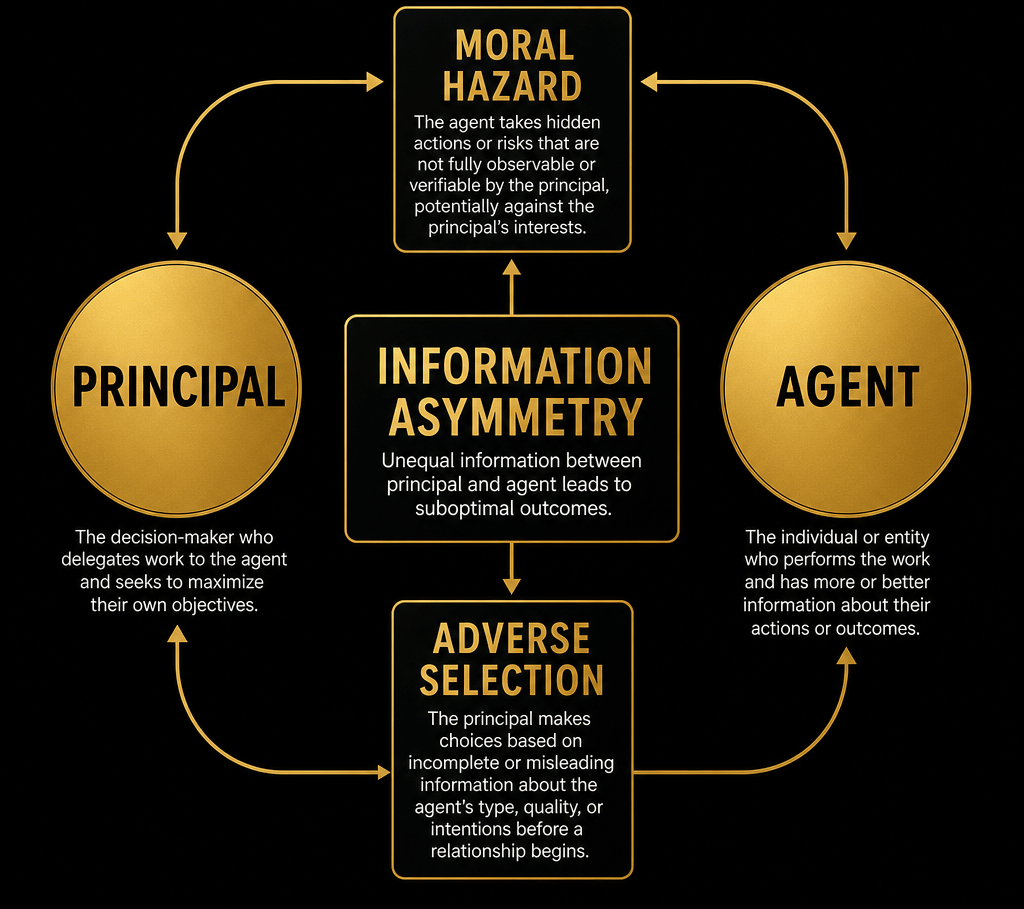
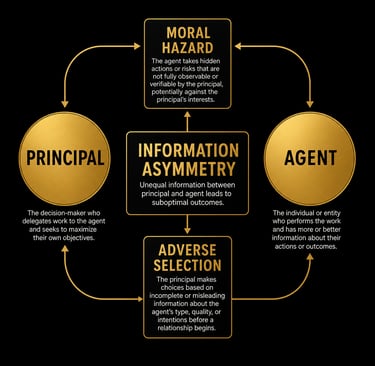
In Economics, Information asymmetry occurs when one party in an economic transaction has more or better information than the other. Because markets rely on the assumption that all participants have equal access to relevant information, any imbalance distorts decision‑making and leads to inefficient outcomes. When sellers know more about the quality of a product than buyers, or when borrowers know more about their likelihood of repayment than lenders, the market cannot price risk accurately. This mismatch produces predictable failures such as adverse selection, where high‑quality participants exit the market because they cannot signal their value, and moral hazard, where individuals change their behavior after securing a contract. After all, the other party cannot fully observe their actions. Information asymmetry explains why warranties exist, why insurance markets struggle, why credit markets ration loans, and why trust becomes a form of economic currency. At its core, the concept shows that markets do not fail because people are irrational, but because information is unevenly distributed, and when information is uneven, power is uneven.
Every relationship begins with imperfect information. Two people meet, each carrying a private world of experiences, fears, desires, and expectations. Each person knows their own emotional history, but neither knows the other’s. Each person understands their own intentions, but only guesses at the intentions of the other. This is the first asymmetry: the self is transparent to itself but opaque to others. And because humans are meaning‑making creatures, we fill the gaps with assumptions. We interpret silence as disinterest, hesitation as rejection, confidence as arrogance, kindness as obligation, and distance as punishment. We project our internal narratives onto external behavior. We treat our interpretations as facts. And in doing so, we create a relationship not with the other person, but with our idea of them.
Economists call this adverse selection: the risk of making choices based on incomplete or misleading information. In markets, adverse selection leads buyers to choose low‑quality goods because high‑quality sellers cannot credibly signal their value. In relationships, adverse selection leads people to choose partners who do not match their emotional needs because the signals they rely on are incomplete, ambiguous, or distorted. A person who appears confident may actually be emotionally unavailable. A person who appears attentive may be performing a role rather than revealing their true intentions. A person who appears distant may simply be afraid. When information is uneven, people make decisions based on the wrong signals, and the relationship begins with a structural disadvantage.
But the deeper asymmetry emerges after trust is granted. In economics, this is moral hazard: when one party changes their behavior after the other has committed. In relationships, moral hazard appears when someone becomes less careful with the other’s feelings once they feel secure. It appears when someone hides their true preferences to avoid conflict. It appears when someone takes advantage of the other’s emotional investment. It appears when someone stops signaling effort because they assume the relationship will hold. The asymmetry grows because one person has more information about their internal shifts than the other. And because the other cannot see these shifts directly, they interpret the behavioral changes through their own emotional lens. They assume the worst. They internalize the change. They blame themselves. The relationship becomes a negotiation between what is felt and what is shown, and the gap between the two becomes the breeding ground for misunderstanding.
Emotional signaling is the human equivalent of market signaling. In markets, firms signal quality through warranties, branding, pricing, and reputation. In relationships, people signal through tone, timing, vulnerability, consistency, and presence. But emotional signals are far less reliable than economic ones because humans are not rational agents broadcasting perfect information. Humans are emotional agents broadcasting filtered information. People signal what they think is safe to reveal. They signal what they hope will be interpreted correctly. They signal what they believe will protect them from rejection, judgment, or loss of power. And because fear is often louder than honesty, the signals people send are rarely clean. A person who wants closeness may signal indifference to avoid appearing needy. A person who wants reassurance may signal anger because vulnerability feels too risky. A person who wants to be understood may signal silence because they fear being misunderstood. The signal becomes noise, and the noise becomes misinterpretation.
Hidden intentions deepen the asymmetry because they create a silent gap between what people feel and what they reveal, and that gap becomes the fault line on which relationships fracture. Human beings rarely present themselves in full. Instead, they curate, filter, and manage the information they release to others, often without conscious awareness. This tendency is not a moral failing but a psychological survival strategy. People hide their insecurities because they fear being seen as weak, a fear rooted in the evolutionary need for social acceptance and belonging. As Baumeister and Leary argue, humans are fundamentally driven by the need to belong, and anything that threatens social inclusion triggers protective behavior (Baumeister & Leary, 1995). Vulnerability feels like exposure, and exposure feels like risk. So people conceal the parts of themselves that feel fragile, believing that invisibility is safer than honesty.
They hide their expectations because expectations create the possibility of disappointment, and disappointment is emotionally costly. Kahneman and Tversky’s work on loss aversion shows that the pain of loss is psychologically more powerful than the pleasure of gain (Kahneman & Tversky, 1979). In relationships, the “loss” people fear is not financial but emotional: the loss of hope, the loss of connection, the loss of imagined futures. By suppressing expectations, individuals believe they are protecting themselves from the emotional equivalent of a financial downturn. They think that if they expect less, they will hurt less. But in reality, unspoken expectations do not disappear; they simply become invisible liabilities that accumulate interest over time.
People hide their long‑term desires because they fear scaring the other person away. This is a form of strategic self‑presentation, a concept Goffman described as the performance of identity to manage impressions and avoid social penalties (Goffman, 1959). Long‑term desires, commitment, stability, partnership, growth are often withheld because they reveal too much too soon. They expose the depth of one’s emotional investment, and emotional investment creates vulnerability. When someone fears that their desires will be perceived as pressure, they silence themselves. They ration their truth. They offer only the parts of themselves they believe the other person can handle. The result is a relationship where both people are negotiating futures without ever articulating what those futures actually are. They hide their emotional needs because emotional needs are often framed as burdens. Many people grow up internalizing the belief that needing reassurance, affection, or clarity makes them “too much.” Attachment theory suggests that early relational experiences shape how individuals express or suppress their needs in adulthood (Bowlby, 1982). Those who learned that their needs were inconvenient or ignored often become adults who minimize or disguise those needs to avoid rejection. They fear that revealing their emotional hunger will make them appear dependent, demanding, or unstable. So they pretend to need less than they do. They shrink their desires to fit what they believe is acceptable. They starve themselves emotionally to avoid the shame of appearing needy.
They hide their fears because fear is the ultimate loss of control. To admit fear is to admit uncertainty, and uncertainty threatens the illusion of competence and stability. Humans are deeply motivated to maintain a sense of control over their environment, a principle well‑documented in psychological research (Skinner, 1996). When people fear abandonment, inadequacy, or failure, they often mask those fears with confidence, detachment, or even anger. Fear becomes the hidden variable driving behavior, but because it is concealed, the other person interprets the behavior without access to the underlying cause. What looks like indifference may actually be anxiety. What looks like avoidance may actually be longing. What looks like anger may actually be fear. But without the information, the interpretation becomes distorted.
The result is a relationship where each person is negotiating with partial information, trying to interpret signals that were never meant to be decoded, trying to understand motives that were never fully revealed. This mirrors Akerlof’s classic description of markets with hidden information, where one party cannot accurately assess the quality of the good being offered because the seller withholds critical details (Akerlof, 1970). In relationships, the “good” being evaluated is not a product but a person’s emotional truth. When that truth is obscured, the other person is forced to rely on assumptions, projections, and guesses. They fill the gaps with their own fears, histories, and insecurities. They respond not to the person in front of them but to the story they construct in the absence of clarity.
The emotional market becomes inefficient because the information flow is constrained by fear. Fear acts as a tax on communication, increasing the cost of honesty and reducing the supply of transparency. When fear governs what is shared and what is withheld, the relationship becomes a marketplace where the most valuable information, intentions, needs, and vulnerabilities are the least likely to be exchanged. This creates a structural imbalance. One person may be operating with a full emotional ledger, while the other is working with missing data. One person may be making decisions based on assumptions, while the other is making decisions based on unspoken fears. The asymmetry widens, and with it, the potential for misunderstanding.
In behavioral economics, markets with high information asymmetry tend to collapse because the cost of uncertainty becomes too high for participants to bear. The same is true in relationships. When people cannot trust the information they receive, they begin to withdraw. When they cannot interpret the signals accurately, they begin to doubt. When they cannot understand the motives behind behavior, they begin to protect themselves. Protection becomes distance. Distance becomes disconnection. Disconnection becomes the slow erosion of trust. And trust, once eroded, is difficult to rebuild because the very thing required to rebuild it, transparency, is the thing fear prevents.
Hidden intentions do not merely distort communication; they distort the entire relational ecosystem. They create emotional inefficiencies that accumulate over time, like friction in a machine. They create psychological transaction costs that make every interaction heavier, slower, and more fragile. They create a dynamic where both people are trying to love each other through a fog of uncertainty. And in that fog, even the most well‑intentioned actions can be misread, misinterpreted, or misunderstood.
Information asymmetry in relationships is not about deception but about protection. People hide because they fear losing what they value. They conceal because they fear being hurt. They withhold because they fear being misunderstood. But the paradox is that the very act of hiding creates the conditions for the pain they are trying to avoid. The more people protect themselves through concealment, the more they undermine the trust that would have made protection unnecessary. The more they hide their truth, the more they risk losing the connection they are trying to preserve. The path to emotional symmetry is not radical transparency but courageous honesty, the willingness to reveal enough truth to allow the other person to understand your behavior, your needs, and your fears. It is the recognition that vulnerability is not a liability but a form of relational capital. And it is the understanding that information, when shared with care, becomes the foundation on which trust is built.
Trust failures occur when the asymmetry becomes too large to bridge. Trust is not broken by a single event; it is eroded by accumulated uncertainty. When one person feels they are giving more than they are receiving, the asymmetry becomes emotional debt. When one person feels unheard, the asymmetry becomes emotional distance. When one person feels misled, the asymmetry becomes emotional risk. Trust collapses not because people are flawed, but because the information structure of the relationship becomes unstable. The emotional market crashes.
The tragedy is that most trust failures are preventable. They are not caused by malice but by misalignment. They are not caused by betrayal but by miscommunication. They are not caused by incompatibility but by asymmetry. When people do not share accurate emotional information, the relationship becomes a guessing game. And guessing is the enemy of trust. Trust requires clarity. Clarity requires transparency. Transparency requires courage. And courage requires the willingness to reveal information that could be used against you. This is why emotional honesty is so rare. It is costly. It is risky. It is vulnerable. But it is also the only way to create information symmetry.
The behavioral economics insight is that relationships fail for the same reason markets fail: unequal information, distorted signals, hidden motives, fear‑based communication, and misaligned expectations. When people do not share their true emotional states, the other person fills the gaps with their own fears. When people do not communicate their intentions, the other person assumes the worst. When people do not clarify their needs, the other person misinterprets their behavior. The relationship becomes an inefficient market where both parties are operating with incomplete data, making decisions based on assumptions rather than the truth. But the solution is not perfect transparency. Humans are not spreadsheets. Emotions are not data points. The goal is not to eliminate all uncertainty but to reduce unnecessary asymmetry. Emotional symmetry does not mean revealing everything; it means revealing what matters. It means sharing the information that allows the other person to understand your behavior, your intentions, your needs, and your fears. It means creating a relational environment where signals are clearer, motives are more aligned, and misunderstandings are less likely to metastasize into conflict.
Transparency becomes a form of emotional equity. When people share accurate information, they reduce the emotional transaction costs of the relationship. They reduce the need for guessing, interpreting, and overthinking. They reduce the risk of misalignment. They increase the stability of trust. They create a relationship where both parties can make decisions based on truth rather than fear. And in doing so, they transform the relationship from an imperfect market into a cooperative system.
In the end, information asymmetry in human relationships is not a flaw of human nature but a feature of human vulnerability. People hide because they fear being hurt. People signal indirectly because they fear being rejected. People misunderstand because they fear being wrong. But when two people commit to reducing asymmetry, not by demanding perfection but by offering clarity, they create a relationship that is not only emotionally richer but structurally stronger. They create a connection where trust is not a gamble but an investment. They create a bond where understanding is not accidental but intentional. They create a partnership where information flows freely enough for both people to feel seen, heard, and valued.
And that is the essence of emotional symmetry: the courage to let yourself be known, and the grace to truly know another.
Image Credit: Conceptual infographic (Cover Page) created by the author with the assistance of Microsoft Copilot (AI‑generated).
References:
Akerlof, G. A. (1970). The market for “lemons”: Quality Uncertainty and the Market Mechanism. Quarterly Journal of Economics, 84(3), 488–500.
Baumeister, R. F., & Leary, M. R. (1995). The Need to Belong: Desire for Interpersonal Attachments as a Fundamental Human Motivation. Psychological Bulletin, 117(3), 497–529.
Bowlby, J. (1982). Attachment and Loss: Vol. 1. Attachment (2nd ed.). New York: Basic Books.
Goffman, E. (1959). The Presentation of Self in Everyday Life. New York: Doubleday.
Kahneman, D., & Tversky, A. (1979). Prospect Theory: An Analysis of Decision Under Risk. Econometrica, 47(2), 263–291.
Skinner, E. A. (1996). A Guide to Constructs of Control. Journal of Personality and Social Psychology, 71(3), 549–570.
© 2026 Enoma Ojo. All rights reserved.
No part of this publication may be reproduced, distributed, or transmitted in any form or by any means, including photocopying, recording, scanning, or other electronic or mechanical methods, without the prior written permission of the author, except in the case of brief quotations embodied in critical reviews and certain other noncommercial uses permitted by copyright law.