
Human Progress as an Economic System
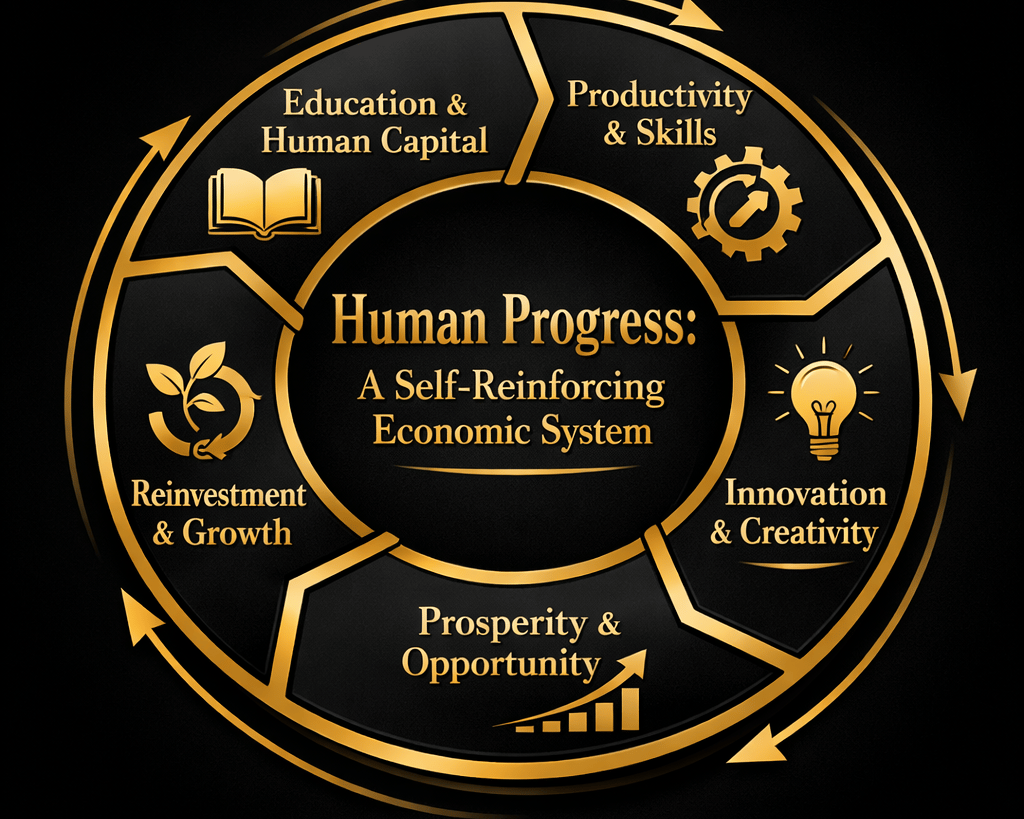
Human Progress as an Economic System explores the idea that progress is not random, it follows the same logic as an economic system. Human potential becomes the central resource, institutions act as the rules of the game, and psychology shapes the incentives that drive behavior. When societies design environments that reward curiosity, protect dignity, and enable upward mobility, progress accelerates. When they fail to do so, progress stalls. This article shows readers that the true engine of national advancement is not wealth or technology alone, but the way a society organizes and unleashes human potential.
INSIGHTS
Enoma Ojo (2026)
6/10/20264 min read
Why Societies Rise when Human Potential becomes the Central Resource
Human progress is rarely linear; it behaves more like a dynamic economic system shaped by incentives, institutions, and the psychology of the individuals operating within it. Development is not simply the accumulation of physical capital or technological upgrades; it is the unfolding of human capability within environments that either amplify or suppress it. Economists have long argued that growth emerges not only from material resources but from the “rules of the game” that structure human behavior, expectations, and opportunity (North, 1990). These rules determine whether people invest in their future, retreat into survival mode, or disengage entirely. When societies design incentives that reward curiosity, protect dignity, and encourage risk‑taking, they convert human potential into a compounding engine of progress. This is the central insight of institutional economics and modern political economy: inclusive systems unlock creativity and innovation, while extractive ones suffocate them (Acemoglu & Robinson, 2012). Progress accelerates when individuals believe their effort will be rewarded, when the social contract feels legitimate, and when upward mobility is not a privilege but a possibility. Under these conditions, human capital becomes self‑reinforcing; each investment in skills, trust, or knowledge increases the returns to the next.
Yet the deepest driver of progress lies in psychology. People innovate when they feel safe enough to take risks, confident enough to imagine alternatives, and empowered enough to act on their ideas. This aligns with decades of research showing that perceived control, self‑efficacy, and social trust shape economic behavior as powerfully as material incentives (Bandura, 1997). Progress, therefore, is not merely an economic phenomenon; it is a behavioral equilibrium. It emerges when institutions and incentives align with the fundamental architecture of human motivation. In this sense, the trajectory of a society is ultimately a reflection of what its people are allowed, and encouraged, to become. At its core, progress is a resource‑allocation problem. Nations that treat people as their primary asset, not merely as units of labor but as carriers of ideas, creativity, and adaptive intelligence, experience higher long‑run growth (Romer, 1990). Education becomes investment, trust becomes infrastructure, and innovation becomes a cultural equilibrium rather than a rare deviation. This aligns with endogenous growth theory, which shows that human capital and knowledge spillovers generate increasing returns over time (Lucas, 1988).
But the deepest driver is psychological. People innovate when they believe effort leads to reward, a principle supported by decades of behavioral research on motivation and perceived control (Bandura, 1997). They take risks when institutions reduce fear and uncertainty, reinforcing what Douglass North called the “rules of the game” that shape economic behavior (North, 1990). Trust, fairness, and social stability act as invisible economic variables that determine whether individuals invest in the future or retreat into survival mode (Putnam, 2000). Societies rise not because they possess the most natural resources, but because they create environments where human potential can flourish. History is full of resource‑rich nations that stagnated and resource‑poor nations that transformed themselves through institutional design, cultural norms, and strategic investment in people. When a society builds systems that reward effort, protect rights, and enable upward mobility, it activates what economists call dynamic complementarities; each improvement in human capability amplifies the next (Heckman, 2006). Progress becomes less about what a country has and more about what its people are empowered to become.
Institutions matter because they shape the psychological climate in which individuals make decisions. When people trust that the rules are fair, that opportunity is real, and that success will not be punished, they shift from short‑term survival behavior to long‑term investment behavior (North, 1990). This transition, from fear to possibility, is the true inflection point of development. It is where creativity expands, risk‑taking becomes rational, and innovation becomes a cultural habit rather than an exception. Human progress is ultimately a story about environments that unlock latent potential. It is about the quiet but compounding power of dignity, agency, and opportunity. When societies align their institutions with the deep architecture of human psychology, they create a self‑reinforcing cycle: empowered people build stronger systems, and stronger systems empower people. In the end, progress is not a mystery; it is the predictable outcome of environments that invite human beings to grow, contribute, and imagine beyond the constraints of the present.
Human progress ultimately unfolds within the spatial and social environments that societies create. Urbanization, when well‑governed, becomes a powerful accelerator of human potential, concentrating ideas, skills, and opportunities in ways that rural economies rarely can. But when cities grow faster than institutions, they reproduce and magnify inequality, creating what scholars describe as “urban opportunity gradients” that determine who benefits from development and who is left behind (UN‑Habitat, 2022). The promise of the city is not automatic; it depends on whether urban systems expand access to education, mobility, and secure livelihoods, or whether they entrench spatial divides that limit human flourishing.
Inequality sits at the center of this dynamic. High inequality distorts incentives, weakens trust, and shifts individual behavior toward short‑term survival rather than long‑term investment (Milanovic, 2016; Piketty, 2014). In such environments, even the most talented individuals face psychological and structural barriers that suppress innovation and risk‑taking. Conversely, societies that reduce inequality, not by flattening outcomes but by expanding genuine opportunity, unlock broader participation in the engines of growth. As Galor and Zeira (1993) show, equitable access to human‑capital investment generates intergenerational gains that compound across decades. When people believe the system is fair, they invest more deeply in their own future.
This is why human capital remains the decisive variable in the story of development. Cities that nurture learning, protect rights, and reward effort create ecosystems where human potential becomes self‑reinforcing. Institutions aligned with human psychology, institutions that cultivate dignity, agency, and upward mobility, transform urban spaces into platforms for collective advancement. In the end, progress is not merely the accumulation of infrastructure or income; it is the unfolding of human capability. Societies rise when they design environments that invite people to grow, contribute, and imagine beyond the constraints of the present. Human progress, therefore, is not a mystery; it is the predictable outcome of systems that choose to invest in people.
References
Acemoglu, D., & Robinson, J. A. (2012). Why nations fail: The origins of power, prosperity, and poverty. Crown.
Bandura, A. (1997). Self-efficacy: The exercise of control. W.H. Freeman.
Lucas, R. E. (1988). On the mechanics of economic development. Journal of Monetary Economics, 22(1), 3–42.
North, D. C. (1990). Institutions, institutional change and economic performance. Cambridge University Press.
Putnam, R. D. (2000). Bowling alone: The collapse and revival of American community. Simon & Schuster.
© 2026 Enoma Ojo. All rights reserved. Human Progress as an Economic System infographic and accompanying text are protected under U.S. and international copyright law.