
From Hospital Bills to Balance Sheets: The Economics of Health We Cannot Ignore.
An exploration of the hidden economics shaping American healthcare — from hospital bills to national balance sheets. This article breaks down why costs keep rising, how financial structures influence patient outcomes, and why understanding the economics of health is essential for meaningful reform.
Enoma Ojo
1/3/20265 min read
Health is more than a personal matter; it is the cornerstone of economic strength. A healthy population fuels productivity, innovation, and growth, while poor health drains resources and limits opportunity. Every hospital bill represents not just an individual’s struggle but a broader economic signal that affects families, businesses, and the nation. Health is the foundation of prosperity. A hospital bill is not just a medical record; it is an economic signal. When populations are healthy, productivity rises, innovation thrives, and economies grow. When health declines, families, businesses, and nations all pay the price. The cost of illness is staggering. Chronic and preventable diseases consume nearly three‑quarters of U.S. healthcare spending. These costs ripple outward, lowering workforce participation, raising insurance premiums, and draining household budgets. Prevention and wellness consistently deliver higher returns than reactive treatment.
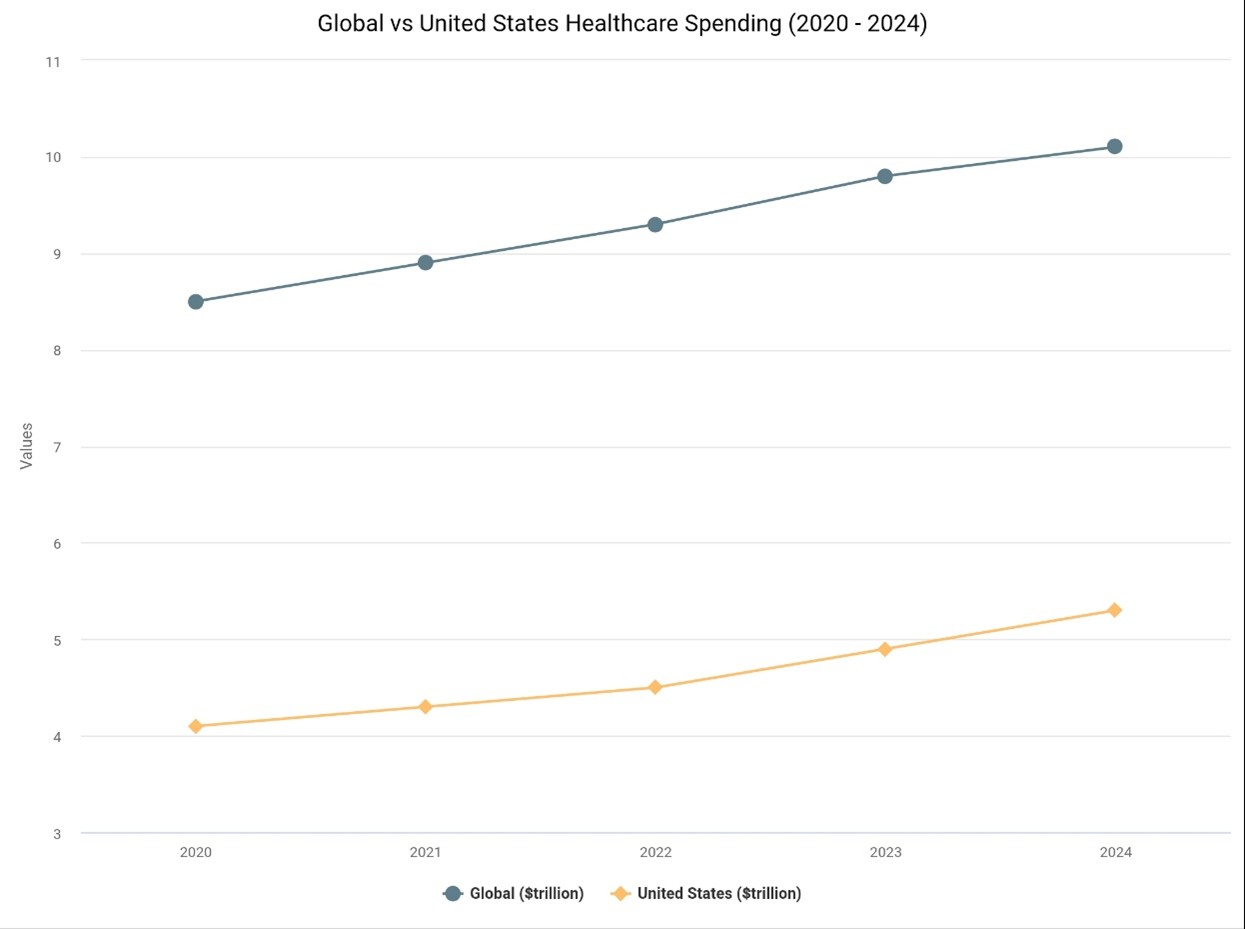
Figure 1 compares the global healthcare spending and the US. Global health spending rose steadily from $8.5 trillion in 2020 to $10.2 trillion in 2024. U.S. healthcare spending increased from $4.1 trillion in 2020 to $5.3 trillion in 2024. The U.S. consistently accounts for nearly half of global health spending, despite having only approximately 4 percent of the world’s population. The gap highlights both the scale of U.S. investment and ongoing debates about efficiency, equity, and healthcare outcomes. In 2021, the U.S. spent $7,500 per person on inpatient and outpatient care, while comparable countries averaged $2,969 Health is more than a personal matter; it is the cornerstone of economic strength and the foundation upon which societies build prosperity. When populations are healthy, they are more productive, innovative, and resilient. Workers can contribute consistently, families can thrive without the constant burden of medical debt, and businesses can focus resources on growth rather than covering the costs of absenteeism or rising insurance premiums. Conversely, poor health drains resources, limits opportunity, and creates ripple effects that extend far beyond the individual. Every hospital bill represents not just a personal struggle, but a broader economic signal that reverberates across households, corporations, and national budgets.
Consider the impact of chronic illness: conditions such as diabetes, cardiovascular disease, and respiratory disorders account for the majority of healthcare spending worldwide. In the United States, these preventable diseases consume nearly three‑quarters of total healthcare expenditures, translating into trillions of dollars annually. The economic consequences are staggering, including lost productivity, reduced workforce participation, and escalating insurance costs that affect both employers and employees. For families, a single medical emergency can destabilize financial security, forcing trade‑offs between healthcare, education, and housing. For businesses, rising healthcare premiums erode profitability and competitiveness. For governments, the cumulative effect is ballooning public expenditure that strains budgets and limits investment in infrastructure, education, and innovation. The economics of health also reveal deep inequities. Communities with limited access to healthcare services face reduced earning potential, higher poverty rates, and generational cycles of disadvantage. Health disparities are not only moral failures but economic liabilities, as they perpetuate inequality and weaken the overall resilience of the economy. A nation cannot fully harness its human capital if large segments of its population are excluded from preventive care, affordable treatment, and wellness opportunities. Addressing these disparities is both a moral imperative and a strategic economic decision. By investing in equitable healthcare systems, societies unlock untapped potential, reduce long‑term costs, and create conditions for sustainable growth.
At the organizational level, the business case for wellness is undeniable. Companies that prioritize employee health through preventive programs, mental health support, and workplace safety see measurable returns: lower turnover, higher engagement, and reduced insurance costs. Health is no longer a perk; it is a competitive advantage in attracting and retaining talent. On a macro scale, governments that treat healthcare spending as an investment rather than a cost build resilience against crises like pandemics and unlock long‑term prosperity. Innovations in telemedicine, artificial intelligence diagnostics, and preventive care models demonstrate that smarter spending can reduce inefficiencies while expanding access. Ultimately, the economics of health is clear: investing in well‑being today secures prosperity for tomorrow. A healthy population is not just a social good; it is the most valuable economic asset any nation can possess. Health disparities mirror and magnify economic inequality. Communities with limited access to care face reduced earning potential, higher poverty rates, and generational cycles of disadvantage. Addressing these inequities is not only a moral imperative but also an economic strategy, as healthier communities contribute more robustly to national prosperity. Health inequality fuels economic inequality. Communities with limited access to care face reduced earning potential and higher poverty rates. Breaking these cycles isn’t just moral, it is strategic. Health equity builds stronger, more resilient economies. Organizations that prioritize employee wellness are not simply offering perks; they are making strategic investments in their most valuable asset, people. When companies embed wellness into their culture, they see measurable gains in engagement, retention, and productivity. Employees who feel supported in their physical and mental health are more likely to remain loyal, contribute innovative ideas, and perform at higher levels. Reduced absenteeism, lower turnover, and decreased healthcare costs translate directly into financial savings, while improved morale fosters collaboration and creativity. In today’s competitive labor market, wellness programs are no longer optional; they are a differentiator that attracts top talent and strengthens organizational resilience.
On a larger scale, governments that treat healthcare spending as an investment rather than a cost build stronger, more resilient societies. Public health infrastructure is the backbone of national security and economic stability. Countries that allocate resources to preventive care, equitable access, and innovation in healthcare delivery are better prepared to withstand crises such as pandemics, natural disasters, or economic shocks. The COVID‑19 pandemic underscored this truth: nations with robust healthcare systems were able to recover faster, protect their populations, and sustain economic activity. By contrast, underinvestment in health leads to vulnerabilities that magnify the impact of crises, destabilize economies, and widen inequalities. The economics of health is clear: investing in well‑being today secures prosperity for tomorrow. Every dollar directed toward preventive care, wellness initiatives, and equitable access yields multiple returns in reduced treatment costs, increased productivity, and stronger communities. For businesses, the return on investment is seen in healthier, more engaged employees who drive innovation and growth. For governments, the return is measured in resilient populations, reduced poverty, and sustainable economic development. Health is not a peripheral issue; it is central to economic planning, workforce strategy, and national policy.
Ultimately, healthy nations are wealthy nations. The prosperity of a society is inseparable from the health of its people. Whether through corporate wellness programs or public health investments, the principle remains the same: well‑being fuels growth. Organizations that recognize this truth gain a competitive edge, while governments that embrace it secure long‑term stability. The economics of health is not abstract theory, it is a practical roadmap for building stronger businesses, more resilient communities, and more prosperous nations. By prioritizing wellness at every level, we unlock the full potential of human capital and lay the foundation for a future defined by both health and wealth. Health is not just personal; it is economic. Every choice we make about access, prevention, and innovation shapes the prosperity of tomorrow.
www.enomaojo.com
© 2025 Enoma Ojo. All rights reserved.
#EconomicsOfHealth #HealthcareInnovation #WellbeingAtWork #HealthEquity #FutureOfWork