
Fear as a Financial Constraint: How Emotional Avoidance Mimics Poverty Behavior
This article reframes fear not as a fleeting emotion but as a structural force that constrains human potential. It argues that fear operates like a financial constraint, taxing cognitive bandwidth, impairing executive function, and narrowing the field of perceived options. When fear dominates, people think and behave as if they are in scarcity: they make short‑term decisions, avoid risk, and underinvest in their own futures. Drawing on behavioral economics, cognitive psychology, and affective neuroscience, the piece synthesizes insights from Mullainathan and Shafir’s Scarcity Theory, Kahneman’s Dual‑Process Model, Baumeister’s Ego Depletion research, and contemporary neuroscience on threat processing. The result is a unified framework that explains how emotional avoidance, the instinct to escape discomfort, mirrors the behavioral patterns of financial poverty. This introduces the concept of emotional liquidity, a resource analogous to financial liquidity. Emotional liquidity represents the capacity to think clearly, regulate emotions, and engage with challenges without being overwhelmed by fear. When emotional liquidity is low, individuals, organizations, and societies experience cognitive contraction and systemic inefficiency. When it is restored, bandwidth expands, creativity returns, and long‑term decision‑making becomes possible. Ultimately, Fear as a Financial Constraint is a call to redesign our systems, educational, organizational, and cultural, to reduce fear and increase emotional liquidity. It challenges leaders, policymakers, and individuals to see fear not as a private weakness but as a public cost. By treating fear reduction as a form of resource design, we can expand human possibility, strengthen resilience, and create environments where people can think, act, and flourish freely.
enoma ojo (2025)
4/12/202624 min read
Abstract
Fear is widely understood as an emotional state, yet its cognitive, behavioral, and economic consequences remain underexamined within behavioral science. This article argues that fear functions as a de facto financial constraint by reducing cognitive bandwidth, impairing executive function, and narrowing the field of perceived options. Drawing on research in behavioral economics, cognitive psychology, and affective neuroscience, the article demonstrates that emotional avoidance, a common response to fear, produces behavioral patterns that closely resemble those observed in conditions of financial scarcity. These include short‑term decision‑making, risk aversion, reduced planning capacity, and diminished long‑term investment in goals. By synthesizing empirical findings from Mullainathan and Shafir’s scarcity theory, Kahneman’s dual‑process model, Baumeister’s ego‑depletion research, and contemporary neuroscience on threat processing, this article positions fear as a structural constraint on human agency. The analysis concludes by proposing a framework for understanding emotional liquidity as a resource analogous to financial liquidity, with implications for policy design, organizational leadership, and individual behavior change.
Keywords: Emotional Avoidance; Cognitive Bandwidth; Behavioral Economics; Emotional Liquidity
Introduction
Fear is typically conceptualized as an affective state, a subjective experience of threat, discomfort, or anticipated harm. Yet fear is also a cognitive event, a behavioral driver, and a systemic constraint. In the same way that financial scarcity reduces the capacity to plan, evaluate options, and make long‑term decisions, fear constricts the mind’s ability to operate at full cognitive bandwidth. This article advances the thesis that fear behaves like an internal poverty, and that emotional avoidance, the behavioral strategy used to escape or minimize fear, produces patterns that mirror those observed in financial scarcity. The relationship between fear and decision‑making has been documented across multiple domains. Research in affective neuroscience demonstrates that fear activates the amygdala and suppresses prefrontal cortex functioning, impairing executive processes such as planning, working memory, and inhibitory control (LeDoux, 2015; Phelps et al., 2014). Behavioral economics has shown that scarcity, whether of money, time, or cognitive resources, produces tunneling, short‑termism, and reduced capacity for long‑term investment (Mullainathan & Shafir, 2013). When fear consumes mental bandwidth, individuals exhibit similar patterns: they avoid decisions, defer action, and prioritize immediate relief over future benefit.
This article situates fear within the broader behavioral economy by examining how emotional avoidance mimics poverty behavior. Avoidance is often interpreted as laziness, irresponsibility, or lack of discipline. However, research suggests that avoidance is a rational response to perceived emotional cost (Hayes et al., 2012). When the emotional price of engagement feels too high, individuals behave as though they are operating under a binding constraint, much like a financial budget limit. This article argues that fear imposes a cognitive tax that functions analogously to economic scarcity, shaping behavior in predictable and measurable ways. The analysis proceeds in ten sections. First, it outlines the theoretical foundation for understanding fear as a cognitive load. Second, it examines the neuroscience of fear and its impact on executive function. Third, it explores emotional avoidance as a behavioral economy. Fourth, it draws explicit parallels between fear‑driven behavior and poverty behavior. Fifth, it analyzes the opportunity costs and emotional debt generated by avoidance. Sixth, it considers fear as a constraint on ambition and upward mobility. Seventh, it examines the relational consequences of fear. Eighth, it analyzes the identity‑level effects of chronic fear. Ninth, it proposes a framework for restoring emotional liquidity. Finally, it concludes with implications for policy, leadership, and system design.
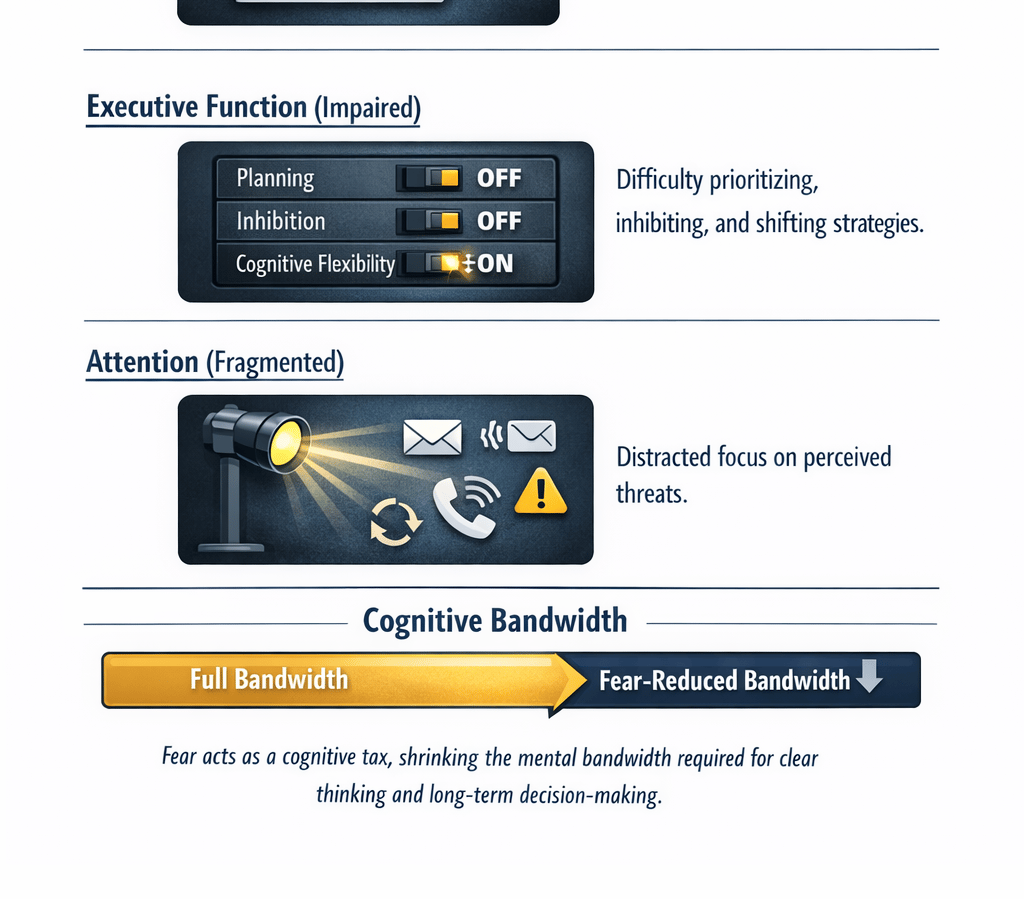
Fear is not merely an emotional reaction; it is a cognitive event that consumes mental resources. Cognitive load theory posits that the mind has limited working memory capacity and that tasks requiring attention, planning, or problem‑solving draw from this finite pool (Sweller, 2011). When fear is present, it occupies a disproportionate share of cognitive bandwidth, leaving fewer resources available for executive function. The concept of cognitive bandwidth has been central to behavioral economics. Mullainathan and Shafir (2013) argue that scarcity, whether of money, time, or attention, reduces the mental capacity available for decision‑making. Scarcity creates tunneling, a cognitive narrowing that prioritizes immediate concerns at the expense of long‑term planning. Fear produces a similar effect. When individuals experience fear, their attention narrows to the perceived threat, reducing their ability to consider broader options or future consequences. Dual‑process theories of cognition further illuminate the relationship between fear and decision‑making. Kahneman (2011) distinguishes between System 1 (fast, automatic, emotional) and System 2 (slow, deliberate, analytical). Fear activates System 1, triggering rapid threat responses and suppressing the slower, more reflective processes associated with System 2. As a result, individuals under fear are more likely to make impulsive decisions, avoid complex tasks, and rely on heuristics rather than analytical reasoning. Fear also interacts with self‑regulation. Baumeister et al. (1998) propose that self‑control draws from a limited pool of cognitive resources. When fear consumes these resources, individuals have less capacity for self‑regulation, increasing the likelihood of avoidance, procrastination, and short‑term decision‑making. This aligns with research showing that stress impairs working memory and executive function (Shields et al., 2016). Taken together, these theories suggest that fear functions as a cognitive tax. It reduces available bandwidth, impairs executive function, and narrows the field of perceived options. This cognitive constriction mirrors the effects of financial scarcity, providing a theoretical foundation for understanding fear as an internal poverty.
The Neuroscience of Fear as a Cognitive Load
Fear is fundamentally a neurobiological event. Its effects on cognition and behavior are mediated through well‑documented neural pathways that prioritize survival over deliberation. Understanding fear as a financial‑like constraint requires examining how the brain reallocates resources under threat, shifting from reflective processing to reactive, short‑term responses. The amygdala, a key structure in the limbic system, plays a central role in detecting and responding to threats. When a potential danger is perceived, the amygdala initiates a cascade of physiological and cognitive changes designed to prepare the organism for immediate action (LeDoux, 2015). This activation triggers the hypothalamic‑pituitary‑adrenal (HPA) axis, releasing stress hormones such as cortisol and adrenaline. These hormones heighten vigilance and mobilize energy resources but simultaneously impair higher‑order cognitive functions (McEwen & Morrison, 2013). One of the most significant consequences of amygdala activation is the suppression of prefrontal cortex (PFC) activity. The PFC is responsible for executive functions such as planning, decision‑making, impulse control, and working memory (Miller & Cohen, 2001). When the amygdala signals threat, neural resources are diverted away from the PFC toward subcortical regions involved in rapid threat response. This shift is adaptive in acute danger but maladaptive in situations requiring complex reasoning or long‑term planning. Research using functional magnetic resonance imaging (fMRI) has shown that fear reduces PFC activation and increases reliance on habitual or avoidance‑based behaviors (Phelps et al., 2014). Under fear, individuals are more likely to choose immediate, low‑effort options, even when these options are suboptimal in the long term. This mirrors the decision patterns observed in financial scarcity, where cognitive load reduces the ability to evaluate future consequences (Shah et al., 2012). Fear also impairs working memory, a core component of cognitive bandwidth. Working memory allows individuals to hold and manipulate information, enabling tasks such as problem‑solving, planning, and decision‑making. Stress and fear reduce working memory capacity by interfering with PFC functioning and increasing distractibility (Shields et al., 2016). This impairment contributes to the cognitive narrowing associated with both fear and scarcity.
A very important concept of neural mechanisms is attentional bias. Fear heightens attention to threat‑related stimuli, reducing the ability to attend to neutral or positive information (Bar‑Haim et al., 2007). This attentional narrowing parallels the tunneling effect described in scarcity research, where individuals focus disproportionately on immediate deficits at the expense of broader considerations (Mullainathan & Shafir, 2013). Taken together, these findings demonstrate that fear imposes a measurable cognitive load that reduces executive function, narrows attention, and impairs long‑term planning. These neural mechanisms provide a biological foundation for understanding fear as a constraint analogous to financial scarcity.
Emotional Avoidance as a Behavioral Economy
Emotional avoidance is one of the most common behavioral responses to fear. Avoidance involves efforts to escape, minimize, or suppress uncomfortable emotions, thoughts, or situations (Hayes et al., 2012). While avoidance may provide short‑term relief, it often produces long‑term costs, including impaired functioning, reduced goal attainment, and increased psychological distress. From a behavioral economics perspective, avoidance can be conceptualized as a cost‑minimizing strategy. When the emotional cost of engaging with a task or decision feels too high, individuals behave as though they are operating under a binding constraint. This constraint is not financial but emotional: “I cannot afford the emotional price of this right now.” This framing aligns with research showing that individuals weigh emotional costs similarly to financial costs when making decisions (Loewenstein & Lerner, 2003). Avoidance behaviors often mirror the patterns observed in financial scarcity. For example, individuals experiencing fear‑driven avoidance may prioritize short‑term relief over long‑term benefit, similar to how individuals in poverty may prioritize immediate needs over future investments (Haushofer & Fehr, 2014). Avoidance also leads to procrastination, a behavior associated with both emotional discomfort and reduced cognitive bandwidth (Sirois & Pychyl, 2013). Emotional avoidance can also be understood through the lens of opportunity cost. When individuals avoid tasks or decisions, they forgo potential benefits, such as career advancement, relationship repair, or personal growth. These opportunity costs accumulate over time, creating a form of emotional debt. Emotional debt refers to the increasing burden of unresolved tasks, unmade decisions, and unaddressed emotions. Like financial debt, emotional debt compounds, making re‑engagement more difficult and costly. Avoidance also interacts with self‑efficacy. Bandura (1997) argues that self‑efficacy, the belief in one’s ability to succeed, is a key determinant of behavior. Fear and avoidance reduce self‑efficacy by reinforcing the belief that one cannot handle difficult tasks or emotions. This creates a feedback loop in which avoidance leads to reduced confidence, which in turn increases avoidance. In sum, emotional avoidance functions as a behavioral economy governed by perceived emotional costs, opportunity costs, and emotional debt. These dynamics mirror the patterns observed in financial scarcity, supporting the argument that fear operates as an internal poverty.
The Poverty Parallel: How Fear Shrinks the Field of Possibility
Fear and financial scarcity share a common psychological architecture: both create environments of contraction. When individuals experience fear, their cognitive and emotional resources narrow, reducing their ability to consider long‑term goals, evaluate multiple options, or engage in complex decision‑making. This contraction mirrors the effects of poverty, which limits financial options and constrains cognitive bandwidth. Research on poverty has shown that scarcity reduces cognitive capacity, leading to impaired decision‑making and reduced long‑term planning (Mani et al., 2013). Scarcity creates tunneling, a cognitive narrowing that focuses attention on immediate deficits at the expense of broader considerations. Fear produces a similar tunneling effect. When individuals experience fear, their attention narrows to the perceived threat, reducing their ability to consider alternative perspectives or future consequences. Fear also reduces risk tolerance. Individuals experiencing fear are more likely to avoid risks, even when those risks offer potential long‑term benefits (Lerner & Keltner, 2001). This risk aversion mirrors the behavior of individuals in financial scarcity, who may avoid investments or opportunities due to the perceived risk of loss. Another parallel between fear and poverty is the impact on trust. Research has shown that scarcity reduces trust in others, as individuals become more focused on protecting limited resources (Haushofer & Fehr, 2014). Fear similarly reduces trust by heightening vigilance and increasing sensitivity to potential threats. Reduced trust limits social support, collaboration, and access to resources, further constraining the field of possibility. Fear also affects time perception. Individuals experiencing fear perceive time as more limited, leading to a focus on immediate concerns and reduced long‑term planning (Gable et al., 2019). This temporal narrowing mirrors the short‑termism observed in financial scarcity, where individuals prioritize immediate needs over future goals. Taken together, these parallels suggest that fear and poverty share a common psychological structure. Both conditions reduce cognitive bandwidth, narrow attention, increase risk aversion, reduce trust, and impair long‑term planning. These similarities support the argument that fear functions as an internal poverty, shaping behavior in ways that mirror the effects of financial scarcity.
The Economics of Avoidance, Opportunity Costs, and Emotional Debt
Avoidance is often framed as a failure of discipline or motivation, but within an economic framework, it is more accurately understood as a cost‑minimizing strategy. When individuals experience fear, the emotional cost of engaging with a task or decision increases. This perceived cost functions as a constraint, shaping behavior in ways that mirror financial scarcity. In both cases, individuals prioritize immediate relief over long‑term benefit, leading to patterns of short‑termism, underinvestment, and accumulated debt. Avoidance is often perceived as a cost‑minimizing strategy. Behavioral economics emphasizes that individuals make decisions based not only on financial costs but also on psychological and emotional costs (Loewenstein & Lerner, 2003). Fear increases the emotional cost of engagement, making tasks feel more burdensome, risky, or overwhelming. When the emotional cost exceeds perceived emotional resources, individuals choose avoidance as the least costly option. This aligns with prospect theory, which suggests that individuals are more sensitive to losses than gains (Kahneman & Tversky, 1979). In the context of fear, the “loss” is emotional discomfort, and avoidance becomes a strategy to minimize that loss. Avoidance also reflects the principle of bounded rationality. Simon (1955) argued that individuals make decisions within the limits of their cognitive resources. When fear reduces cognitive bandwidth, individuals rely on heuristics and choose low‑effort options. Avoidance is one such heuristic: it requires minimal cognitive effort and provides immediate emotional relief, even if it leads to long‑term costs.
Opportunity cost is a central concept in economics, referring to the benefits forgone when choosing one option over another. Avoidance carries significant opportunity costs, as individuals forgo potential gains in career, relationships, health, and personal development. These costs accumulate over time, creating a widening gap between potential and actual outcomes. For example, avoiding a difficult conversation may preserve short‑term emotional comfort but forgoes the opportunity to repair a relationship, set boundaries, or resolve conflict. Avoiding financial decisions may prevent immediate anxiety, but it forgoes opportunities for investment, savings, or debt reduction. Avoiding career‑related tasks may reduce stress in the moment but forgoes opportunities for advancement, skill development, or increased income. Research on procrastination supports this analysis. Sirois and Pychyl (2013) found that procrastination is driven by emotion regulation rather than time management. Individuals avoid tasks to reduce negative emotions, but this avoidance leads to increased stress, reduced performance, and long‑term negative outcomes. These findings suggest that avoidance is a form of opportunity cost miscalculation, where individuals prioritize immediate emotional relief over long‑term benefits.
Emotional debt refers to the accumulation of unresolved tasks, unmade decisions, and unaddressed emotions. Like financial debt, emotional debt compounds over time, increasing the cost of re‑engagement. The longer a task is avoided, the more emotionally burdensome it becomes, creating a cycle of increasing avoidance and increasing emotional cost. This dynamic mirrors the concept of debt spirals in economics, where individuals become trapped in a cycle of borrowing to cover previous debts, leading to an increasing financial burden (Banerjee & Duflo, 2011). In the context of fear, individuals avoid tasks to reduce emotional discomfort, but this avoidance increases emotional debt, making future engagement even more difficult. Emotional debt also interacts with cognitive load. As unresolved tasks accumulate, they occupy mental space, reducing cognitive bandwidth and increasing stress. Research on the Zeigarnik effect suggests that unfinished tasks remain active in working memory, creating cognitive tension (Baumeister & Masicampo, 2010). This cognitive tension increases the emotional cost of engagement, reinforcing avoidance.
Temporal discounting refers to the tendency to devalue future rewards relative to immediate ones. Individuals experiencing fear are more likely to engage in steep temporal discounting, prioritizing immediate emotional relief over long‑term benefits. This mirrors the behavior of individuals in financial scarcity, who may prioritize immediate needs over future investments due to limited cognitive bandwidth (Shah et al., 2012). Fear increases temporal discounting by narrowing attention to immediate threats and reducing the ability to consider future consequences. This leads to decisions that prioritize short‑term comfort over long‑term well‑being, such as avoiding difficult tasks, delaying important decisions, or choosing low‑effort options. From an economic perspective, avoidance can be understood as a rational response to perceived emotional scarcity. When individuals feel that they lack the emotional resources to handle a task, they behave as though they are operating under a binding constraint. This constraint shapes behavior in predictable ways, leading to short‑termism, risk aversion, and underinvestment in long‑term goals. Fear not only shapes immediate decisions but also constrains long‑term ambition, risk‑taking, and personal growth. These constraints mirror the effects of financial scarcity, which limits upward mobility by reducing access to resources, opportunities, and long‑term planning capacity. Fear functions as an internal barrier to growth, shaping behavior in ways that limit potential and reinforce existing patterns. Risk aversion is a well‑documented consequence of fear. Lerner and Keltner (2001) found that fear increases pessimistic risk assessments, leading individuals to avoid risks even when potential gains outweigh potential losses. This risk aversion mirrors the behavior of individuals in financial scarcity, who may avoid investments or opportunities due to the perceived risk of loss. Fear‑driven risk aversion limits upward mobility by reducing willingness to pursue opportunities that require uncertainty or discomfort. This includes career changes, entrepreneurial ventures, financial investments, and personal development goals. When fear constrains risk‑taking, individuals remain in familiar but limiting environments, reducing long‑term growth.
Ambition paralysis refers to the inability to pursue long‑term goals due to fear‑driven cognitive and emotional constraints. When fear reduces cognitive bandwidth, individuals struggle to plan, initiate, or sustain long‑term efforts. This paralysis mirrors the effects of financial scarcity, which reduces the capacity for long‑term planning and investment (Mani et al., 2013). Ambition paralysis is reinforced by avoidance, which reduces self‑efficacy and increases emotional debt. As individuals avoid tasks related to their goals, they internalize the belief that they are incapable of achieving those goals. This creates a feedback loop in which fear reduces ambition, and reduced ambition reinforces fear. Human capital refers to the skills, knowledge, and abilities that contribute to economic and personal success. Fear reduces investment in human capital by increasing the emotional cost of learning, growth, and self‑improvement. This mirrors the behavior of individuals in financial scarcity, who may underinvest in education or training due to limited resources. Fear‑driven underinvestment in human capital has long‑term consequences, reducing career opportunities, income potential, and personal fulfillment. This underinvestment is often misinterpreted as a lack of motivation or discipline, but it is more accurately understood as a rational response to perceived emotional constraints. Fear also functions as a ceiling on potential by limiting the range of actions individuals are willing or able to take. This ceiling is not based on ability but on perceived emotional capacity. When fear reduces cognitive bandwidth and increases emotional cost, individuals operate below their potential, making decisions that prioritize safety over growth. This ceiling mirrors the structural barriers faced by individuals in financial scarcity, who may be unable to pursue opportunities due to a lack of resources. In both cases, the constraint is not internal ability but external or internal scarcity.
The Social Dimension: How Fear Distorts Relationships and Trust
Fear does not operate solely within the individual; it also shapes interpersonal dynamics, social behavior, and relational decision‑making. In the same way that financial scarcity constrains social participation, reduces trust, and limits access to supportive networks, fear creates relational scarcity, a reduction in the emotional, cognitive, and behavioral resources available for connection. This section examines how fear alters communication, trust, conflict resolution, and social investment, drawing parallels to the relational consequences of poverty. Trust is a foundational component of social and economic exchange. Research in behavioral economics shows that scarcity reduces trust by increasing vigilance and perceived vulnerability (Haushofer & Fehr, 2014). Fear produces a similar effect. When individuals experience fear, the amygdala heightens sensitivity to potential threats, including social threats such as rejection, criticism, or conflict. This heightened vigilance reduces the willingness to rely on others, share information, or engage in collaborative decision‑making. Lerner and Keltner (2001) found that fear increases pessimistic risk assessments, including assessments of interpersonal risk. Individuals experiencing fear are more likely to interpret ambiguous social cues as negative, overestimate the likelihood of betrayal, and underestimate the reliability of others. This reduces trust and increases social withdrawal, limiting access to supportive networks and collaborative opportunities. Fear significantly alters communication patterns. Individuals experiencing fear are more likely to avoid difficult conversations, suppress emotions, and engage in indirect communication. This avoidance mirrors the short‑termism observed in financial scarcity, where individuals prioritize immediate comfort over long‑term relational health. Research on emotion regulation suggests that suppression, a common avoidance strategy, impairs communication and reduces relational satisfaction (Gross & John, 2003). Suppression increases cognitive load, reduces emotional clarity, and impairs the ability to respond adaptively to social cues. This leads to misunderstandings, unresolved conflicts, and relational strain. Fear also reduces assertiveness. Individuals experiencing fear may struggle to express needs, set boundaries, or advocate for themselves. This reduces relational equity and increases the likelihood of resentment, withdrawal, or conflict escalation. These patterns mirror the relational consequences of scarcity, where individuals may lack the resources to engage in effective communication or conflict resolution.
Fear and Social Withdrawal
Social withdrawal is a common response to fear. When individuals perceive social interactions as emotionally costly, they may withdraw to reduce emotional discomfort. This withdrawal mirrors the behavior of individuals in financial scarcity, who may reduce social participation due to limited resources. Social withdrawal has significant consequences for mental health and well‑being. Research shows that social isolation increases stress, reduces resilience, and impairs cognitive functioning (Cacioppo & Hawkley, 2009). Withdrawal also reduces access to social support, which is a key buffer against stress and a predictor of positive outcomes in health, work, and relationships. Fear‑driven withdrawal creates a feedback loop. As individuals withdraw, they lose opportunities for positive social experiences, reinforcing the belief that social interactions are risky or overwhelming. This increases fear and further reduces social engagement, creating a cycle of relational scarcity. Conflict avoidance is a specific form of emotional avoidance that has significant relational consequences. When individuals avoid conflict, they forgo opportunities to resolve issues, clarify expectations, or repair relationships. This avoidance mirrors the opportunity costs observed in financial scarcity, where individuals forgo long‑term benefits due to short‑term constraints. Research on conflict resolution suggests that avoidance leads to unresolved issues, increased tension, and reduced relational satisfaction (Gottman, 2011). Avoidance also reduces trust, as individuals may interpret avoidance as disinterest, disengagement, or lack of commitment. These relational costs accumulate over time, creating emotional debt within relationships. Relational scarcity is the reduction in relational resources, such as trust, communication, support, and collaboration, caused by fear. This scarcity mirrors the relational consequences of financial scarcity, which reduces access to supportive networks, increases stress, and limits opportunities for social mobility. Fear‑driven relational scarcity has significant implications for well‑being. Social support is a key predictor of resilience, mental health, and life satisfaction (Taylor, 2011). When fear reduces relational resources, individuals become more vulnerable to stress, less able to cope with challenges, and less likely to pursue opportunities that require collaboration or support. Social capital refers to the resources available through social networks, including information, support, and opportunities.
Fear reduces social capital by limiting social participation, reducing trust, and impairing communication. This mirrors the effects of financial scarcity, which reduces access to social networks and opportunities for upward mobility. Reduced social capital has long‑term consequences. Individuals with low social capital are less likely to access job opportunities, mentorship, or collaborative projects. They are also less likely to receive emotional support during times of stress. Fear‑driven reductions in social capital therefore limit both personal and professional growth. Cooperation is essential for social and economic functioning. Research shows that fear reduces cooperative behavior by increasing self‑protection and reducing trust (De Dreu et al., 2010). Individuals experiencing fear are more likely to prioritize personal safety over collective benefit, reducing willingness to collaborate, share resources, or engage in joint decision‑making. This reduction in cooperation mirrors the behavior of individuals in financial scarcity, who may prioritize immediate personal needs over collective goals due to limited resources. Fear‑driven reductions in cooperation therefore have implications for teamwork, organizational functioning, and community engagement.
Fear and Self‑Efficacy
Self‑efficacy is the belief in our ability to succeed in specific tasks or situations (Bandura, 1997). Fear reduces self‑efficacy by increasing perceived difficulty and reducing perceived capacity. When individuals experience fear, tasks feel more overwhelming, risks feel more threatening, and challenges feel more insurmountable. This reduces confidence and increases avoidance. Reduced self‑efficacy creates a feedback loop. As individuals avoid tasks due to fear, they lose opportunities to build competence, reinforcing the belief that they are incapable. This mirrors the effects of financial scarcity, which reduces opportunities for skill development and reinforces beliefs about limited ability or potential. Self‑concept refers to the beliefs individuals hold about themselves. Fear alters self‑concept by increasing self‑criticism, reducing self‑compassion, and reinforcing negative identity narratives. Individuals experiencing fear may internalize beliefs such as “I can’t handle this,” “I’m not capable,” or “I’ am not good enough.” These beliefs reduce motivation, increase avoidance, and limit personal growth. Research on self‑compassion suggests that individuals who respond to fear with self‑criticism experience increased stress, reduced resilience, and impaired functioning (Neff, 2011). Fear‑driven self‑criticism, therefore, has significant implications for identity and well‑being. Identity narratives are the stories individuals tell about themselves, who they are, what they can do, and what is possible for them. Fear shapes these narratives by narrowing the field of possibility. When individuals experience fear, they may adopt narratives that emphasize limitation, vulnerability, or inadequacy. These narratives reduce ambition, limit risk‑taking, and reinforce avoidance. This mirrors the identity‑level effects of financial scarcity, which can lead individuals to internalize narratives of limitation, helplessness, or unworthiness. Research on poverty stigma suggests that individuals in financial scarcity may internalize negative stereotypes, reducing self‑esteem and limiting upward mobility (Walker, 2014). Fear produces similar identity‑level effects, reducing the sense of agency and possibility.
Agency refers to the capacity to act intentionally and influence one’s environment. Fear reduces agency by increasing perceived constraints and reducing perceived control. When individuals experience fear, they may feel powerless, overwhelmed, or unable to influence outcomes. This reduces motivation, increases avoidance, and limits goal pursuit. Reduced agency mirrors the effects of financial scarcity, which reduces perceived control and increases feelings of helplessness. Research on learned helplessness suggests that individuals who experience repeated uncontrollable stressors may develop a generalized sense of helplessness, reducing motivation and impairing functioning (Maier & Seligman, 2016). Fear can produce similar effects, reduce agency, and limit potential. Identity poverty refers to a diminished sense of self, reduced sense of possibility, and limited sense of agency. Fear creates identity poverty by reducing self‑efficacy, altering self‑concept, narrowing identity narratives, and reducing agency. This identity poverty mirrors the effects of financial scarcity, which reduces opportunities for identity development and reinforces narratives of limitation. Identity poverty has significant implications for behavior, well‑being, and long‑term outcomes. Individuals experiencing identity poverty are less likely to pursue opportunities, take risks, or invest in long‑term goals. They are also more vulnerable to stress, less resilient, and more likely to engage in avoidance. Fear‑driven identity poverty, therefore, limits both personal and professional growth.
Breaking the Cycle: Restoring Emotional Liquidity
If fear functions as an internal scarcity and avoidance behaves like a cost‑minimizing strategy under emotional constraint, then the pathway out of fear‑driven behavior must be conceptualized not as a moral transformation but as a resource restoration process. In the same way that financial scarcity interventions focus on increasing liquidity, reducing cognitive load, and expanding access to resources, interventions for fear‑driven avoidance must focus on restoring emotional liquidity, the capacity to tolerate, process, and move through emotional discomfort without becoming cognitively overloaded. Emotional liquidity is analogous to financial liquidity: it represents the availability of flexible, accessible emotional resources that can be deployed to meet internal demands. Individuals with high emotional liquidity can engage with difficult tasks, tolerate uncertainty, and navigate discomfort without becoming overwhelmed. Individuals with low emotional liquidity experience emotional bottlenecks, where even small tasks feel disproportionately costly. This section examines the psychological, behavioral, and environmental mechanisms that restore emotional liquidity and reduce fear‑driven avoidance. Emotional liquidity is closely tied to cognitive bandwidth. When individuals have sufficient emotional resources, they can allocate cognitive resources to planning, decision‑making, and problem‑solving. When emotional resources are depleted, cognitive bandwidth narrows, leading to avoidance, short‑termism, and impaired functioning. Research on stress and cognitive load supports this relationship. Shields et al. (2016) found that acute stress impairs working memory and executive function, reducing the capacity for complex cognitive tasks. Conversely, interventions that reduce stress, such as mindfulness, cognitive reappraisal, and social support, improve cognitive functioning and increase emotional resilience (Gross, 2015). These findings suggest that emotional liquidity can be increased by reducing emotional load and enhancing emotional regulation. Reducing emotional load involves decreasing the emotional demands placed on the individual. This can be achieved through strategies that reduce fear, increase safety, and create emotional margin.
Across these sections, a single truth becomes unmistakable: fear is not merely an emotional event but a systemic condition shaped by the environments we build, the demands we impose, and the resources we provide. Emotional liquidity, the capacity to think clearly, regulate effectively, and engage without being overwhelmed, emerges not from willpower but from context. When psychological safety is high, uncertainty is reduced, emotional margin is restored, and environments are designed to reduce cognitive friction, people regain the bandwidth to function at their best. The research is consistent across domains. Supportive systems increase resilience. Predictable structures reduce threat responses. Mindfulness, reappraisal, and exposure expand emotional capacity. Social support and self‑compassion replenish internal resources. Behavioral design reduces cognitive load and enables better choices. In short, emotional liquidity is not an individual luxury; it is a structural outcome. This systemic lens reframes fear-driven behavior as a predictable response to scarcity, not moral failure, not lack of discipline, but a deficit of psychological, emotional, and environmental resources. When organizations, communities, and institutions design for safety, clarity, support, and cognitive ease, fear diminishes, and human potential expands.
Conclusion
Fear functions as a financial constraint because it taxes the very systems we rely on to think, plan, and act. It narrows cognitive bandwidth, disrupts executive function, and collapses the field of perceived options into a tight, survival‑driven tunnel. Emotional avoidance, the brain’s attempt to escape discomfort, produces behavioral patterns that look strikingly similar to those observed in financial scarcity: short‑term decisions, risk aversion, and chronic underinvestment in long‑term goals. What appears as procrastination, inconsistency, or lack of discipline is often the predictable outcome of emotional depletion, not personal failure. But the impact of fear extends far beyond individual behavior. It shapes relationships by creating relational scarcity, a reduction in trust, openness, and connection. It shapes identity by producing identity poverty, a shrinking sense of agency, possibility, and self‑worth. And it shapes systems by generating systemic costs, reduced innovation, impaired decision‑making, increased conflict, and diminished collective capacity. Fear is not just a feeling; it is an economic force that drains human potential. Restoring emotional liquidity is therefore not optional. It is essential for breaking the cycle of fear‑driven behavior. Emotional liquidity expands cognitive bandwidth, reduces avoidance, and strengthens functioning across every domain of life. It enables individuals to tolerate uncertainty, engage with difficult tasks, and pursue long‑term goals without being overwhelmed by the emotional cost of doing so.
Interventions must shift accordingly. Instead of demanding more discipline, more grit, or more willpower, we must focus on increasing emotional resources, reducing emotional demands, and designing environments that support emotional resilience. This mirrors the research on scarcity: people do not rise to pressure; they rise to support, clarity, and well‑designed systems. Fear‑reducing system design is a public good. Systems that reduce fear and increase emotional liquidity do more than help individuals cope; they expand the collective field of possibility. They increase cognitive bandwidth, enhance decision‑making, strengthen relationships, and enable communities and organizations to flourish. Understanding fear as a financial constraint gives us a powerful framework for designing interventions that support individual, organizational, and societal well‑being.
If fear can function like poverty, then ignoring fear is no longer a personal oversight; it is a structural failure. We cannot continue to treat fear as a private, internal problem while building systems that amplify uncertainty, overload cognitive bandwidth, and punish emotional vulnerability. The cost is too high. Every day we delay redesigning our environments, we lose human potential, organizational capacity, and societal resilience. The wake‑up call is simple: fear is not just an emotion to be managed; it is an economic drain, a cognitive tax, and a systemic liability.
If we want people to think clearly, collaborate effectively, innovate boldly, and live fully, we must design systems that make emotional liquidity the norm rather than the exception. The future belongs to the individuals, organizations, and societies that understand this truth, and act on it.
References
Bandura, A. (1997). Self-efficacy: The exercise of control. W.H. Freeman.
Banerjee, A., & Duflo, E. (2011). Poor economics: A radical rethinking of the way to fight global poverty. PublicAffairs.
Bar-Haim, Y., Lamy, D., Pergamin, L., Bakermans-Kranenburg, M. J., & van IJzendoorn, M. H. (2007). Threat-related attentional bias in anxious and nonanxious individuals: A meta-analytic study. Psychological Bulletin, 133(1), 1–24.
Baumeister, R. F., & Masicampo, E. J. (2010). Consider it done! Plan making can eliminate the cognitive effects of unfulfilled goals. Journal of Personality and Social Psychology, 98(6), 933–947.
Baumeister, R. F., Bratslavsky, E., Muraven, M., & Tice, D. M. (1998). Ego depletion: Is the active self a limited resource? Journal of Personality and Social Psychology, 74(5), 1252–1265.
Cacioppo, J. T., & Hawkley, L. C. (2009). Perceived social isolation and cognition. Trends in Cognitive Sciences, 13(10), 447–454.
Craske, M. G., Treanor, M., Conway, C. C., Zbozinek, T., & Vervliet, B. (2014). Maximizing exposure therapy: An inhibitory learning approach. Behaviour Research and Therapy, 58, 10–23.
De Dreu, C. K. W., Greer, L. L., Handgraaf, M. J. J., Shalvi, S., Van Kleef, G. A., Baas, M., Ten Velden, F. S., Van Dijk, E., & Feith, S. W. W. (2010). The neuropeptide oxytocin regulates parochial altruism in intergroup conflict among humans. Science, 328(5984), 1408–1411.
Dutton, J. E., & Heaphy, E. D. (2003). The power of high-quality connections. In K. S. Cameron, J. E. Dutton, & R. E. Quinn (Eds.), Positive organizational scholarship (pp. 263–278). Berrett-Koehler.
Edmondson, A. (1999). Psychological safety and learning behavior in work teams. Administrative Science Quarterly, 44(2), 350–383.
Gable, P. A., Poole, B. D., & Harmon-Jones, E. (2019). Anger perceptually and conceptually narrows attention on target objects. Emotion, 19(5), 814–828.
Gottman, J. (2011). The science of trust: Emotional attunement for couples. W.W. Norton.
Gross, J. J. (2015). Emotion regulation: Current status and future prospects. Psychological Inquiry, 26(1), 1–26.
Gross, J. J., & John, O. P. (2003). Individual differences in two emotion regulation processes: Implications for affect, relationships, and well-being. Journal of Personality and Social Psychology, 85(2), 348–362.
Grupe, D. W., & Nitschke, J. B. (2013). Uncertainty and anticipation in anxiety: An integrated neurobiological and psychological perspective. Nature Reviews Neuroscience, 14(7), 488–501.
Haushofer, J., & Fehr, E. (2014). On the psychology of poverty. Science, 344(6186), 862–867.
Hayes, S. C., Strosahl, K. D., & Wilson, K. G. (2012). Acceptance and commitment therapy: The process and practice of mindful change (2nd ed.). Guilford Press.
Kahneman, D. (2011). Thinking, fast and slow. Farrar, Straus and Giroux.
Kahneman, D., & Tversky, A. (1979). Prospect theory: An analysis of decision under risk. Econometrica, 47(2), 263–291.
LeDoux, J. E. (2015). Anxious: Using the brain to understand and treat fear and anxiety. Viking.
Lerner, J. S., & Keltner, D. (2001). Fear, anger, and risk. Journal of Personality and Social Psychology, 81(1), 146–159.
Loewenstein, G., & Lerner, J. S. (2003). The role of affect in decision making. In R. Davidson, K. Scherer, & H. Goldsmith (Eds.), Handbook of affective science (pp. 619–642). Oxford University Press.
Maier, S. F., & Seligman, M. E. P. (2016). Learned helplessness at fifty: Insights from neuroscience. Psychological Review, 123(4), 349–367.
Mani, A., Mullainathan, S., Shafir, E., & Zhao, J. (2013). Poverty impedes cognitive function. Science, 341(6149), 976–980.
Mayer, J. D., Roberts, R. D., & Barsade, S. G. (2008). Human abilities: Emotional intelligence. Annual Review of Psychology, 59, 507–536.
McEwen, B. S., & Morrison, J. H. (2013). The brain on stress: Vulnerability and plasticity of the prefrontal cortex over the life course. Neuron, 79(1), 16–29.
Miller, E. K., & Cohen, J. D. (2001). An integrative theory of prefrontal cortex function. Annual Review of Neuroscience, 24, 167–202.
Mullainathan, S., & Shafir, E. (2013). Scarcity: Why having too little means so much. Times Books.
Neff, K. D. (2011). Self-compassion, self-esteem, and well-being. Social and Personality Psychology Compass, 5(1), 1–12.
Newman, A., Donohue, R., & Eva, N. (2017). Psychological safety: A systematic review of the literature. Human Resource Management Review, 27(3), 521–535.
Phelps, E. A., Lempert, K. M., & Sokol-Hessner, P. (2014). Emotion and decision making: Multiple modulatory neural circuits. Annual Review of Neuroscience, 37, 263–287.
Putnam, R. D. (2000). Bowling alone: The collapse and revival of American community. Simon & Schuster.
Shah, A. K., Mullainathan, S., & Shafir, E. (2012). Some consequences of having too little. Science, 338(6107), 682–685.
Shields, G. S., Sazma, M. A., & Yonelinas, A. P. (2016). The effects of acute stress on core executive functions: A meta-analysis and comparison with cortisol. Neuroscience & Biobehavioral Reviews, 68, 651–668.
Simon, H. A. (1955). A behavioral model of rational choice. The Quarterly Journal of Economics, 69(1), 99–118.
Tang, Y. Y., Hölzel, B. K., & Posner, M. I. (2015). The neuroscience of mindfulness meditation. Nature Reviews Neuroscience, 16(4), 213–225.
Taylor, S. E. (2011). Social support: A review. In H. S. Friedman (Ed.),
© 2026 Enoma Ojo. All rights reserved. This article is an original scholarly work. The concepts, frameworks, and analytical structures presented herein, including the constructs of emotional liquidity, relational scarcity, identity poverty, and fear as a systemic constraint, are the intellectual property of the author. Permission must be obtained for any reproduction, distribution, quotation beyond fair use, or adaptation of the theoretical models or language contained in this work.