Education Inequality and the Future of Learning
This article explores how digital access, lifelong learning, and global innovation are reshaping the future of education. It examines the systems that elevate some learners while excluding others, and it asks a simple but urgent question: What kind of future are we building if millions of people cannot access the tools required to thrive in it?
ARTICLES & ESSAYS
enoma ojo (2025)
1/27/20266 min read


The future of learning is being written in real time, but not everyone has a pen. As technology reshapes classrooms, workplaces, and entire economies, the world is dividing into two distinct realities: those who can access the tools of the future and those who are locked out before they even begin. A child with a tablet, stable internet, and digital‑literate teachers steps into a world of limitless possibilities. A child without these essential steps is entering a world where opportunity is rationed, delayed, or denied. Education inequality is no longer just about textbooks, teachers, or school buildings. It is about who gets to participate in the digital age. It is about whether learning becomes a universal right or a selective privilege. And it is about whether the next generation inherits a world where knowledge is shared, or a world where it is gated behind economic, geographic, and technological barriers.
The world is undergoing a profound transformation in how people learn, driven by digital technology, artificial intelligence, and global connectivity. Yet this transformation is unfolding unevenly, creating new forms of inequality that mirror, and intensify, old ones. Education inequality has always shaped opportunity, but in the digital age, the consequences are more far‑reaching. Access to technology now determines who can participate in the future economy and who will be left behind. The digital divide has become the new literacy divide. Just as reading determined who could access knowledge, digital access now determines who can access the modern world.
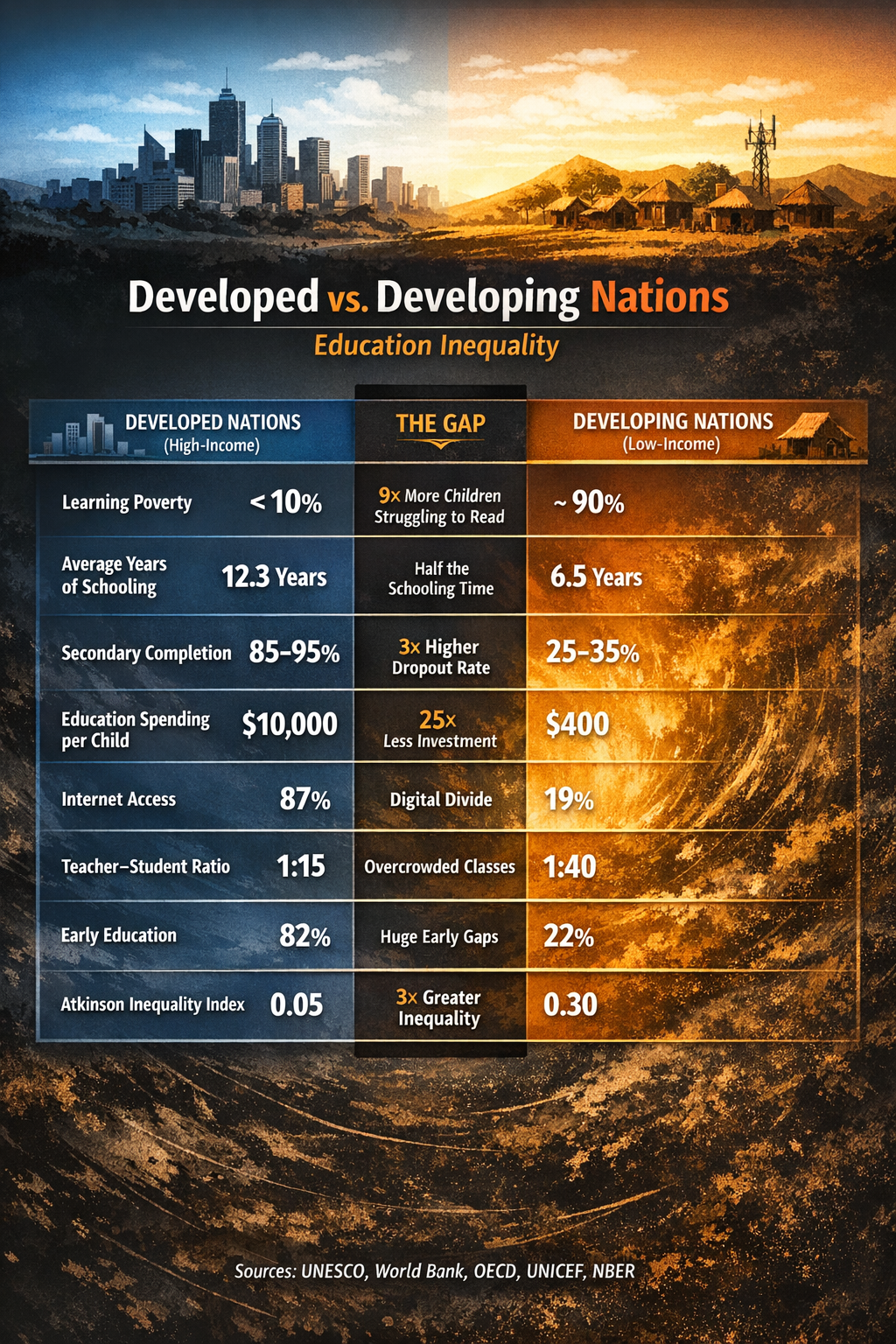
In many high‑income countries, students learn with laptops, AI tutors, and virtual labs. In low‑income regions, millions of children still lack electricity, textbooks, or safe classrooms. The gap is widening, not closing. Digital access shapes opportunity from early childhood. Children who grow up with connectivity develop stronger digital literacy, problem‑solving skills, and confidence navigating online spaces. Meanwhile, children without access fall behind academically and socially. They miss out on online learning, global resources, and the digital fluency required for modern careers. The pandemic exposed this divide dramatically. While 87% of children in high‑income countries accessed online learning, only 6% in low‑income countries could do the same. Years of progress were erased in months. Digital inequality does not end in childhood. The future of work demands continuous learning, upskilling, and adaptability, all of which require digital access. Adults without connectivity face shrinking economic mobility. They cannot access online courses, digital certifications, or remote work opportunities.
Lifelong learning has become a human development imperative. It is no longer optional; it is essential for economic survival and personal growth. The psychological benefits of lifelong learning are equally important. Continuous learning builds confidence, resilience, and a sense of agency, especially for those navigating economic hardship. Global data shows that digital access has become one of the strongest predictors of educational opportunity. The OECD reports that unequal access to devices, broadband, and digital skills now drives learning disparities across countries and income levels. Even in wealthy nations, socio‑economically advantaged schools are significantly better prepared for digital learning across nearly every indicator measured. This confirms that the digital divide is not just a technological issue; it is a structural one.
The pandemic exposed this divide with unprecedented clarity. While most students in high‑income countries could transition to online learning, millions in low‑income regions were completely disconnected. UNESCO found that remote learning failures were driven by a lack of devices, weak infrastructure, and limited teacher training. These gaps erased years of progress and widened global learning inequalities, especially for children already facing economic hardship. In the United States, new 2024 data reveal that digital inequality remains widespread even in a high‑income nation. A national study found that 28% of school‑age children did not use the internet at home or school, and another 22.8% only had access at home. These disparities were strongly linked to income, community demographics, and school resources. This shows that digital access is not guaranteed by national wealth; it is shaped by local investment and policy choices.
The consequences extend far beyond childhood. As the future of work becomes increasingly digital, adults without connectivity face shrinking economic mobility. They cannot access online courses, digital certifications, or remote work opportunities. Lifelong learning, once a personal choice, has become a survival skill in a rapidly changing global economy. Without digital access, entire communities’ risk being locked out of emerging opportunities. The data also highlights that digital access alone is not enough. Even when students have devices and internet, many struggle with motivation, comprehension, and digital literacy. The OECD notes that students across multiple countries reported difficulty understanding assignments during remote learning, revealing that technology must be paired with strong pedagogy, teacher training, and supportive learning environments. Taken together, the data paints a clear picture: the future of learning will be defined by digital access, and the world is not prepared. Inequality is deepening across countries, communities, and generations. Without intentional investment in connectivity, infrastructure, and digital literacy, the global education system will continue to reproduce and intensify, the very inequalities it should be dismantling.
Global case studies reveal both the depth of inequality and the power of innovation. In Kenya, solar‑powered tablets are transforming rural education. In India, girls in low‑income communities are learning coding and reshaping gender norms. In Scandinavia, digital literacy begins in early childhood, supported by national policy. These countries demonstrate what is possible when governments treat digital access as a public good. In the United States, however, many districts still rely on outdated computers and inconsistent internet access, showing that inequality exists even in wealthy nations. In refugee camps, mobile‑based education has become a lifeline, proving that innovation can reach even the most vulnerable when designed intentionally. These stories highlight a central truth: technology can democratize learning, but only if access is equitable. Innovation without inclusion deepens inequality.
Policymakers must recognize that digital access is not a luxury. It is infrastructure, as essential as roads, electricity, and clean water. National strategies must prioritize connectivity, teacher training, digital literacy, and long‑term investment in educational technology. The future of learning is at a crossroads. It can become a force for global equality or a driver of deeper division. The outcome depends on the choices leaders make today. The next generation is watching. Their future will be shaped by whether we build systems that include them or exclude them. The responsibility is ours, and the time to act is now.
The future of learning is not an accident waiting to happen; it is a choice waiting to be made. Every nation, institution, and leader must decide whether education will be a bridge to opportunity or a barrier that reinforces inequality. Digital access, lifelong learning, and global innovation are not luxuries; they are the infrastructure of human development in the 21st century. If we fail to act, the divide between the connected and the disconnected will harden into a permanent global fault line. But if we choose courage, investment, and equity, we can build a world where every learner, regardless of birthplace, income, or circumstance, has the tools to rise.
The next generation is watching. They are watching how we respond to learning poverty, how we expand digital access, how we protect girls’ education, and how we prepare adults for a rapidly changing world. They are watching whether we treat education as a public good or a private privilege. And their future will be shaped not by our intentions, but by our decisions. This is the moment to lead. This is the moment to invest. This is the moment to build a future where learning is not a privilege for the few but a pathway for all. Because education is not just about classrooms and curricula, it is about power, possibility, and participation. It is about whether a child in a rural village, a refugee camp, or an underfunded district can access the tools to shape their own future. It is about whether adults can re‑skill, re‑learn, and re‑enter a workforce that demands constant adaptation. And it is about whether nations will rise together or fracture along lines of access and exclusion.
We must recognize that digital access, lifelong learning, and inclusive policy are not optional features of modern education; they are the infrastructure of human development. They determine who gets to innovate, who gets to lead, and who gets to thrive in the 21st century. To every policymaker, educator, and global leader: the time for incremental reform has passed. What’s needed now is bold investment, systemic redesign, and a moral commitment to equity. We must fund connectivity as we fund roads. We must train teachers as we train engineers. We must protect girls’ education as we protect national security. And we must build systems that honor every learner’s dignity, regardless of income, geography, or circumstance.
Because when we invest in education, we invest in peace, prosperity, and shared human potential. If we fail to invest, we do not just fail children, we fail the future. Let us choose wisely. Let us choose boldly. Let us choose to build a world where every mind has the chance to rise.
References
1. UNESCO. (2023). Global Education Monitoring Report.
2. World Bank. (2022). Learning Poverty: What It Is and Why It Matters.
3. OECD. (2020). Education at a Glance.
4. Blanden, J., Doepke, M., & Stuhler, J. (2022). Education Inequality. Centre for Economic Performance.
5. Farquharson, C., McNally, S., & Tahir, I. (2024). Education Inequalities. Oxford Open Economics.
6. Reimers, F. (2021). Learning from a Pandemic: The Impact of COVID‑19 on Global Education. Harvard Education Press.
7. UNICEF. (2021). COVID‑19 and School Closures: One Year of Education Disruption.
8. NBER. (2022). Educational Inequality. National Bureau of Economic Research.
9. OECD. (2019). Trends Shaping Education.
10. UNESCO Institute for Statistics. (2020). New Methodology for Measuring Learning Outcomes.
.© 2026 Enoma Ojo Inquiry & Insight. All Rights Reserved.
This original work blends research, narrative analysis, and strategic insight. Reproduction or redistribution without written permission is prohibited.