
Bridging the Cybersecurity Workforce Gap in U.S. Healthcare: A National Imperative.
“Bridging the Cybersecurity Workforce Gap in U.S. Healthcare” highlights the urgent need to strengthen the nation’s digital defenses by expanding and supporting the cybersecurity workforce. As healthcare systems face rising cyber threats, closing this talent gap has become a national priority, essential for protecting patient data, ensuring continuity of care, and safeguarding critical infrastructure.
enoma ojo (2024)
1/4/20264 min read
The U.S. healthcare system faces a growing cybersecurity crisis, driven by rapid digital transformation and a severe shortage of specialized cyber professionals. Hospitals, clinics, and public health agencies increasingly rely on electronic health records, telemedicine platforms, and connected medical devices, all of which are vulnerable to sophisticated cyberattacks. Yet, the federal government lacks a coordinated strategy to recruit and retain experts who understand both cybersecurity and the unique demands of healthcare environments. Recent reports reveal alarming gaps in workforce data and interagency coordination. The Government Accountability Office found that most federal agencies do not maintain accurate records of their cybersecurity personnel, especially contractors. This lack of visibility undermines national efforts to assess vulnerabilities and deploy talent where it’s needed most. In healthcare, the problem is compounded by the absence of training programs tailored to clinical workflows, HIPAA compliance, and patient safety.
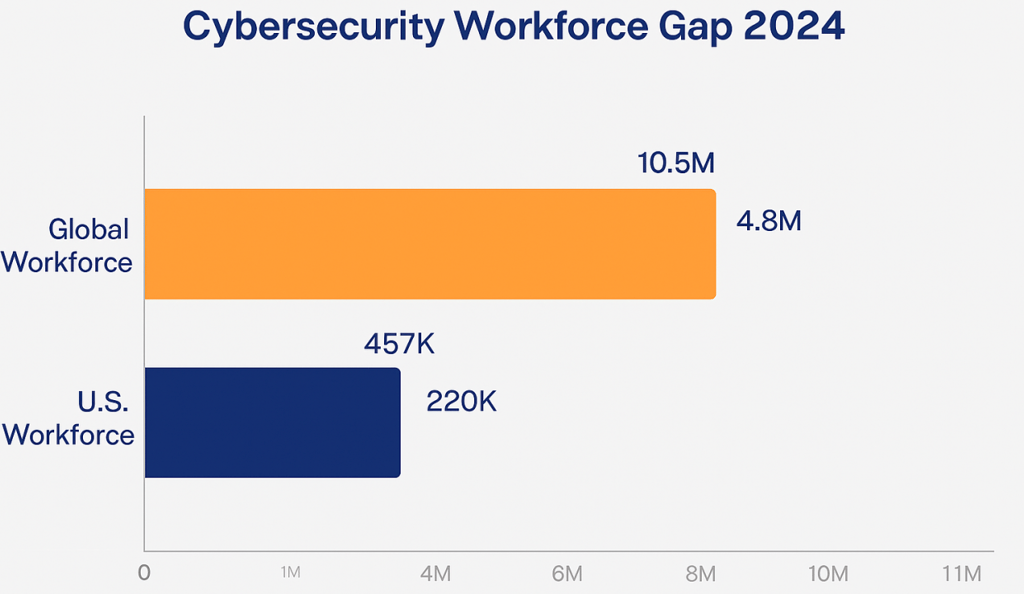
Global Cybersecurity Workforce Gap: As of 2024, the global cybersecurity workforce stood at 5.5 million, but the estimated demand was 10.2 million, resulting in a gap of 4.8 million professionals, a 19% year-over-year increase. U.S. Cybersecurity Job Openings: In 2025, there were 457,398 cybersecurity-related job postings across the United States, with a supply-to-demand ratio that remains critically low. Healthcare Sector Specifics: While exact numbers for healthcare cybersecurity are harder to isolate, industry leaders at the 2025 HIMSS conference emphasized that 55% of health systems plan to increase cybersecurity staffing, yet many still lack the talent pipelines to meet those goals. Federal Agency Blind Spots: A recent GAO report revealed that 22 out of 23 federal agencies could not accurately account for their cybersecurity contractor workforce, making strategic planning nearly impossible. According to the 2024 (ISC)² Cybersecurity Workforce Study, the global shortfall in cyber professionals has reached 4.8 million. In the U.S. alone, CyberSeek reports over 450,000 open cybersecurity roles, with healthcare systems struggling to fill specialized positions. A 2023 GAO report revealed that 22 out of 23 federal agencies lack accurate data on their cyber contractor workforce, making strategic planning nearly impossible.
Healthcare cybersecurity demands far more than general technical proficiency; it requires a deep, sector-specific understanding of clinical environments, regulatory frameworks, and patient-centered care. Unlike other industries, healthcare systems operate with life-critical infrastructure, legacy technologies, and highly sensitive data that must be protected without disrupting medical workflows. Cyber professionals in this space must grasp the nuances of HIPAA compliance, electronic health record (EHR) systems, and the vulnerabilities inherent in connected medical devices. Legacy systems pose a unique challenge. Many hospitals and clinics still rely on outdated software and hardware that were never designed with cybersecurity in mind. These systems often lack basic encryption, patching capabilities, or network segmentation, making them prime targets for ransomware and data breaches. Securing such environments requires not only technical upgrades but also strategic planning that balances patient safety, operational continuity, and budget constraints, skills that only healthcare-savvy cybersecurity experts can offer.
Moreover, the rise of telehealth, remote monitoring, and AI-driven diagnostics has expanded the attack surface exponentially. Cyber threats now extend beyond hospital walls into patients’ homes and cloud-based platforms. Anticipating and mitigating these risks requires professionals who understand both the technological architecture and the ethical implications of digital health. Without targeted investment in healthcare-specific cybersecurity education, fellowships, and workforce development, the U.S. risks leaving its most vulnerable institutions exposed. To safeguard the future of American healthcare, the federal government must prioritize building a pipeline of cyber professionals trained specifically for this sector. This includes funding interdisciplinary programs, incentivizing public-private partnerships, and creating career pathways that attract talent into healthcare cybersecurity. The cost of inaction is not just financial, it’s human. Every breach threatens lives, erodes trust, and undermines the integrity of care. Bridging this workforce gap is not optional; it is essential to the resilience and dignity of our healthcare system.
Federal inaction has created a dangerous vacuum, but the path forward is clear. Policymakers must prioritize funding for healthcare cybersecurity fellowships, mandate transparent workforce reporting, and build public-private partnerships to accelerate talent development. A national registry of cyber experts could help match professionals to high-risk sectors, while universities and hospitals should be incentivized to co-develop training pipelines. This is not merely a technical challenge; it is a moral imperative that strikes at the heart of public trust and human dignity. In healthcare, cybersecurity breaches don’t just compromise data; they disrupt care, expose vulnerable patients, and erode the sanctity of institutions meant to heal. When a hospital system is locked down by ransomware or a patient’s medical history is leaked, the consequences ripple far beyond IT departments. They touch families, clinicians, and communities who depend on safe, uninterrupted care. The stakes are not abstract, they are personal, immediate, and life-altering.
Every breach chips away at the credibility of our healthcare infrastructure and the confidence citizens place in it. Institutional trust is not built overnight; it is earned through consistency, transparency, and protection. Yet, without a robust cybersecurity workforce equipped to defend against evolving threats, even the most advanced health systems remain dangerously exposed. The current shortage of healthcare-specific cyber professionals is not just a workforce issue; it’s a national vulnerability. Bridging this gap is essential to restoring faith in America’s digital health future and ensuring that innovation does not outpace security. The time to act is now. Policymakers must move beyond rhetoric and invest in targeted solutions that build a resilient, healthcare-savvy cybersecurity workforce. This includes funding fellowships, mandating workforce transparency, and forging partnerships between government, academia, and industry. The cost of inaction is too high, and the opportunity to lead with vision and integrity is too urgent to ignore. Protecting lives, preserving dignity, and securing the future of healthcare begins with the people trained to defend it.
© 2025 Enoma Ojo. All rights reserved.