Africa’s Missed Century: How the Continent Can Still Rewrite Its Future
This article reframes Africa’s development story by arguing that the continent did not simply “fall behind”; it was structurally interrupted. The 20th century, which should have been Africa’s great inflection point, became a century of missed industrialization, weak state formation, and global marginalization. Yet the piece insists that history is not destiny. With demographic momentum, accelerating urbanization, digital connectivity, and a shifting global order, Africa now faces a narrow but extraordinary window to redefine its economic and political future. The article blends historical analysis, structural economics, and forward‑looking policy insights to show how a missed century need not become a missed future.
INSIGHTS
Enoma Ojo (2026)
5/16/202623 min read
A century is a long time to wait for a promise to be fulfilled. Yet for Africa, the last hundred years read like a ledger of unrealized potential, a century in which the world leapt forward, and the continent was too often forced to stand still. Not because it lacked talent, ambition, or imagination, but because history pressed its thumb on the scale. The 20th century was supposed to be Africa’s great inflection point. Instead, it became the century that slipped away.
This is not a eulogy. It is a reckoning.
Africa’s “missed century” is not a story of failure; it is a story of structural interruption, of a continent whose trajectory was bent, distorted, and delayed by forces beyond its choosing. Colonial extraction hollowed out institutions before they could form. Independence arrived without the infrastructure needed to sustain it. Globalization rewarded those who industrialized early and punished those who did not. And while other regions built factories, supply chains, and human capital systems, Africa was left to navigate debt crises, political turbulence, and the long shadow of underdevelopment. Yet the most important truth is this: the past is not destiny. The next 30 years will determine whether Africa remains on the margins of global power or becomes one of its central engines. Demographics, urbanization, digital connectivity, and a shifting global order have created a narrow but extraordinary window, a window that, if seized, could allow the continent to rewrite the very future it was once denied.
This article is not about lamenting what was lost. It is about confronting what is still possible. It is about understanding how a continent that missed its moment can still claim the next one, decisively, unapologetically, and on its own terms. Africa did not enter the 20th century empty‑handed. It entered with land, labor, culture, ingenuity, and a demographic engine that, under different structural conditions, could have powered one of the great development stories of the modern world. The continent did not lack potential; it lacked the institutional scaffolding, technological foundations, and political stability required to convert potential into power. What unfolded over the next hundred years was not a failure of people, but a failure of systems.
To call it a “missed century” is not to condemn Africa or to rehearse the tired narratives of deficiency. It is to recognize a historical inflection point, one in which global forces, colonial extraction, and institutional distortions converged to delay Africa’s ascent at the very moment other regions were accelerating. While East Asia industrialized, Latin America urbanized, and Europe rebuilt, Africa was forced to navigate a development path shaped by constraints it did not choose. This is a story of divergence, but also of agency. A story of how history bent the arc of African development, and how the continent now stands at the threshold of rewriting that arc. The missed century is not a closed chapter; it is unfinished business. And the question before Africa today is not what was lost, but what can still be built, deliberately, strategically, and on its own terms.
The Promise of the Early 20th Century
At the dawn of the 20th century, Africa stood at a crossroads of extraordinary possibilities. The continent possessed one of the world’s youngest populations, vast reserves of arable land, and mineral wealth that would later fuel global industries. Its societies were complex, adaptive, and economically interconnected through trade routes that stretched from the Sahel to the Swahili Coast. In a world on the cusp of industrial transformation, Africa had the raw ingredients to become a central player in the emerging global economy. The global context made this potential even more striking. The early 1900s were a period of rapid technological diffusion, and railways, electricity, mechanized agriculture, and early manufacturing systems were reshaping the economic landscape. Nations that could harness these technologies were poised to leap forward. Africa, with its strategic geography and abundant labor force, was not inherently excluded from this trajectory. Under different institutional conditions, the continent could have industrialized alongside Asia and Latin America, building cities, factories, and knowledge systems that anchored long-term development. This is the counterfactual that haunts the historical record: Africa was not destined to lag. The foundations for a different future were present. What was missing were the political and economic structures capable of mobilizing these assets into sustained growth. The promise of the early 20th century was real, tangible, and within reach, until external forces intervened and redirected the continent’s path.
The Structural Break: Colonial Extraction and Institutional Distortion
The early promise of the 20th century did not fade on its own. It was interrupted. Colonialism did not simply redraw borders; it re-engineered entire economies around a single organizing principle: extraction. Railways were built not to connect African markets, but to move raw materials from the interior to the coast. Administrative systems were designed not to cultivate capable states, but to enforce compliance and facilitate resource transfer. The colonial state was never meant to be developmental; it was meant to be extractive, efficient, and unaccountable.
This institutional architecture left a deep imprint. Where other regions built bureaucracies capable of long-term planning, Africa inherited structures optimized for control rather than service. Where other regions developed integrated markets, Africa was left with fragmented territories whose borders cut across ethnic, linguistic, and economic lines. And where other regions nurtured domestic industries, Africa’s economies were locked into commodity dependence, exporting what they did not consume and importing what they could not produce. The distortion was not only economic; it was political. Colonial rule weakened indigenous governance systems without replacing them with legitimate, inclusive institutions. The result was a vacuum, a fragile state apparatus that struggled to mediate conflict, deliver public goods, or mobilize national development. By the time independence arrived, the foundations required for industrialization, urban planning, and human capital formation were either absent or severely underdeveloped. This was the structural break: the moment Africa’s development path diverged from the trajectory it might otherwise have taken. Not because the continent lacked the capacity to modernize, but because the institutional conditions necessary for modernization were systematically undermined. The consequences of this distortion would echo across the next century, shaping everything from governance to economic strategy to the very geography of opportunity.
Independence Without Infrastructure
When African nations won independence in the mid‑20th century, they inherited flags, anthems, and borders, but not the institutional or economic foundations required to sustain a modern state. The euphoria of liberation was real and justified, yet beneath the celebration lay a stark reality: political sovereignty had arrived without the infrastructure of development. The new governments faced an impossible mandate. They were expected to build national identities out of arbitrarily drawn borders, construct bureaucracies where none had existed, and deliver economic transformation with institutions designed for extraction rather than production. Colonial administrations had invested minimally in education, industrial capacity, or administrative depth. In many countries, at the moment of independence, fewer than a handful of university‑educated citizens were available to run entire ministries. The machinery of the state had to be built from scratch. Read more
Economically, the challenge was even more daunting. The colonial economy had been structured around exporting raw materials and importing finished goods, a model that generated revenue but not development. There were no integrated domestic markets, no industrial bases, and no large-scale infrastructure networks capable of supporting manufacturing or urban productivity. The continent entered independence with economies that were externally oriented, structurally narrow, and dangerously vulnerable to global price shocks. This created what can only be described as a sovereignty gap: political independence without economic autonomy. Leaders were tasked with transforming economies that had never been designed to serve their own citizens. They had to industrialize without capital, urbanize without planning, and govern without the institutional memory that other nations had accumulated over centuries. The tragedy is not that African states failed to deliver immediate prosperity; no nation could have. The tragedy is that they were expected to succeed under conditions that made success structurally improbable. Independence was a monumental achievement, but it arrived without the developmental scaffolding that could have turned freedom into flourishing.
The Lost Decades: Debt, Dictatorships, and Development Paralysis
By the late 1970s, the cracks in Africa’s post‑independence foundations had widened into structural fractures. The continent entered a period now remembered as the “lost decades,” not because nothing happened, but because so much of what happened pulled nations further away from the path of long‑term development. It was a time defined by economic shocks, political instability, and policy regimes that hollowed out the very institutions needed for growth. The global economy turned sharply against Africa. Commodity prices collapsed, oil shocks destabilized budgets, and external borrowing, initially seen as a bridge to development, spiraled into unsustainable debt. By the 1980s, many African countries were spending more on interest payments than on health, education, or infrastructure. The debt crisis was not merely a financial event; it was a developmental chokehold. Governments lost fiscal space, policy autonomy, and the ability to invest in their own futures.
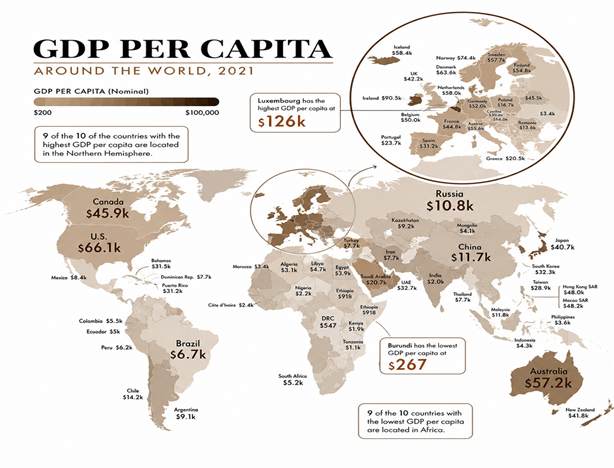
See Figure 1: Global GDP Per Capita
Source: Author’s Illustration based on the World Bank. (2023). International Comparison Program (ICP) 2021: Purchasing power parities and real expenditures.
Political turbulence compounded the economic crisis. Fragile states, already burdened by colonial-era institutional distortions, struggled to manage internal divisions and external pressures. Coups, civil conflicts, and authoritarian regimes became common, not because Africans were predisposed to instability, but because the institutional architecture they inherited was never designed to mediate power peacefully or inclusively. In many countries, the state became a battleground rather than a platform for development. Then came the structural adjustment era. Under pressure from international financial institutions, African governments were required to implement sweeping austerity measures: cutting public spending, privatizing state enterprises, liberalizing markets, and shrinking the role of the state. While some reforms were necessary, the speed and severity of these programs often dismantled what little state capacity existed. Schools deteriorated, hospitals weakened, and public-sector expertise eroded. The very institutions needed to guide industrialization and urban development were stripped down at the moment they were most needed.
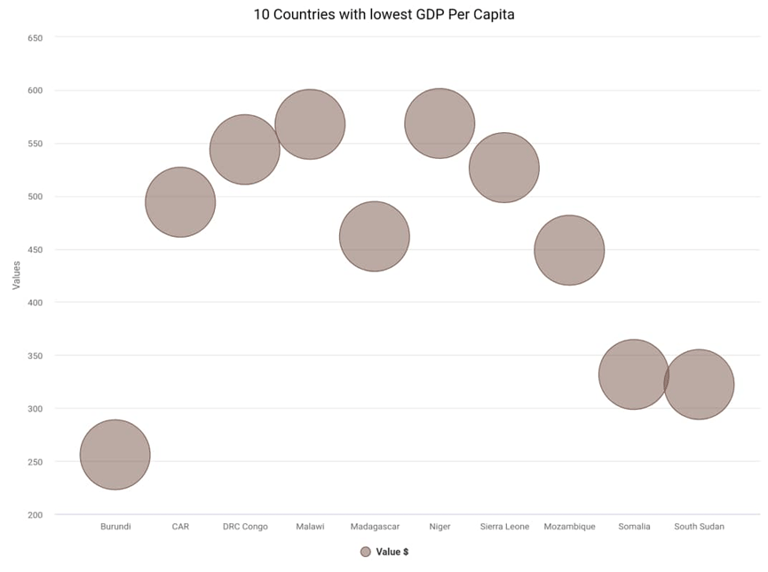
See Figure 2: African Countries with the Least GDP Per Capita
In figure 2, Burundi has the lowest per capita income, followed by South Sudan and Somalia, respectively. Countries with low per capita incomes are usually challenged with low GDP, high population growth rates, poorly developed institutional and physical infrastructure, low quality of life, and a low standard of living. The five poorest nations on earth are in sub-Saharan Africa. Real GDP growth in Africa averages 3.9% as of 2019, and it is expected to increase to 4.1% in 2021. Growth in sub-Saharan Africa varies transversely between countries and regions. Africa’s fastest growing economies, as at 2019, were in the East Africa region, contributing about 5%, while North Africa, the second fastest growing region, had a growth rate of 4.1%. The West Africa sub-region contributed about 3.7%. The regions with the slowest growth were in Southern Africa, with a 0.7% growth rate.
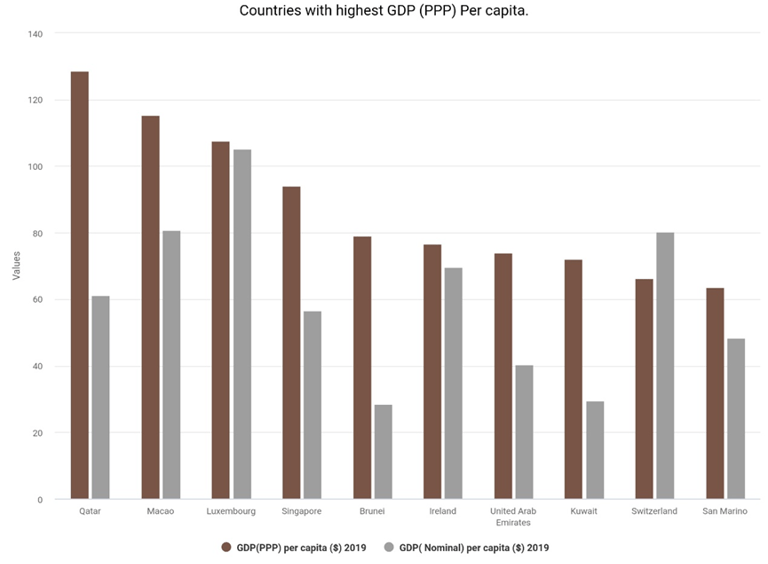
See Figure 3: Countries with the Highest GDP (PPP) Per Capita. 2019
Figure 3, shows the countries with the highest GDP (PPP) per capita as of 2019. Luxembourg has the highest nominal GDP per capita, along with Macao and Switzerland. Qatar has the highest GDP per capita, closely followed by Macao and Luxembourg. Studies have shown that growth in per capita GDP is as a result of technological progress, producing more goods with the same level of population growth. Many developing countries have a population growth rate faster than its GDP, and per capita GDP will be negative. The ten richest countries listed above have some of the lowest population growth rates in the world. A higher population growth rate negatively impacts living standards. UNFPA (2014), in its population and poverty report, observed that the population movement can affect the prospects for poverty reduction and improvements in living standards. Ojo (2021) surmised that growth in population, the age structure, and the ratio of rural to urban population tend to raise welfare and living standards. The structural conditions in Africa required to generate very high GDP per capita never fully developed in African economies between 1960 and 2024, hence no African nation emerges in the global top ten highest GDP per capita economies, and the few that did grow their economies, were too small, too resource‑dependent, or too unequal to lift national averages into the global top 10 as of 2019, and top 20 in 2024.
Meanwhile, other regions surged ahead. East Asia industrialized at historic speed. Latin America has urbanized and diversified. Even parts of South Asia began laying the groundwork for future growth. Africa, by contrast, was trapped in a cycle of crisis management, reacting to shocks rather than shaping its own trajectory. The cost of these lost decades cannot be overstated. They represent the period when Africa fell decisively behind the global development curve. Not because the continent lacked ambition or talent, but because it was forced to navigate a convergence of structural constraints that would have overwhelmed any emerging region. Yet even in this period of paralysis, the seeds of future possibility were quietly being planted, seeds that would begin to emerge in the early 21st century, setting the stage for Africa’s next major turning point.
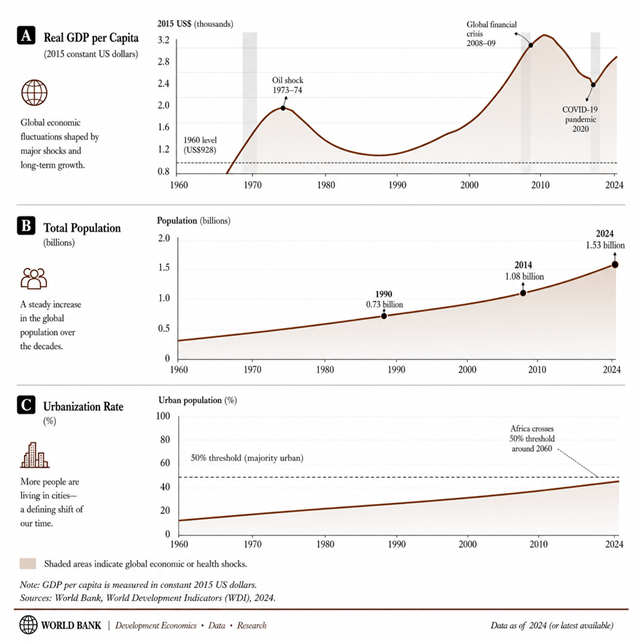
See Figure 4: Development Indicators & Global Trends for Africa. 1960 to 2024
Figure 4, presents a longitudinal overview of Africa’s economic and demographic transformation from 1960 to 2024, using three harmonized indicators from the World Bank’s World Development Indicators. Each panel isolates a distinct dimension of development, income, population, and urbanization, allowing a clear visualization of structural change across six decades. The clean academic layout emphasizes comparability and temporal continuity, with shaded bands marking major global disruptions that influenced regional trajectories.
Panel A traces real GDP per capita in constant 2010 U.S. dollars, revealing cyclical growth punctuated by external shocks. The curve rises steadily through the early post‑independence decades, dips during the 1973-78 oil crisis, and later recovers before flattening around the Global Financial Crisis (2008–09). The COVID‑19 period introduces another contraction, yet the overall mean level of ≈ 2,096 USD illustrates gradual long‑term improvement despite volatility. This panel underscores Africa’s resilience amid repeated global headwinds.
Panel B depicts total population growth, highlighting the continent’s demographic momentum. The population expands from roughly 0.25 billion in 1960 to over 1.5 billion by 2024, corresponding to a compound annual growth rate of ≈ 2.7 percent. Milestones such as the doubling point near 1985 and quadrupling by 2024 illustrate the scale of demographic expansion that underpins Africa’s labor‑force potential and urban demand. The smooth upward trajectory contrasts sharply with the cyclical nature of income growth.
Panel C visualizes urbanization, showing the proportion of Africans living in cities rising from below 20 percent in 1960 to over 50 percent around 2010. Crossing this threshold marks a structural shift toward a majority‑urban continent, with implications for infrastructure, governance, and spatial inequality. The steady ascent reflects both natural population growth and migration toward economic hubs. Together, the three panels portray Africa’s evolution from a predominantly rural, low‑income region to one characterized by expanding cities, growing populations, and gradual economic diversification.
The 21st Century Paradox: Growth Without Transformation
The early 2000s ushered in a wave of optimism across Africa. After decades of stagnation, many countries began posting impressive GDP growth rates. New democracies emerged, conflicts subsided, and global investors rediscovered the continent. Mobile phones spread faster in Africa than anywhere else in the world. A rising middle class took shape. For the first time in a generation, the narrative seemed to shift from crisis to possibility. Yet beneath the surface of this resurgence lay a deeper paradox: Africa was growing, but it was not transforming. Much of the continent’s economic expansion was driven by a commodity super cycle, oil, minerals, and agricultural exports whose prices were set in global markets and whose value chains were controlled elsewhere. When commodity prices rose, GDP surged; when they fell, economies contracted. This was growth without diversification, without industrial depth, without the structural change that anchors long-term prosperity.
Urbanization accelerated, but without the productivity gains that typically accompany it. Cities expanded outward instead of upward, becoming larger but not more efficient. Informal economies absorbed millions of young people, but without the wages, protections, or upward mobility that formal employment provides. Africa’s demographic boom, its greatest potential asset, became a source of pressure rather than power, as job creation lagged far behind population growth. Technological adoption followed a similar pattern. Mobile money, fintech, and digital platforms flourished, showcasing Africa’s capacity for innovation. But these breakthroughs existed atop weak physical infrastructure, limited manufacturing capacity, and education systems struggling to keep pace with the demands of a modern economy. Digital leapfrogging created islands of progress in a sea of structural constraints. The result was a continent caught between momentum and inertia. Africa was no longer the stagnant region of the late 20th century, but it had not yet become the dynamic growth pole its demographics and resources suggested it could be. The 21st century brought movement, but not the kind of movement that shifts a continent from the periphery of the global economy to its center.
The Missed Century in Numbers
The story of Africa’s missed century is not abstract. It is visible in the data, in the widening gaps between Africa and the regions that industrialized, urbanized, and built human capital systems during the 20th century. Numbers do not tell the whole story, but they reveal the scale of divergence and the structural forces that shaped it. By the mid‑20th century, Africa’s share of global manufacturing was less than 1 percent, a figure that has barely changed today. While East Asia transformed itself into the world’s factory, Africa remained locked in primary commodities, exporting raw materials and importing finished goods. The continent’s export complexity stagnated, even as other regions climbed the value chain.
Human capital followed a similar pattern. In 1960, average years of schooling in Africa were roughly on par with parts of Asia. By 2000, the gap had widened dramatically. East Asia invested aggressively in education, technical training, and literacy, creating a workforce capable of powering industrial growth. Africa, constrained by weak institutions and limited fiscal space, struggled to keep pace. The result was a generation of young people entering labor markets without the skills demanded by a modern economy.
Urbanization, historically the engine of productivity, also diverged. African cities grew rapidly in population but not in economic density. Unlike the manufacturing‑driven urbanization of East Asia or the service‑driven urbanization of Latin America, Africa’s urban growth was largely informal. Productivity gains remained limited, infrastructure lagged behind, and the economic benefits of urban concentration failed to materialize at scale.
Technological adoption tells the same story. While Africa leapfrogged in mobile connectivity, the continent still lags in broadband penetration, digital infrastructure, and industrial technology. Innovation exists, but it is not yet embedded in the broader economic system in a way that drives structural transformation. These numbers do not indict Africa; they illuminate the structural constraints that shaped its trajectory. They show a continent that moved forward, but not fast enough to close the gap created by a century of institutional distortion and missed opportunities. And they underscore a critical truth: the next phase of Africa’s development cannot rely on growth alone; it must be anchored in transformation.
The Turning Point: Why the Next 30 Years Matter More Than the Last 100
Africa stands today at a demographic and economic crossroads unlike any other moment in its modern history. The next 30 years will determine whether the continent remains a peripheral player in the global economy or emerges as one of its central engines. This window is narrow, unprecedented, and profoundly consequential, not only for Africa but for the world.
The first force shaping this turning point is demographics. By 2050, Africa will be home to more than a quarter of the world’s population and the largest workforce on the planet. This is not merely population growth; it is a potential productivity revolution. No other region will add workers at this scale. If Africa can educate, employ, and empower this generation, it will unlock a development surge comparable to East Asia’s rise in the late 20th century. If it cannot, the demographic dividend becomes a demographic burden, a source of instability rather than strength.
The second force is urbanization. Africa is urbanizing faster than any region in history. Cities are where productivity accelerates, where industries cluster, and where innovation takes root. Yet African urbanization has so far been spatial rather than structural, expansion without efficiency. The next three decades offer a chance to reverse this pattern, to build cities that are engines of growth rather than zones of congestion. Urban governance, infrastructure investment, and land-use reform will determine whether Africa’s cities become platforms for prosperity or pressure points of inequality.
The third force is global realignment. The world is shifting toward multipolarity, with new trade routes, new geopolitical alliances, and new technological ecosystems. Africa is no longer a passive recipient of global trends; it is a strategic actor in a world hungry for markets, minerals, labor, and innovation. The climate transition alone, with its demand for critical minerals, renewable energy, and carbon markets, positions Africa at the center of the next global economic cycle. The question is whether the continent can negotiate from a position of strength rather than vulnerability.
The fourth force is digital transformation. Africa has already shown its capacity to leapfrog, from mobile money to fintech to digital identity systems. But the next phase requires more than innovation; it requires institutions capable of scaling and regulating that innovation. Digital infrastructure, data governance, and technological sovereignty will shape whether Africa becomes a producer in the digital economy or remains a consumer on its margins.
Taken together, these forces create a rare convergence: a moment when Africa’s structural disadvantages can be overcome by structural opportunities. The next 30 years matter more than the last 100 because they offer something the previous century never did, the possibility of building development on Africa’s own terms, with its own assets, in a world that finally recognizes its strategic importance. This is the turning point. A window that will not remain open indefinitely. A chance to transform a missed century into a reclaimed future.
Five Levers That Can Rewrite Africa’s Future
Africa’s next chapter will not be written by chance. It will be shaped by deliberate choices, strategic investments, and the courage to break from inherited constraints. The continent does not need to replicate the development paths of others; it needs to leverage its own assets with precision. Five levers, if pulled with intention, can transform Africa from a region of deferred potential into a global center of gravity.
1. Urban Productivity and Megacity Governance
Africa’s cities are growing faster than any in human history, yet they remain underpowered engines of development. Urbanization without productivity is congestion; urbanization with productivity is transformation. The continent must shift from spatial expansion to economic concentration, building cities that are dense, connected, and economically vibrant. This requires modern land‑use systems, efficient public transport, and metropolitan governance capable of coordinating across jurisdictions. When cities function, they become platforms for innovation, manufacturing, and human capital formation. When they fail, they trap millions in low‑productivity informal work. Africa’s future will be urban. The question is whether its cities will be engines or obstacles.
2. Human Capital Acceleration
No continent has more young people entering the workforce. But demographic advantage is not automatic; it must be built. Africa needs an education revolution, one that prioritizes foundational literacy, technical skills, and vocational pathways aligned with the demands of a modern economy. Universities must become centers of research and innovation, not just credentialing institutions. Technical and vocational training must be scaled to absorb millions of young workers into productive employment. Human capital is not a sector; it is the foundation of every sector. Without it, no industrial strategy can succeed.
3. Industrialization Through Regional Integration
Africa cannot industrialize country by country; the markets are too small, the costs too high, and the fragmentation too deep. But as a region, Africa is a giant, a 1.4‑billion‑person market with the potential to support large‑scale manufacturing and competitive value chains. The African Continental Free Trade Area (AfCFTA) is the most ambitious integration project in the world today. If implemented effectively, it can reduce trade barriers, harmonize regulations, and create regional manufacturing clusters capable of competing globally. Industrialization will not come from exporting raw materials; it will come from producing what Africa consumes and exporting what Africa produces. Regional integration is not a political aspiration; it is an economic necessity.
4. Digital Leapfrogging: With Institutions Behind It
Africa has already shown the world what digital leapfrogging looks like. Mobile money, fintech, and digital identity systems have transformed daily life. But the next phase of digital transformation requires more than innovation; it requires institutions. Digital infrastructure must be expanded. Data governance frameworks must be strengthened. Regulatory systems must be modernized to support digital entrepreneurship while protecting consumers. And governments must invest in the digital public goods, broadband, cloud infrastructure, and digital IDs, that enable private innovation to scale. Leapfrogging is not a shortcut; it is a strategy. But it only works when institutions are strong enough to sustain it.
5. Governance Reform and State Capacity
No lever matters more than this one. Development is not possible without a capable state, one that can plan, regulate, invest, and deliver. Africa’s governance challenge is not simply corruption; it is capacity. Many states lack the administrative depth, fiscal tools, and institutional memory required to implement long-term development strategies. Reform must focus on building professional bureaucracies, strengthening accountability systems, modernizing public finance, and embedding evidence-based policymaking. Capable states are not luxuries; they are the engines of development. Every successful development story, from East Asia to Northern Europe, begins with a state that can execute. Africa’s future will be shaped not only by markets and technology, but by the quality of the institutions that govern them.
The Moral Argument: Africa’s Future Is a Global Future
Africa’s future is not an isolated question. It is a global question, one that will shape the stability, prosperity, and moral direction of the 21st century. The world cannot afford an Africa that remains structurally marginalized, economically fragile, or politically unstable. Nor should it accept one. The continent’s trajectory will influence everything from global supply chains to climate resilience, migration patterns, technological adoption, and the balance of geopolitical power. The moral argument begins with a simple truth: development is dignity. For too long, Africa has been framed through the lens of charity, crisis, or deficit. This framing is not only inaccurate; it is dehumanizing. Africa is not a problem to be solved but a partner to be engaged, a continent whose people, ideas, and institutions deserve the same opportunities to flourish as any other region. The missed century was not just an economic loss; it was a moral failure of the global system.
But the argument extends beyond ethics. Africa’s rise is essential to global stability. A continent of 2.5 billion people by 2050 cannot remain on the margins without profound consequences. If Africa succeeds, if it industrializes, educates its youth, and builds capable states, the world gains a new engine of growth, innovation, and cultural dynamism. If it falters, the pressures of unemployment, climate stress, and political fragility will reverberate far beyond its borders.
Africa is also central to the climate transition. The minerals that power renewable energy, cobalt, lithium, manganese, and rare earths, are concentrated in African soil. The forests that regulate global carbon cycles stand in African landscapes. The future of sustainable development quite literally runs through the continent. A world that seeks a green transition without empowering Africa is a world that misunderstands its own dependencies. And then there is the question of global equity. For centuries, Africa contributed to the wealth of other regions without receiving proportional returns. The next century must be different. It must be defined by partnership rather than extraction, by investment rather than indifference, by shared prosperity rather than structural imbalance. The moral argument is not about guilt; it is about justice, about building a global order that recognizes Africa not as an afterthought, but as a cornerstone. Africa’s future is global because the world’s stability, economy, and moral integrity depend on it. The missed century belongs to history. The century ahead belongs to all of us, and it will be shaped by the choices Africa makes and the support the world provides.
A Vision for 2050
Imagine an Africa in 2050 that has not only caught up with the world but has begun to reshape it. A continent where cities hum with productivity, where industries compete on global value chains, where young people step into futures defined not by constraint but by possibility. This is not a fantasy. It is a plausible outcome if Africa chooses transformation over inertia. In the future, Africa’s cities will no longer be sprawling zones of informality but dynamic engines of innovation. Lagos, Nairobi, Accra, Kigali, Johannesburg, and Abidjan have become continental hubs, dense, connected, and economically vibrant. Efficient transport systems move millions daily. Industrial corridors link cities across borders. Urban planning is no longer reactive; it is strategic, data-driven, and designed to maximize productivity. Africa’s workforce, the largest on the planet, is skilled, mobile, and globally competitive. Education systems have been rebuilt around foundational literacy, technical training, and digital fluency. Universities serve as research powerhouses, feeding industries with talent and ideas. Millions of young Africans work in manufacturing, technology, logistics, renewable energy, and creative industries that did not exist a generation earlier.
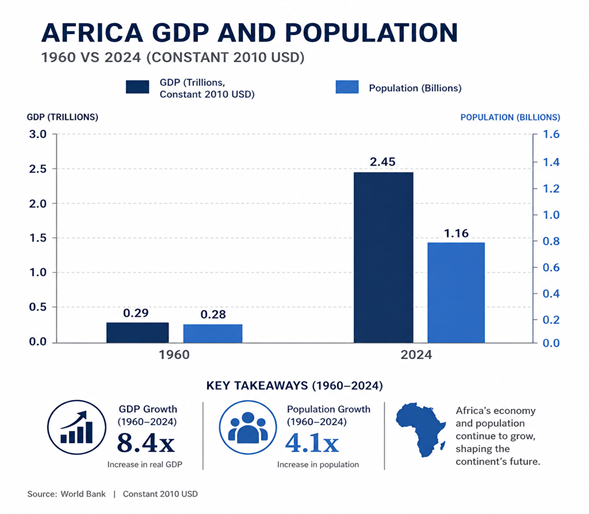
See Figure 5: Africa GDP vs Population 1960 – 2024 Summary Chart
Source: Visualization by the author. Data: World Bank (WDI) & UN Statistical Commission (ICP 2021).
Figure 5 shows Africa’s economic and demographic evolution between 1960 and 2024, revealing a continent in transition. In 1960, Africa’s GDP stood at $0.29 trillion (constant 2010 USD), while its population was 0.28 billion. By 2024, GDP had surged to $2.45 trillion, and the population had expanded to 1.16 billion. This simultaneous growth underscores the continent’s shift from a primarily agrarian economy toward one increasingly driven by industrialization, urbanization, and regional integration. The chart’s dual‑axis design highlights the differing pace of these two trajectories. Economic output grew roughly 8.4 times, while population increased 4.1 times, suggesting that productivity gains and structural reforms have outpaced demographic pressures. This widening gap between GDP and population reflects gradual improvements in per‑capita income and living standards, even as inequality and uneven development persist across regions. Overall, the chart encapsulates Africa’s journey from post‑colonial fragility to emerging economic strength. The continent’s expanding markets, youthful population, and growing investment capacity position it as a dynamic force in global development. The chart serves not only as a statistical snapshot but as a visual metaphor for Africa’s resilience and its continuing pursuit of sustainable growth.
Industrialization has taken root. Regional value chains stretch across the continent, powered by the African Continental Free Trade Area. African firms produce everything from pharmaceuticals to electric vehicle components to processed foods for a 1.4‑billion‑person market. The continent is no longer a supplier of raw materials; it is a producer of finished goods and a driver of global demand. Digital transformation is deep and inclusive. Broadband is universal. Digital IDs, mobile payments, and e‑government systems have made public services transparent and efficient. African tech ecosystems rival those of Asia and Latin America, attracting global investment and exporting innovation. The continent is not just leapfrogging; it is leading.
Governance has matured. States are more capable, more accountable, and more effective. Public institutions plan long-term, regulate fairly, and deliver consistently. Corruption has not disappeared, but it no longer defines the system. Citizens trust their governments because their governments perform.
Africa’s role in the world has shifted. The continent is central to the global green transition, supplying critical minerals, hosting renewable energy hubs, and shaping climate negotiations. Its cultural influence is global. Its economic weight is undeniable. Its political voice is respected. This is what success looks like: a continent that has reclaimed its agency, rewritten its trajectory, and transformed a missed century into a century of momentum. A continent that stands not at the margins of global power, but at its center.
The Future of Africa Is Not Inevitable, It Is Chosen
Africa’s story has never been one of inevitability. It has been a story of interruptions, resilience, reinvention, and unrealized possibilities. The missed century was not the product of fate, nor is the century ahead predetermined. History may shape the starting point, but it does not dictate the destination. The future belongs to those who claim it. The next chapter of Africa’s development will not be written by external forces or inherited constraints. It will be written by the decisions African nations make about their cities, institutions, young people, and place in the global economy. It will be shaped by leaders who choose long-term vision over short-term politics, by citizens who demand accountability, and by a global community willing to engage Africa as a partner rather than a peripheral concern. The stakes could not be higher. A continent that missed its moment can still define the next, not by replicating others’ paths but by forging its own. Africa has the demographics, resources, creativity, and strategic position to become one of the world’s great centers of gravity. But potential is not power until it is organized, mobilized, and sustained.
The missed century is behind us. The century of possibility is ahead. And the truth at the heart of Africa’s future is simple: nothing is inevitable, except the future a continent chooses to build.
References
Barro, R. J., & Sala‑i‑Martin, X. (2004). Economic Growth (2nd ed.). MIT Press.
Solow, R. M. (1956). A contribution to the theory of economic growth. Quarterly Journal of Economics, 70(1), 65–94.
Romer, P. M. (1990). Endogenous technological change. Journal of Political Economy, 98(5), S71–S102.
Kuznets, S. (1973). Modern economic growth: Findings and reflections. American Economic Review, 63(3), 247–258.
Enoma Ojo (2023) Dual Gap Model and Africa’s Debt Crisis: A Theoretical Perspective. Iosr Journal Of Economics And Finance (Iosr-Jef) E-Issn: 2321-5933,P-Issn: 2321-5925.Volume 14, Issue 6 Ser. 3
Lucas, R. E. (1988). On the mechanics of economic development. Journal of Monetary Economics, 22(1), 3–42.
Rodney, W. (1972). How Europe Underdeveloped Africa. Bogle‑L’Ouverture Publications.
Mkandawire, T. (2010). Running while others walk: Knowledge and the challenge of Africa’s development. Africa Development, 35(4), 1–36.
Acemoglu, D., Johnson, S., & Robinson, J. A. (2001). The colonial origins of comparative development. American Economic Review, 91(5), 1369–1401.
Herbst, J. (2000). States and Power in Africa: Comparative Lessons in Authority and Control. Princeton University Press.
Grinin, L., & Korotayev, A. (2021). Africa: The Continent of the Future. Challenges and Opportunities. Springer.
World Bank. (2024). World Development Indicators: Africa regional data (1960–2024). Washington, DC: World Bank.
African Development Bank (AfDB). (2023). African Economic Outlook 2023: Mobilizing private sector finance for climate and growth. Abidjan: AfDB.
United Nations Economic Commission for Africa (ECA). (2023). Economic Report on Africa 2023: Growth, inequality, and structural transformation. Addis Ababa: UNECA.
UNESCO, UNICEF, & African Union. (2025). Transforming Learning and Skills Development in Africa: 2nd Continental Report. Paris: UNESCO.
UNFPA. (2023). State of World Population 2023: 8 Billion Lives, Infinite Possibilities. New York: UNFPA.
Bloom, D. E., Canning, D., & Sevilla, J. (2003). The Demographic Dividend: A New Perspective on the Economic Consequences of Population Change. RAND Corporation.
Henderson, J. V., & Kriticos, S. (2018). The development of the African city. Journal of Urban Economics, 103, 1–18.
Fox, L., & Thomas, A. (2016). Africa’s got work to do: Employment prospects in the new century. IMF Working Paper WP/16/201.
McKinsey Global Institute. (2023). Africa’s Growth Story: Unlocking productivity and urban potential.
United Nations Development Programme (UNDP). (2024). Human Development Report 2024: Reimagining Development in an Age of Uncertainty. New York: UNDP.
© 2026 Enoma Ojo. All rights reserved.